 Angryturtle
Ask five local SEO providers in India what they charge and you'll get five different answers built on five different assumptions about what's included. Some quote per listing, some per city, some as a flat retainer regardless of how many locations you run. Before comparing any of those numbers, it helps to understand what actually drives cost, because that's the part almost nobody explains clearly.
Contents
- What actually drives local SEO cost
- Self-serve vs managed, and why the price gap exists
- Angryturtle's own pricing, stated plainly
- Where the real cost hides for multi-location businesses
- Questions worth asking before you sign anything
- Frequently asked questions
What actually drives local SEO cost
Number of locations is the single biggest multiplier. A one-clinic dermatology practice and a 40-branch NBFC are not buying the same service even if both call it "local SEO" — the second one needs multi-location strategy, governance across listings, and someone watching for NAP consistency failures that compound with every added branch.
Review volume and velocity matter too, though not in the direction most people expect. A business with almost no reviews needs review-generation work built into the cost; a business that already gets 20 reviews a month organically needs response management and sentiment tracking instead, which is a different kind of ongoing effort, covered in review generation strategy and review sentiment analysis.
Citation cleanup depth is the quiet cost driver nobody quotes upfront. A brand-new listing with clean data everywhere costs far less to maintain than a 10-year-old business with three duplicate listings, a wrong address on two directories, and an old phone number still live on a fourth. Removing duplicate listings and fixing scattered NAP data is real, billable work, and it's the part of a quote that varies most between providers depending on how thorough they actually are.
Category complexity and industry regulation add cost in specific verticals. Healthcare and BFSI both carry compliance considerations that a generic local SEO provider without vertical experience will either skip or price in as a premium — see local SEO for banks and NBFCs and healthcare reputation management for what that actually involves.
Self-serve vs managed, and why the price gap exists
A self-serve platform gives you the tools — scoring, an action plan, the ability to push edits — and you or your team do the work of acting on them. A managed service means someone else executes: writing the posts, requesting the reviews, fixing the citations, watching the dashboard weekly. The price gap between the two reflects labor, not just software access, and it's worth being honest with yourself about which one your business or agency actually has time to run.
Agencies sit in a slightly different position: they need the tooling to serve many clients efficiently, which is why agency-tier plans exist as a distinct category from a solo owner's self-serve subscription, priced around volume and multi-client workflows rather than a single listing.
Angryturtle's own pricing, stated plainly
On the self-serve side, Solo runs ₹999 a month for up to two profiles, one seat and 130 credits, and Agency runs ₹3,499 a month for ten profiles, unlimited seats and 300 credits. Both start with a 15-day trial. Those are base figures: the amount actually charged is ₹1,296.70 and ₹4,541.70 respectively, once the 10% platform fee and 18% GST are added. Enterprise pricing is custom, built around unlimited profiles, volume, and SSO — see the full breakdown on pricing.
On the managed side, where Angryturtle's own team does the work per location, Managed Essentials runs ₹1,499 with a ₹5,000 setup fee, and Managed Growth runs ₹3,999 with a ₹9,000 setup fee. Agency Partner pricing starts from ₹6,999 per location with setup waived at volume, and Managed Enterprise is scoped individually. These are real, current prices, not illustrative ranges, and they're worth comparing directly against what a quote from any other provider actually includes for the same money.
What that price buys is the combination described in the product overview — a Rank OS score, a ranked action plan, and for managed clients, someone actually executing the fixes and pushing them live to Google rather than handing back a report and a list of recommendations.
Where the real cost hides for multi-location businesses
A single-location quote rarely tells you what the tenth location costs, and that's usually where the real number lives. Per-location managed pricing scales roughly linearly for straightforward chains, but the setup cost per location, cleaning up whatever mess of duplicate listings and inconsistent data existed before, often front-loads cost in year one that a monthly retainer figure alone won't show you.
Franchise and retail chains in particular tend to inherit years of inconsistent listings created by different local managers, franchisees, or previous agencies, and untangling that is genuinely more expensive the longer it's been left unaddressed. Franchise GBP management and retail chain local SEO both go into what that cleanup actually involves before ongoing management even starts.
Questions worth asking before you sign anything
Ask exactly what's included per location versus billed as an add-on — citation cleanup, review generation, and posting cadence are the three most commonly excluded from a headline price and quoted separately once you're already committed.
Ask whether the provider can actually push changes live to Google, or whether their "management" stops at recommendations you still have to implement yourself. That distinction is covered in more depth in how to choose a local SEO agency, and it changes what a given price is actually buying.
Ask what happens to your data, your listing history and your reporting, if you leave. A provider that can't answer that clearly is telling you something about how the relationship is structured.
Frequently asked questions
Is managed local SEO always more expensive than self-serve? Per location, generally yes, because you're paying for labor as well as software. But for a business with limited internal capacity, the effective cost of self-serve can be higher if the tools sit unused — the cheaper plan on paper doesn't help if nobody acts on the action plan it generates.
Why do local SEO quotes vary so much between providers for what looks like the same service? Mostly because "local SEO" bundles different scopes under one name. A quote that includes deep citation cleanup and active review generation should cost more than one that's just monthly posting and a monthly report — the mistake is comparing two very different scopes as if they were the same product.
Does more locations always mean proportionally more cost? Roughly, yes, for ongoing management, but setup cost per location can vary a lot depending on how messy the existing data is. A chain with clean, consistent listings from day one costs less to onboard than one inheriting years of duplicate and inconsistent profiles.
Should I budget separately for review generation? It's worth understanding whether it's included in a quoted price or billed separately, since review volume and velocity are ongoing work, not a one-time fix, and a quote that treats it as a line item you'll need indefinitely is being more honest than one that implies it's a problem solved once.
Stop guessing where you rank locally.
Rank OS scores your Google Business Profile the way Google's local algorithm does — relevance, review health, freshness, entity authority and AIO readiness — and shows you exactly what to fix.
Book a live demo →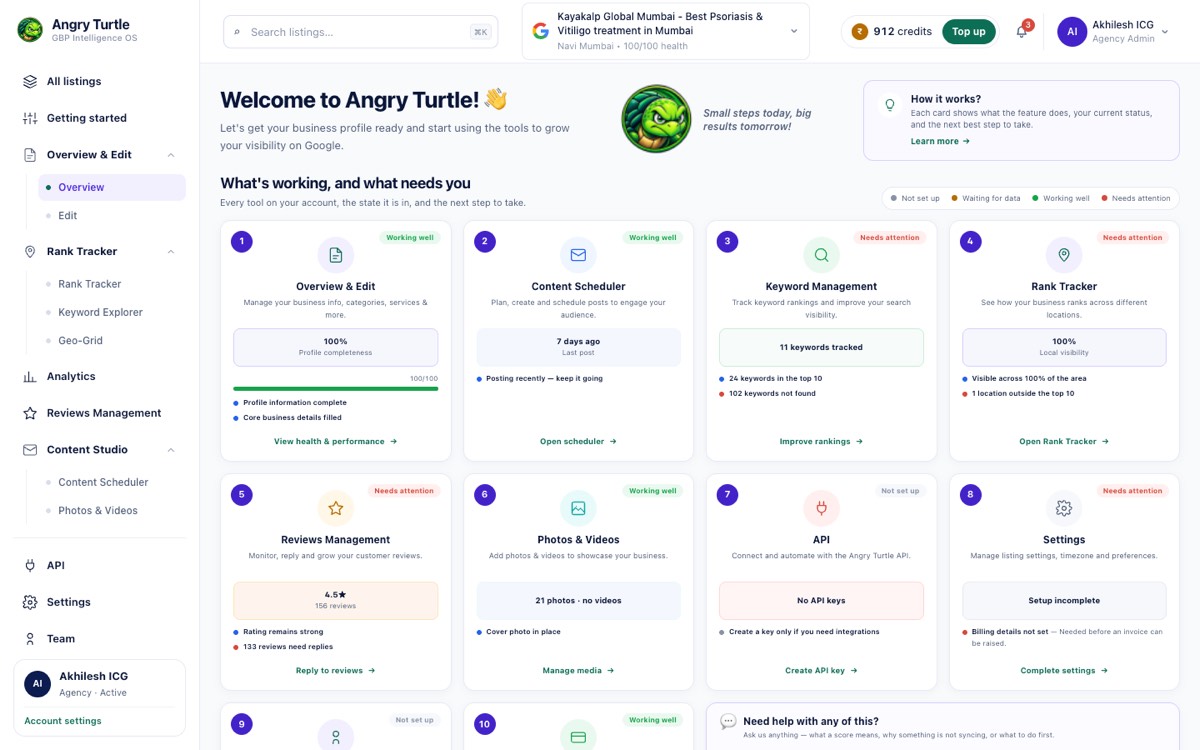

Ready to have this run for you?
Book a free audit — we'll show you where you stand in 48 hours.