 Angryturtle
How to Choose a Local SEO Agency (Questions That Expose Weak Ones)
·
Most agency pitches sound identical after the first ten minutes: rank higher, get more calls, dedicated account manager. The questions that actually separate a strong local SEO agency from a weak one aren't in the pitch deck at all. They're the ones the agency doesn't want asked, because the honest answer reveals how thin the service actually is underneath the reporting dashboard.
Contents
- Can they show write-back, or only reports
- Can they explain their scoring, not just show it
- What happens to your data if you leave
- How they handle multi-location and franchise accounts
- What their review and reputation process actually looks like
- How they price, and what that tells you
- Red flags worth walking away from
- Frequently asked questions
Can they show write-back, or only reports
The single most useful question to ask a prospective agency is whether they can make a change directly to your Google Business Profile from inside their own tool, or whether their process is "we tell you what to change and you go do it." Most tools in this category, historically, have been read-only or partial on this — flagging problems without a path to actually fixing them without leaving the dashboard, a gap covered in more depth in done-for-you vs DIY local SEO.
Ask them to demo an actual edit live, in the meeting, not a screenshot from a past client. A category change, a hours update, a post publish — anything that shows the edit going from their screen to your actual Google listing. Angryturtle's own direct GBP editing does exactly this, pushing name, description, categories, hours and posts straight to Google, and it's the kind of thing worth insisting any agency demonstrate rather than describe.
If an agency's answer is some version of "we send you a monthly checklist," that's not automatically disqualifying, but it changes what you're paying for. You're buying advice, not execution, and the price should reflect that difference.
Can they explain their scoring, not just show it
Almost every agency will show you a score or a grade for your listing. Few can explain exactly what goes into it, in what proportion, and why. Ask what the weighting actually is between things like review health, profile completeness, and citation consistency — a real, defensible scoring model has an answer to that question that doesn't change every time you ask it.
A tunable, transparent scoring model is genuinely rare in this category. Angryturtle's own Rank OS publishes its five weighted dimensions, relevance, review health, freshness, entity authority, and AIO readiness, openly, and the weights themselves are config-tunable rather than a locked black box. An agency that can't articulate anything close to this, and instead describes their score as proprietary and unexplainable, is asking you to trust a number you can't verify — see local ranking factors for 2026 for what a defensible model should actually be weighing.
What happens to your data if you leave
This is the question agencies answer worst, because the honest answer sometimes reveals a lock-in strategy. Ask specifically: if you cancel next month, do you keep access to your listing history, your citation records, your review data? Does the agency retain admin access to your Google Business Profile that's awkward to revoke?
A trustworthy setup keeps you, the business owner, as the actual verified owner or manager of your own GBP listing at all times, with the agency operating as a manager role you can remove. If an agency insists on being the sole verified owner of your listing with no path for you to reclaim primary access, that's worth pausing on regardless of how good their reporting looks.
How they handle multi-location and franchise accounts
If you run more than one location, ask how the agency actually manages consistency across listings, not just whether they "can." NAP consistency at scale is genuinely hard to maintain by hand past a handful of locations, and an agency without a real bulk-management workflow will quietly let smaller branches drift out of sync while attention goes to the flagship location.
Ask whether pricing and service scope change per location, and how onboarding works for a newly opened branch. Onboarding new business locations is a recurring task for any growing chain, and an agency that treats it as a one-off custom project every time isn't set up for a business that opens branches regularly. This matters more the bigger the footprint gets — a single clinic and a nine-branch diagnostics chain need genuinely different answers here, which is part of why single-location local SEO is worth reading even if you're evaluating an agency for a chain, just to see where the two approaches actually diverge.
What their review and reputation process actually looks like
Ask specifically how they generate reviews, and listen for anything that sounds like gating, filtering unhappy customers away from the review link, or incentivizing reviews. Both violate Google's policies and can put your listing at risk, and an agency that treats this as a normal practice is a liability, not an asset. Review generation strategy covers what a compliant process actually looks like.
Ask who writes review responses and how fast. A generic, templated response posted a week late does less for your listing than a specific, timely one — see responding to reviews for what a well-run process should look like in practice.
How they price, and what that tells you
A quote that's clear about what's included per location, versus what gets billed separately later, tells you more about an agency's honesty than almost anything in the pitch itself. What local SEO actually costs in India breaks down the real cost drivers, number of locations, review volume, citation cleanup depth, worth reading before any quote so you know which parts of a number are negotiable and which reflect genuine work.
Comparing an agency's pricing against alternatives in the same category, whether that's another full-service agency or a self-serve platform like the ones reviewed against Whitespark, Moz Local or Synup, gives a useful sense check on whether a quote is in a reasonable range for what it claims to deliver.
Red flags worth walking away from
An agency that guarantees a specific ranking position or a specific timeline for results is either inexperienced or not being straight with you — Google's ranking factors aren't controlled fully by any third party, and honest providers frame outcomes as likely, not guaranteed. See how long local SEO actually takes for a more grounded sense of what a realistic timeline looks like.
An agency that can't or won't name the specific tools or platform they use internally, hiding behind "proprietary methodology" with no substance underneath, is worth double-checking. And an agency whose pricing structure only becomes clear after a sales call, rather than being reasonably transparent upfront, tends to correlate with scope creep later.
For a broader comparison of who's actually operating in this space in India, the top local SEO agencies is a reasonable starting point before narrowing down to a shortlist worth these specific questions.
Frequently asked questions
Should I choose an agency that only does local SEO, or one that offers everything including web design and ads? Depends on your needs, but a specialist tends to go deeper on the specific mechanics that actually move a Google Business Profile, whereas a full-service agency may treat local SEO as one line item among many without the depth a dedicated provider brings.
How many client references should I expect an agency to provide? Enough to actually verify the claim being made. One reference proves nothing definitive; a small handful, ideally in your own industry, gives you something real to check.
Is a lower price always a red flag? Not automatically, but it's worth understanding what's excluded. A cheap retainer that excludes citation cleanup or review generation entirely may cost more over a year once those gaps get billed separately or simply never get addressed.
What's a reasonable trial or initial commitment period? Most credible engagements run at least a few months before results are meaningful, since profile changes take time to show up in ranking and review signals. Be wary of both extremes: a provider demanding a multi-year lock-in upfront, and one offering to "prove it" in two weeks.
Stop guessing where you rank locally.
Rank OS scores your Google Business Profile the way Google's local algorithm does — relevance, review health, freshness, entity authority and AIO readiness — and shows you exactly what to fix.
Book a live demo →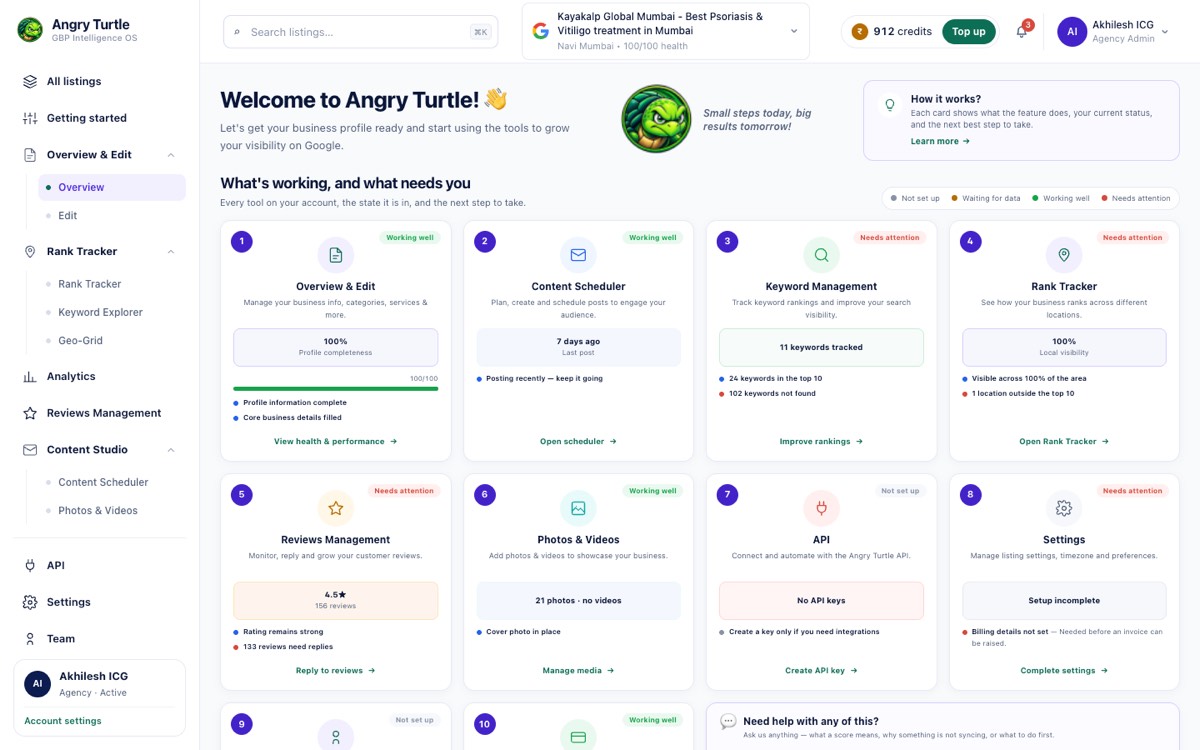

Related reading
Ready to have this run for you?
Book a free audit — we'll show you where you stand in 48 hours.