 Angryturtle
Local SEO for Retail Chains in India
How Indian retail chains rank each store higher on Google Maps. Per-store GBP management, store locator SEO, product catalogue, seasonal campaigns, and review management at scale.
·
Local SEO for Indian Retail Chains: Managing Local Presence at Multi-Store Scale
Indian retail chains — fashion, electronics, furniture, jewellery, consumer durables — face a specific local SEO challenge: they need to rank in the local pack for "near me" and "[category] store near me" searches at every individual store location across every city they operate in.
A Fabindia in Bandra and a Fabindia in Lower Parel are both competing in their respective local markets. Neither benefits automatically from the other's local SEO. Rank at one store tells you almost nothing about rank at the next, even under the same brand name and the same head-office marketing team. This is the same multi-location SEO problem retail chains, bank branch networks, and franchise operators all run into — a single brand identity, dozens or hundreds of independent local search battles.
The per-store GBP is non-negotiable
Each physical store location needs its own Google Business Profile. There is no "chain GBP" that covers all locations — Google's local algorithm is location-specific. The store that ranks in the Bandra local pack is the Bandra store's GBP, not the brand's corporate profile.
What every store GBP needs:
- Verified, with an accurate store-specific address
- Category: the most specific applicable retail category ("Clothing Store," "Electronics Store," "Jewellery Store" — not "Store")
- Accurate store hours, including extended hours for sales and festivals
- Product catalogue updated with current key products
- At least 20 store-specific photos: exterior with signage, interior displays, featured products
- Review generation active at that store, not just at head office level
A chain running 40 stores with 40 GBPs set up once at launch and never touched again is common, and it's the reason many otherwise well-known retail brands underperform independent local shops in their own local pack. The independent shop's owner checks their GBP weekly. Nobody at the chain checks store 27's profile at all. Angryturtle's guide to managing multiple business locations covers the operational side of keeping every profile current at scale.
The Indian retail seasonal campaign calendar for GBP
Indian retail has more seasonal promotional occasions than most markets. Retail chains that align their GBP posting cadence to this calendar outperform those that post generic evergreen content year-round.
Q1 (Jan–Mar): Republic Day sale (Jan 26), Budget season impact posts (Feb), Holi offers (Mar), end-of-winter-season clearance.
Q2 (Apr–Jun): Summer collection launch (Apr), Mother's Day (May), end-of-season sale — one of India's highest-volume retail search periods.
Q3 (Jul–Sep): Monsoon collection (Jul), back-to-school and back-to-college (Aug), Independence Day (Aug 15), Onam (Sep), Ganesh Chaturthi (Sep).
Q4 (Oct–Dec): Navratri–Dussehra festive season (Oct), Diwali — India's highest retail search and footfall period — through October and November, Bhai Dooj, Children's Day (Nov), Christmas, New Year's Eve.
For each major occasion, post one offer (discount or promotion with dates) plus one "what's new" post covering a new collection or launch. A store that posts nothing between Diwali and the next Diwali is invisible during exactly the windows when local search volume for its category spikes hardest. Angryturtle's guide to GBP post ideas has content angles beyond the seasonal calendar.
Product catalogue management for retail GBPs
The GBP product catalogue lets retail chains showcase specific items directly in the profile panel — customers see products before visiting the store. This sits alongside GBP products and services management more broadly, which many retail chains under-use.
Feature hero products from the current season's collection, new arrivals updated at each season launch, sale items during EOSS and Diwali windows, and bestsellers that stay always-on. Leave out anything out of stock, discontinued, or priced in a way that changes often without an update — a customer who drives to a store for a product shown at a price that's no longer honoured is a lost customer and a review risk.
Product photos should be clean, well-lit, and represent the product accurately. Fashion does well with flat-lay or model shots; electronics reads better with product-on-surface, clean-background photography. See Angryturtle's GBP photo best practices for the specifics that apply across categories.
Review management for multi-store retail
Generation at store level works through a few channels that don't require store managers to remember anything complicated: a QR code in every shopping bag and on every receipt, a brief verbal request from billing staff at point of sale, and for loyalty programme members, a post-purchase digital review request via app or SMS. The mechanics of building that request flow, and why WhatsApp specifically outperforms other channels for Indian customers, are covered in Angryturtle's WhatsApp review request guide.
Product quality, staff helpfulness, pricing, and parking are the most common review themes in Indian retail. Responses should be personalised and brief, not generic — a response that specifically references the product or experience mentioned in the review signals genuine care, and genuinely personalised responses are what separate a store that's actively managed from one that isn't. The response side of this is a bigger operational question at chain scale than it looks; see Angryturtle's guide to review response management for how to structure it across dozens of stores.
Building consistent review velocity across every store, not just the flagship ones, is its own discipline — most chains have a handful of stores that generate reviews well and a long tail that generates almost none. Angryturtle's review generation strategy guide covers how to close that gap at scale.
Store locator architecture: the layer most chains skip
Retail chains with more than a handful of locations usually build a store locator page on their website. Most of these are built as JavaScript-only interfaces with no crawlable, location-specific HTML underneath — which means the website contributes nothing to reinforcing each store's local SEO signals. Angryturtle's guide to store locator SEO covers the fix: server-rendered location pages with a stable URL per store, unique content per store, and a NAP block matching that store's GBP exactly. Pair that with dedicated location pages if the chain also wants city-level landing pages beyond individual store URLs.
Common mistakes in Indian retail chain local SEO
Treating GBP as a launch task, not an ongoing one. Profiles set up once at store opening and never revisited fall behind competitors who post seasonally and keep photos current.
Using the wrong category for the sake of brand consistency. A furniture chain listing every store as "Furniture Store" when a specific location is really a "Bedroom Furniture Store" or "Office Furniture Store" is leaving relevance signal on the table.
Letting one flagship store absorb all the marketing attention. The Mumbai flagship gets fresh photos and active review requests; store 33 in a Tier 2 city gets neither. Customers in that city notice the difference before head office does.
Inconsistent NAP across directories. A chain with 60 stores listed slightly differently on JustDial, Sulekha, and the website's own store locator creates the kind of NAP inconsistency that erodes entity confidence at scale. Angryturtle's guide to NAP consistency at scale covers the audit process.
No seasonal cadence. Posting generic content year-round instead of aligning to the retail calendar above wastes the single highest-leverage content opportunity retail GBPs have.
FAQ
Does one strong flagship store GBP help the rest of the chain rank? No. Google's local ranking is calculated per location, based on that location's own proximity, relevance, and prominence signals. A strong flagship store improves that store's rank and, indirectly, brand awareness — but a store across town still needs its own signals built independently.
How many photos should each store GBP have? There's no fixed number that guarantees rank, but profiles with a thin photo set — five or fewer, mostly stock imagery — read as under-maintained relative to competitors with a current, store-specific photo library. Twenty or more, refreshed seasonally, is a reasonable operating target.
Should every store post the same seasonal content on the same day? The offer dates should be consistent, but the specific post — especially the photo — should be store-specific where possible. Identical text and identical stock photography across 40 profiles reads as templated to anyone comparing two nearby stores.
Angryturtle manages retail chain local SEO including seasonal campaign planning →
Stop guessing where you rank locally.
Rank OS scores your Google Business Profile the way Google's local algorithm does — relevance, review health, freshness, entity authority and AIO readiness — and shows you exactly what to fix.
Book a live demo →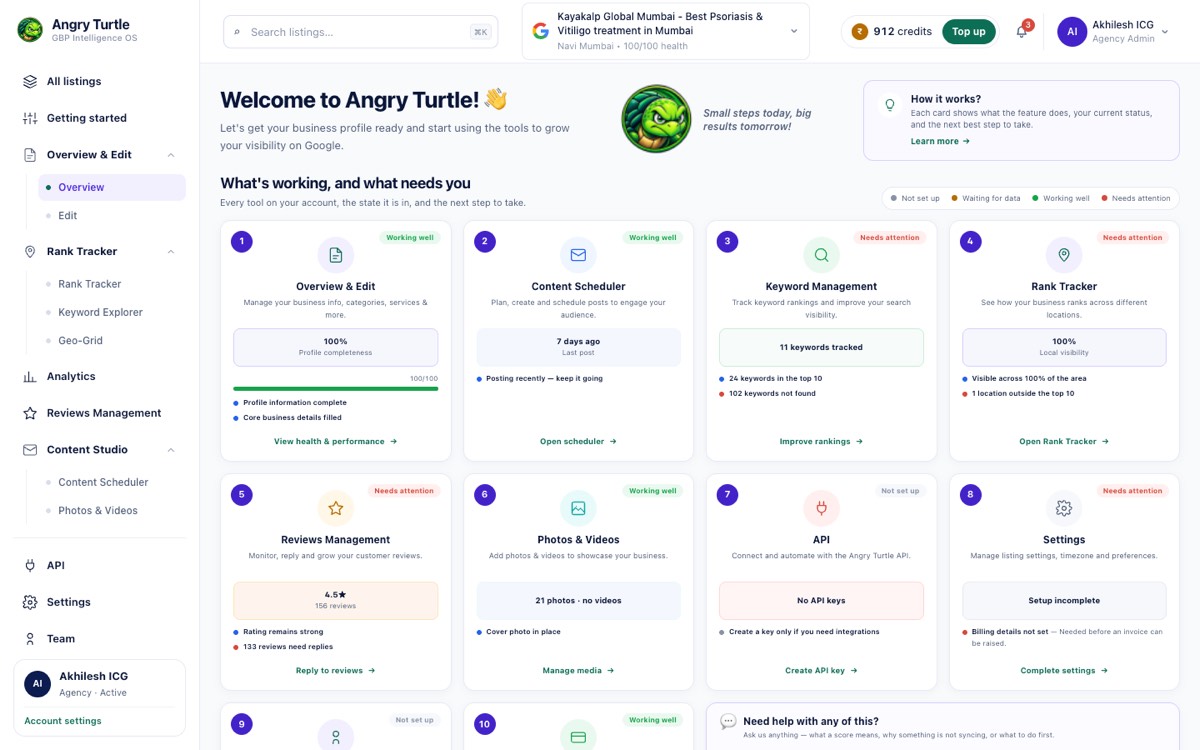

Related reading
Ready to have this run for you?
Book a free audit — we'll show you where you stand in 48 hours.