 Angryturtle
Removing Fake Google Reviews in India
How to identify and remove fake or policy-violating Google reviews in India. Flagging process, appeal escalation, legal options, and what to do while waiting for removal.
·
How to Remove Fake Google Reviews: What's Possible and What Isn't
Fake Google reviews, both fake positive reviews bought by competitors or by the business itself, and fake negative reviews planted by competitors or disgruntled ex-employees, are a growing problem in Indian local search. Understanding what Google will and won't remove, and how to actually work the removal process, is essential knowledge for any Indian business managing its online reputation.
What Google will remove: policy-violating reviews
Google removes reviews that violate its review policies. Spam and fake content covers reviews clearly not from a genuine customer experience — bulk review campaigns, reviews from fake accounts, or reviews about a different business posted on your listing by mistake or malice. Off-topic content covers reviews that don't describe a genuine customer experience with the business at all — political statements, unrelated discussions. Restricted content covers phone numbers, email addresses, or URLs in reviews, which Google treats as a spam signal regardless of intent. Illegal content covers defamatory statements, impersonation, or content violating privacy law. Conflicts of interest covers reviews from current or former employees, owners, or competitors with an obvious interest in skewing the rating.
What Google will not remove: genuine negative reviews, even harshly worded, even unfair-feeling, even from a situation where the business believes the customer was simply wrong. A legitimate negative review describing a real customer experience is protected, and Google does not arbitrate factual disputes between businesses and reviewers. This is the single most important distinction to internalise before spending time on a removal request that was never going to succeed.
How to flag a review for removal
Method 1: in-profile flagging. The simplest route. Find the review on your GBP profile in Google Maps, click the three-dot menu next to it, select "Flag as inappropriate," and choose the policy violation category that fits.
Method 2: Google Business Profile support. Go to business.google.com, then Support, and contact support via chat or email. Provide the business name, the specific review text, the reviewer's name, the reason for flagging, and any evidence that it's fake or policy-violating.
Method 3: the Business Redressal Form. For coordinated fake review attacks, several fake reviews appearing in a short window, use the Business Redressal Form and describe the pattern explicitly, since a single flagged review in isolation doesn't communicate that it's part of an attack.
What evidence helps get reviews removed
Google is more likely to act when you can show that the reviewer was never a customer — if your business uses an appointment or reservation system and can show no booking under the reviewer's name or contact details during the alleged period, that's strong evidence. A pattern of competitive attack helps too: multiple reviews appearing simultaneously from accounts with no review history on other businesses, or accounts created very recently. Obvious spam signals, review text identical or near-identical to reviews left on other unrelated businesses, are also persuasive. And timeline inconsistencies, a review describing a service you didn't offer at the time it claims to have been written, can be decisive.
Timelines for review removal
Google's review removal process is slow and not fully predictable. An initial flag is typically reviewed within 3 to 5 business days, ending in either removal or a decline. If declined and you escalate, expect 1 to 4 additional weeks. Severely violating content, like defamation or clearly illegal material, may move faster if escalated properly and with clear supporting evidence.
During this wait, respond to the review professionally as if it were a genuine review you're addressing publicly. That limits damage to new visitors reading the review while removal is still pending — see the full negative review response framework for exactly how to word that response without appearing to argue with the reviewer.
Legal options for defamatory reviews in India
If a review contains false statements of fact that are damaging to reputation, and Google has declined to remove it, Indian businesses have some legal recourse. Defamation under IPC Section 499/500 applies to online content, and a legal notice to the reviewer, served through an advocate, is sometimes sufficient to prompt voluntary removal without a full case. IT Act Section 66A is largely struck down by the Supreme Court, though Section 66D, cheating by personation, may apply in specific impersonation scenarios. A court order for platform removal requiring Google to remove specific content is enforceable, and Google India complies with valid Indian court orders.
Legal action is slow, expensive, and often disproportionate for a single review, so it's usually reserved for sustained, severe attacks where Google's own process has genuinely failed.
What to do while waiting for removal
Respond publicly with a calm, professional tone that signals to prospective customers you take feedback seriously, without stooping to the reviewer's level. Accelerate genuine review generation, since the fastest fix for a diluted rating is real reviews raising it back up while the removal process runs in parallel — see the full review generation playbook. And document everything: screenshot dates, times, and review content before flagging, since Google sometimes removes a review from your own view before confirming the removal, which makes evidence harder to gather after the fact.
Fake reviews at multi-location scale
A single fake negative review is manageable case by case. A franchise network with 40 branches will occasionally see a coordinated attack, several fake reviews landing across two or three branches within days, usually from a disgruntled ex-employee or a targeted competitor campaign. The response process is identical to a single-location case, but detecting it fast enough depends on the aggregated review monitoring that a multi-location brand should already have in place, since a fake review sitting unnoticed for weeks at a smaller branch does real damage before anyone escalates it.
Common mistakes in fake review removal
The most common mistake is flagging a genuinely negative but real review as fake, hoping Google removes it anyway — this wastes the flag and doesn't work, since Google's process specifically protects genuine negative experiences. The second is waiting to respond publicly until the removal decision comes back, which leaves the review doing damage to new visitors in the meantime. The third is not documenting evidence before flagging, then struggling to prove the case on appeal once the original review view has changed.
Can a business pay to have a fake review removed faster? No — Google doesn't offer an expedited paid removal path, and any service claiming to guarantee removal for a fee should be treated with scepticism.
Is it worth flagging a single mildly negative review as fake if it's borderline? Generally not, unless there's real evidence supporting a policy violation. A borderline flag that gets declined can also flag the business's account for lower trust in future flagging requests.
Angryturtle monitors and manages review removal processes for managed clients →
Stop guessing where you rank locally.
Rank OS scores your Google Business Profile the way Google's local algorithm does — relevance, review health, freshness, entity authority and AIO readiness — and shows you exactly what to fix.
Book a live demo →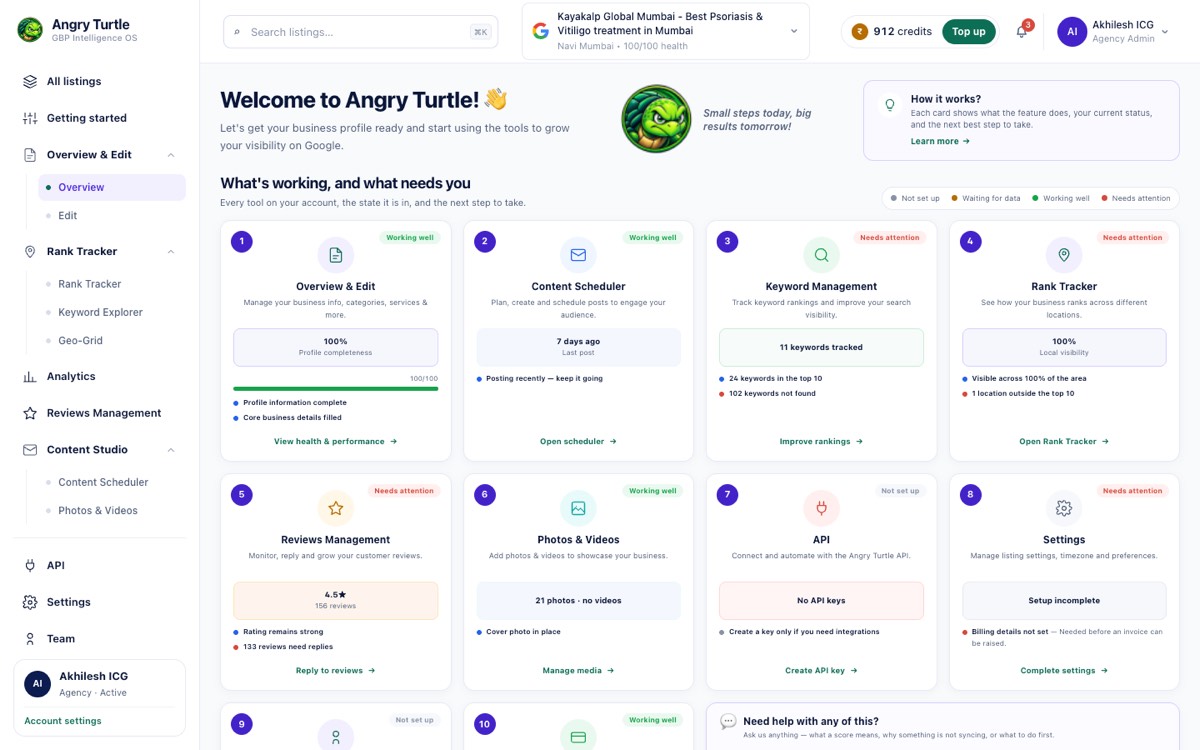

Related reading
Ready to have this run for you?
Book a free audit — we'll show you where you stand in 48 hours.