 Angryturtle
Responding to Negative Reviews: Templates
How to respond to negative Google reviews professionally. Templates for common negative review scenarios in India — with industry-specific guidance for healthcare and BFSI.
·
How to Respond to Negative Google Reviews: The Complete Guide with Templates
Every business with a Google presence receives negative reviews eventually. How you respond publicly is often more impactful than the review itself, since most prospective customers reading it are actually watching how the business handles criticism, not just weighing the original complaint. A professional, empathetic response demonstrates operational maturity and can genuinely convert a skeptical prospective customer who was on the fence.
Here's the strategy, the templates, and where the category-specific rules apply.
The core principles of negative review response
Never dispute facts publicly. Even when the customer is factually wrong, a public argument looks bad regardless of who's actually right — take any factual dispute offline, into a direct message or call.
Acknowledge before you explain. Start with acknowledgement, "We're sorry your experience didn't meet your expectations," not a defensive opener like "We understand your concerns, however..."
Keep it brief. Long responses read as defensive. 80 to 120 words is a reasonable target: state the acknowledgement, the care, and the resolution path, then stop.
Offer a specific resolution path. "Please contact us directly at [email/phone]" is a resolution path a customer can actually act on. "We take all feedback seriously" is not — it commits to nothing and reads as filler.
Respond within 48 hours. An unanswered negative review sitting for weeks signals that nobody's watching the profile, which damages trust more than the original complaint did.
Never copy-paste the same response to every negative review. Beyond the risk that Google may flag duplicate responses, prospective customers reading several reviews in a row can tell, and it undercuts the sincerity of every response, including the genuine ones. See the full optimisation priority list for how review response rate fits into the broader monthly GBP discipline.
Response templates by scenario
Template 1 — service quality complaint. Review says: "Staff was rude and unhelpful."
"Hi [Name], we're genuinely sorry to hear about your experience, this is not the service standard we hold ourselves to. We'd very much like to understand what happened and make it right. Please reach out to us directly at [email] or [phone] and ask for [manager name/designation]. We value your feedback and will use it to improve. — [Your name/designation]"
Template 2 — wait time complaint. Review says: "Waited 2 hours past my appointment time."
"Hi [Name], thank you for your patience, and we sincerely apologise for the wait on your visit. We know your time is valuable. We've been working on improving our scheduling to prevent delays like this. We'd welcome the chance to serve you again, and we'll make sure your next appointment is managed more carefully. Please call [phone] to book directly with our senior team."
Template 3 — pricing complaint. Review says: "Charged more than the price quoted on the phone."
"Hi [Name], we're sorry to hear there was a discrepancy between what you were quoted and what was charged. This shouldn't happen, and we want to look into it specifically for your visit. Please contact [name] at [email] with your appointment date and contact information, and we'll review and resolve this promptly."
Template 4 — product or food quality complaint. Review says: "The food was cold and the portion size was much smaller than expected."
"Hi [Name], we're sorry your meal didn't live up to expectations, both on temperature and portions. Consistency is something we take seriously, and clearly we missed the mark for you. If you'd like to give us another chance, please speak to [manager name] on your next visit, we'd like to make it up to you with a better experience."
Template 5 — a suspected false or unfair review. The review appears to describe an experience that doesn't match any actual visit record.
"Hi [Name], we're sorry to hear about this experience. We've checked our records and haven't been able to find a visit matching these details, we'd genuinely like to understand what happened. Please contact us at [email/phone] so we can investigate. Our team is committed to understanding every customer's experience."
Don't publicly accuse the reviewer of being fake in this scenario — take it to private resolution, or flag it for Google removal if you believe it's a genuine policy violation rather than just an unwelcome truth.
Healthcare-specific response guidelines
Clinic and hospital responses need an extra layer of caution. They should not acknowledge or reference specific clinical details, should not provide medical advice or a diagnosis in the response itself, and should not confirm whether the reviewer is or was a patient at all — even confirming that much can raise a confidentiality concern.
Healthcare-safe response to a wait time complaint: "Thank you for sharing your feedback. We sincerely apologise if your wait time fell short of expectations. We're continuously working to improve our scheduling. Please reach out to our patient experience team at [email] and they'll be happy to assist you further." This template deliberately avoids confirming patient status while still sounding genuinely responsive.
BFSI-specific response guidelines
Bank and NBFC reviews carry their own constraints. Responses should not include specific financial advice, should not reference interest rates, loan terms, or other product specifics, and should not make promises about service delivery timelines that could be read as formal commitments. Where appropriate, reference the formal complaint resolution channel, the bank's helpline or nodal officer, rather than trying to resolve the complaint entirely within the public review response.
BFSI-safe response to a loan complaint: "Thank you for your feedback. We understand your concern and are sorry for the experience you had. We'd encourage you to reach out to our customer support team at [phone/email] or through our formal grievance redressal process at [link] so we can look into this properly and assist you."
Responding at multi-location scale
A single clinic owner can personally read and respond to every review. A 60-branch retail chain can't, which is where aggregated review management becomes necessary — a shared dashboard across all locations, response templates by category that a human reviewer selects and personalises rather than writing from scratch every time, and an SLA with escalation for anything more serious than a routine complaint. The templates above work as the starting point for that library; the personalisation step, filling in the specific name, date, and manager reference, is what keeps them from reading as robotic even when deployed across dozens of locations.
Common mistakes responding to negative reviews
The most damaging mistake is disputing the customer's version of events in the public response, even when the business genuinely believes it's inaccurate — this reads badly to every future reader regardless of who was actually right. The second is responding so slowly that the review sits unanswered for weeks, which reads as indifference even from a business that's otherwise attentive. The third is using an identical response across many reviews, which is easy to spot and undercuts the credibility of every response on the profile, not just the repeated ones.
Should a business respond to positive reviews too, or only negative ones? Both. Responding to positive reviews reinforces the same engagement signal and gives the profile a consistent, active feel rather than one that only shows up when there's a problem to manage.
What if the negative review is about a genuine service failure the business can't fully fix? Acknowledge it honestly and describe the concrete change being made, rather than offering a vague apology with no follow-through. A specific, credible response to an unfixable past failure still builds more trust than a generic one.
Angryturtle drafts and manages review responses for all managed clients →
Stop guessing where you rank locally.
Rank OS scores your Google Business Profile the way Google's local algorithm does — relevance, review health, freshness, entity authority and AIO readiness — and shows you exactly what to fix.
Book a live demo →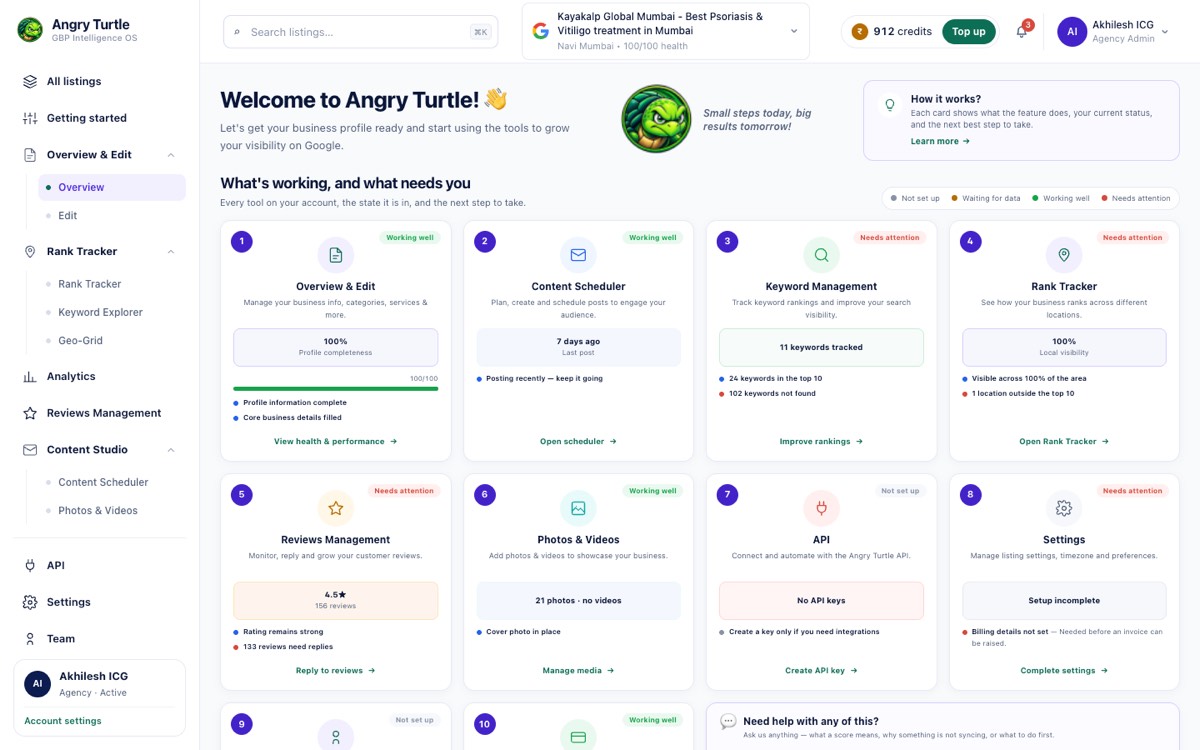

Related reading
Ready to have this run for you?
Book a free audit — we'll show you where you stand in 48 hours.