 Angryturtle
Restaurant SEO in Delhi
The delivery-platform layer versus the Google listing, menu and hours accuracy, and review response, for restaurants, cafes and cloud kitchens in Delhi.
·
A restaurant listed as "Khan Market" without a shop number is asking a hungry diner to guess between a dozen venues packed into two lanes, and that guess usually resolves in favour of whichever listing actually shows a photo of its own frontage. Delhi's market-based addressing is only the most visible part of what makes restaurant SEO here a different job from restaurant SEO anywhere else. This page covers what actually moves a Delhi restaurant, café, cloud kitchen or bar up the local pack, what a restaurant SEO agency in Delhi should be checking that a generic hospitality vendor won't, and where the honest limits of any of this sit. Whether the search that brought you here was restaurant SEO services in Delhi, a restaurant SEO company in Delhi, or restaurant SEO agency in Delhi generally, the underlying fixes are the same, and NCR spillover changes some of them in ways worth knowing before you start.
Market-name addressing, and why it breaks generic profile templates
Delhi diners navigate by market name before street name: Khan Market, Hauz Khas Village, Connaught Place's inner and outer circles, Lajpat Nagar's central market. A restaurant's formal postal address can be technically correct and still fail a diner standing in the wrong lane of Hauz Khas Village looking for the right staircase up to a rooftop venue. Connaught Place complicates this further with its circular block-letter system, where "Connaught Place" alone, without the block, forces a guess between venues that could be five minutes apart or fifty metres apart depending on which block actually applies.
The fix sits in the business description and the photos more than in the address field itself, which is often too rigid to carry the full navigational detail a market name needs. Naming the market, the block or lane, and a specific landmark, "opposite the fountain, Khan Market," "Hauz Khas Village, near the deer park entrance," gives a diner something to match against what they see on the street, which the formal address alone usually can't do in these markets.
Hindi and English share the same search box
Delhi's restaurant search runs in a genuine mix of English, Hindi typed in Roman script, and Hindi typed in Devanagari, and which one dominates shifts by category and neighbourhood the same way it does with any language split. A dhaba-style eatery or a sweet shop in Lajpat Nagar or Karol Bagh sees a real share of queries like "achha khana near me" or "sabse acha dhaba yahan," typed in Roman script rather than Devanagari most of the time. A rooftop bar or a fine-dining spot in Hauz Khas Village or Connaught Place, drawing a younger, more English-first crowd, sees closer to none of that.
The category and services fields in a Google Business Profile match regardless of the language a query arrives in, so nothing changes there. What changes is the business description and the FAQ content on a linked page, which most restaurants write entirely in polished English and then wonder why they're invisible for a meaningful share of real local demand that never used English at all.
The Zomato and Swiggy layer versus the Google listing
A large share of Delhi restaurant discovery, particularly for delivery and for younger diners in markets like Hauz Khas Village, happens on Zomato or Swiggy first, each with its own review pool, its own menu, and its own hours that never sync automatically with Google. A diner checking whether a Khan Market restaurant is actually open before making the trip, or someone who ordered delivery once and wants to book a table this time, goes to Google to verify and remembers it there for the next visit rather than reopening the delivery app.
The practical failure is a name, address or phone mismatch that compounds across three platforms with three different owners of the data. A restaurant listed as "Ministry of Kebabs" on Zomato and "Ministry Of Kebabs Khan Market" on Google, with a phone number on Swiggy that's been disconnected since a lease renewal, is bleeding orders on whichever platform is stale without anyone noticing until a customer complains. NAP consistency across the citation layer needs a scheduled check across all three, not a one-time cleanup.
NCR spillover: when "Delhi" search actually means Gurgaon or Noida
Delhi's restaurant market doesn't stop at the city's administrative border the way search behaviour sometimes assumes. A diner in South Delhi searching "best rooftop restaurant near me" from a location close to the Gurgaon border may see NCR results blend in, and a restaurant chain running outlets across Delhi, Gurgaon and Noida needs each listing's service area and category set correctly for its own specific market rather than treated as interchangeable "Delhi" outlets. Gurgaon's dining scene, built more around corporate and mall-adjacent traffic, behaves differently enough from Hauz Khas Village or Khan Market's leisure-and-culture crowd that identical profile descriptions across the two answer neither search well.
Cloud kitchens sharing one address, and the documentation that keeps them legitimate
Delhi's cloud kitchen density, concentrated heavily in commercial pockets serving Gurgaon and South Delhi delivery zones, runs into the same structural risk it does everywhere multiple delivery brands share a kitchen: Google's systems are built to flag several businesses at one address as a possible spam pattern, because that's also how address-stuffing schemes work. A legitimate operator running four brands from one facility still has to prove each one is real.
Each brand needs its own FSSAI registration reflected on the listing, its own order-routing phone number rather than one shared kitchen line, and photography specific to that brand rather than a single reused kitchen shot across all four profiles. Getting this wrong doesn't usually cost rank, it costs the listing outright through a suspension review, which can sit unresolved for weeks while the kitchen keeps operating with no visible Google presence at all. Duplicate listing cleanup covers the general mechanics; for a shared-kitchen cloud brand the goal isn't removing a duplicate, it's documenting that what looks like one address is legitimately several businesses.
Menu, attributes, and what a Delhi diner actually filters by
An outdated menu costs more in a market like Delhi's, where pure-veg filtering, Jain food options, and alcohol-service attributes all get used as real search filters rather than nice-to-have detail. A restaurant that serves alcohol but hasn't checked that attribute, or a pure-veg establishment that never flagged it, is invisible to a search that filtered specifically on either. Prices need to match what actually appears on the bill; a diner comparing two or three Khan Market options before committing notices a mismatch immediately and reviews accordingly.
Photos that solve the market-navigation problem
Photos do double duty in Delhi's market-based commercial layout: dish photography drives the ordering decision, and an entrance or storefront photo solves the actual wayfinding problem a Khan Market or Hauz Khas Village lane creates. A photo showing the specific staircase, signage, or shopfront that matches what a diner sees on the street closes a gap the address field alone can't, particularly in markets where several venues share a lane and near-identical frontage.
Hours across licensing limits and Delhi's event calendar
Delhi restaurants and bars operate against defined licensing windows for alcohol service, and a kitchen that keeps serving food after the bar closes needs that distinction reflected accurately rather than one blanket closing time for the whole venue. Wedding season and the dense banquet and event-hosting calendar around Delhi's outer ring also shift effective hours at venues that host private events, where a restaurant's public hours may not reflect a night it's fully booked for a private function. A profile that doesn't distinguish this misleads a walk-in diner who shows up expecting a table.
Review response as a daily habit, not a monthly one
Delhi's transient dining traffic, especially near Connaught Place and the tourist-heavy stretches, generates review volume that makes a monthly response batch look neglectful by the time anyone gets to it. A complaint sitting unanswered for two weeks reads worse to the next searcher than the original issue did. Delivery complaints from Swiggy or Zomato orders and dine-in complaints need genuinely different responses, not the same templated apology stretched across both, and response templates by scenario are worth building out separately for each channel rather than relying on one script for everything.
Where this isn't the right fit
A single, well-established Khan Market or Lajpat Nagar restaurant that's consistently full doesn't need managed restaurant SEO. Claim the listing, keep hours accurate including private-event nights, ask regulars for reviews, and that covers most of the value available at that scale. If a restaurant is full but revenue still lags, that's a pricing, staffing, or menu question, not a visibility one, and no amount of listing work reaches that deep. This also doesn't touch food quality, service training, or OTA and delivery-platform commission structures, and any restaurant SEO company in Delhi that implies otherwise is overselling.
What Angryturtle does for Delhi restaurants
Rank OS scores relevance, review health, freshness, entity authority and AIO readiness against named nearby competitors rather than an averaged city figure, and geo-grid tracking shows rank separately across Khan Market, Hauz Khas Village, Connaught Place and Lajpat Nagar instead of blending them into one number that hides where a listing is actually weak. For groups running outlets across Delhi and into Gurgaon or Noida, or a cloud kitchen operating multiple brands from one facility, write-back to Google and managed GBP services keep category corrections, menu changes and hours updates consistent everywhere rather than relying on individual outlet managers to catch up eventually.
Delhi's other sectors sit on the Delhi hub, and the hospitality-wide method, including the hotel-versus-restaurant listing split for properties with their own dining outlet, is covered on the Delhi hospitality page and the hospitality local SEO playbook. The national restaurant local SEO playbook covers category and review fundamentals that apply everywhere, worth reading alongside this page, and cloud kitchen local SEO goes deeper on the shared-kitchen model specifically. Gurgaon's own market, built more around corporate dining, is covered separately on the Gurgaon hospitality page if a Delhi group also runs outlets there. Pricing and a demo are the fastest way to see a Rank OS score against real nearby competitors, or get in touch with specifics about a listing.
FAQ
What makes restaurant SEO in Delhi different from a generic local SEO approach? Mostly the market-based addressing that a formal street address can't fully capture, the Hindi-English-Devanagari mix in real search queries, and NCR spillover into Gurgaon and Noida that a single flat "Delhi" strategy misses.
Do I need a shop or block number in my Connaught Place listing? Yes. The inner, middle and outer circles genuinely confuse navigation without a block letter, and omitting it forces a diner to guess between venues that may be on completely different sides of the circle.
How many Google listings can a cloud kitchen run from one Delhi facility? As many as there are genuinely distinct, separately registered brands, each with its own FSSAI documentation, its own routing phone number, and brand-specific photography. Reusing one kitchen photo or phone line across several listings is what triggers a spam review.
Should a Delhi restaurant write its GBP description in Hindi or English? Both have a role. The category and services fields work the same regardless of query language, but a description and FAQ content that includes the transliterated Hindi terms real diners actually type captures search volume an English-only profile misses entirely.
Does a restaurant near the Gurgaon border need a separate strategy from one deeper in South Delhi? Not a separate platform, but distinct handling of category, service area, and competitive tracking, since the two markets draw genuinely different diners even when a search engine blends the geography.
Does Angryturtle manage Zomato, Swiggy, or restaurant booking-platform listings directly? No. Work covers the Google Business Profile and the citation ecosystem that needs to stay consistent with what's live on those platforms, not the platform listings or their internal ranking systems themselves.
Stop guessing where you rank locally.
Rank OS scores your Google Business Profile the way Google's local algorithm does — relevance, review health, freshness, entity authority and AIO readiness — and shows you exactly what to fix.
Book a live demo →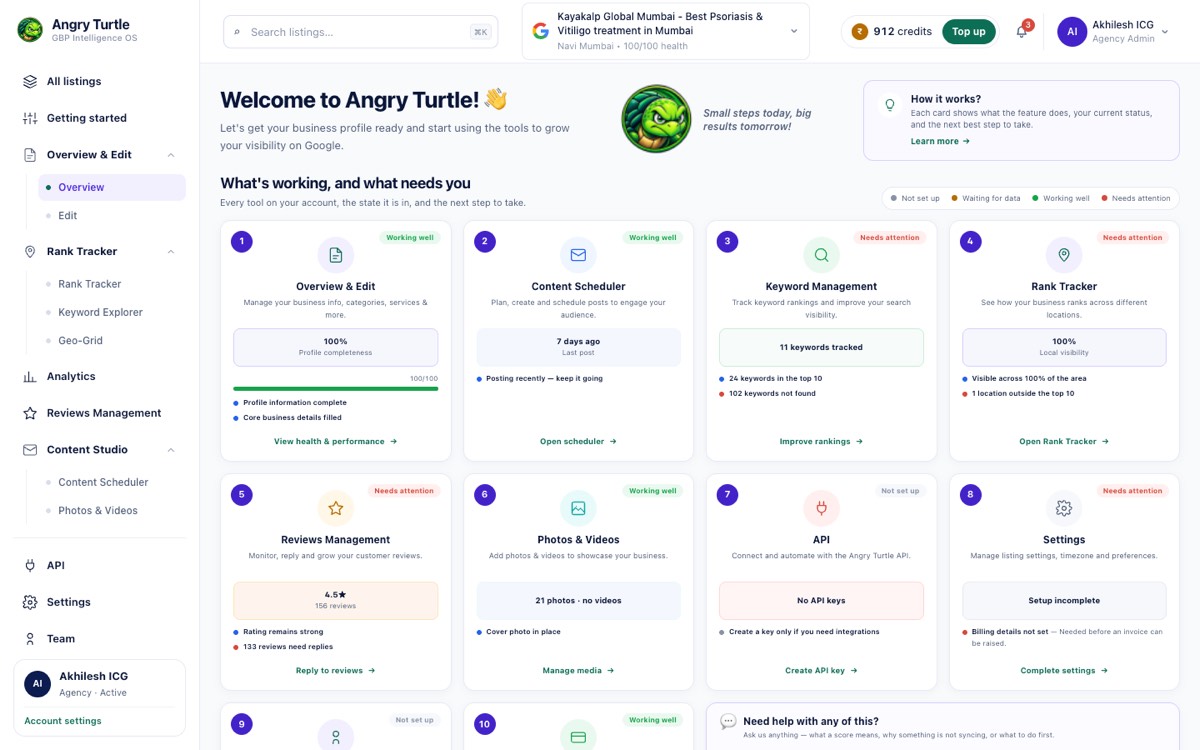

Related reading
Ready to have this run for you?
Book a free audit — we'll show you where you stand in 48 hours.