 Angryturtle
Store Locator SEO Best Practices
How to build a store locator that ranks in Google Search and supports GBP authority. Technical requirements, common mistakes, and India-specific implementation guide.
·
Store Locator SEO: Why Most Indian Retail Locators Fail and How to Fix Them
The store locator is the most-visited section of most multi-location retail and BFSI websites — and the section most commonly built with no SEO consideration at all. Most Indian store locators are JavaScript-rendered, return no indexable URL per store, and hand Google nothing location-specific to crawl. The website layer that should reinforce every store's GBP authority ends up contributing none of that benefit, sitting next to a Google Business Profile network that's doing all the work alone. This is a specific case of the broader multi-location local SEO problem — a website architecture gap rather than a GBP gap.
The core requirement: server-side rendering
Google can technically crawl JavaScript-rendered content, but in practice, JavaScript-heavy store locators are frequently under-indexed. Crawlers tend to prioritise HTML content that's immediately parseable, JavaScript rendering often gets deferred to a second crawl pass that may not happen for months, and dynamic filtering or map interfaces frequently fail to produce stable, crawlable URLs at all.
The fix is to render each store location page server-side with a unique, stable URL. That can mean static HTML pages per location — simplest for a small chain, impractical past a few hundred locations — or server-side rendered pages via a templating system such as Laravel or Next.js SSR. A hybrid approach works well too: a client-side map interface for browsing, paired with server-rendered individual store pages sitting underneath at stable URLs.
URL structure that actually gets crawled and ranks
A clean hierarchy works best: a store locator hub at /stores/, a city hub at /stores/[city]/ listing every store in that city, and an individual store page at /stores/[city]/[area]/. So /stores/ leads to /stores/mumbai/, which leads to /stores/mumbai/bandra-west/.
What to avoid: query-string URLs like /stores/?city=mumbai&area=bandra, which are far less SEO-friendly than a clean path; ID-based URLs like /store/12345 that carry no location context in the URL itself; and a single /store-locator page loading every location through JavaScript with no individually crawlable page per store.
What every individual store page needs
Each /stores/[city]/[area]/ page needs a unique title tag — something like "[Brand] [Area] Store — [City] | Hours, Address & Directions" — and an H1 following the same pattern: "[Brand] [Area], [City]." It needs a NAP block identical to that store's GBP, matching format and phone number exactly, a Google Maps embed for that specific location, current hours including any upcoming holiday adjustments, and LocalBusiness schema carrying that store's specific NAP and hours.
It also needs 100 to 200 words of content genuinely specific to that location — neighbourhood context, parking notes, nearby landmarks, any store specialties — rather than the same paragraph with only the address swapped out. And it needs a clear call to action: a directions link pointing to that store's actual Maps location, a phone link, and a booking link if the business takes one. Angryturtle's guide to location pages for SEO covers the same content-uniqueness problem for local landing pages more broadly.
The store locator hub page itself
The /stores/ hub page has its own job: it should be indexed and competitive for "[Brand] stores in India" and "[Brand] near me" style queries, link out to every city hub page beneath it, offer a working search interface for user experience even if that interface itself is client-side, and carry an overall brand NAP or Organisation schema at the top level. A hub page that's just a map with no supporting text or links contributes almost nothing to search visibility on its own.
Common Indian store locator mistakes
The most common failure is a JavaScript-only locator — an entire React or Angular application with no server-rendered HTML underneath, where Google indexes the empty shell page and nothing about the individual stores. A close second is Google Maps API misuse: a map with store pins but no accompanying HTML content, where the store data lives only inside the JavaScript populating the map and never in crawlable HTML at all.
Copy-pasted content across every store page — the same template with only the address field changed — is thin content that provides no local relevance signal, and Google can tell the difference between genuinely unique location content and a find-and-replace job. And a frequently overlooked gap: no internal link from each store's GBP back to that store's specific page. If every store's GBP "website" link points to the generic homepage instead of the store-specific URL, the chain is missing a straightforward authority reinforcement it's already paying for through GBP itself.
How this connects to the rest of a retail chain's local SEO
A well-built store locator is one piece of a larger retail local SEO system that also depends on individually maintained GBPs, consistent NAP across directories, and active review generation at every store — covered together in Angryturtle's guide to retail chain local SEO. The locator is the website's contribution to that system; it can't substitute for the GBP and review work happening in parallel, but a chain that skips it is leaving one of its own highest-traffic pages doing nothing for search visibility.
BFSI networks face the same architecture problem for branch locators, and much of the fix is identical — see Angryturtle's guide to bank branch local SEO and the BFSI local SEO hub for the sector-specific version, and nap-consistency-at-scale for the audit process that keeps hundreds of locations aligned across directories and the locator at once.
FAQ
Can I keep my existing JavaScript map interface and just add server-rendered pages underneath it? Yes. A hybrid approach — client-side map for browsing, server-rendered individual store pages for crawlability — is a common and practical fix that doesn't require rebuilding the user-facing map experience.
How much unique content does each store page really need? Roughly 100 to 200 words of genuinely location-specific content is enough to avoid reading as thin or duplicated. It doesn't need to be lengthy; it needs to be actually different from every other store's page.
Does the store locator hub page need to rank on its own, separate from individual store pages? Yes. The hub page targets broader brand-plus-location queries ("[Brand] near me," "[Brand] stores in India"), while individual store pages target the specific location searches — they serve different queries and both need their own optimisation.
Angryturtle advises on store locator architecture for retail and BFSI clients →
Stop guessing where you rank locally.
Rank OS scores your Google Business Profile the way Google's local algorithm does — relevance, review health, freshness, entity authority and AIO readiness — and shows you exactly what to fix.
Book a live demo →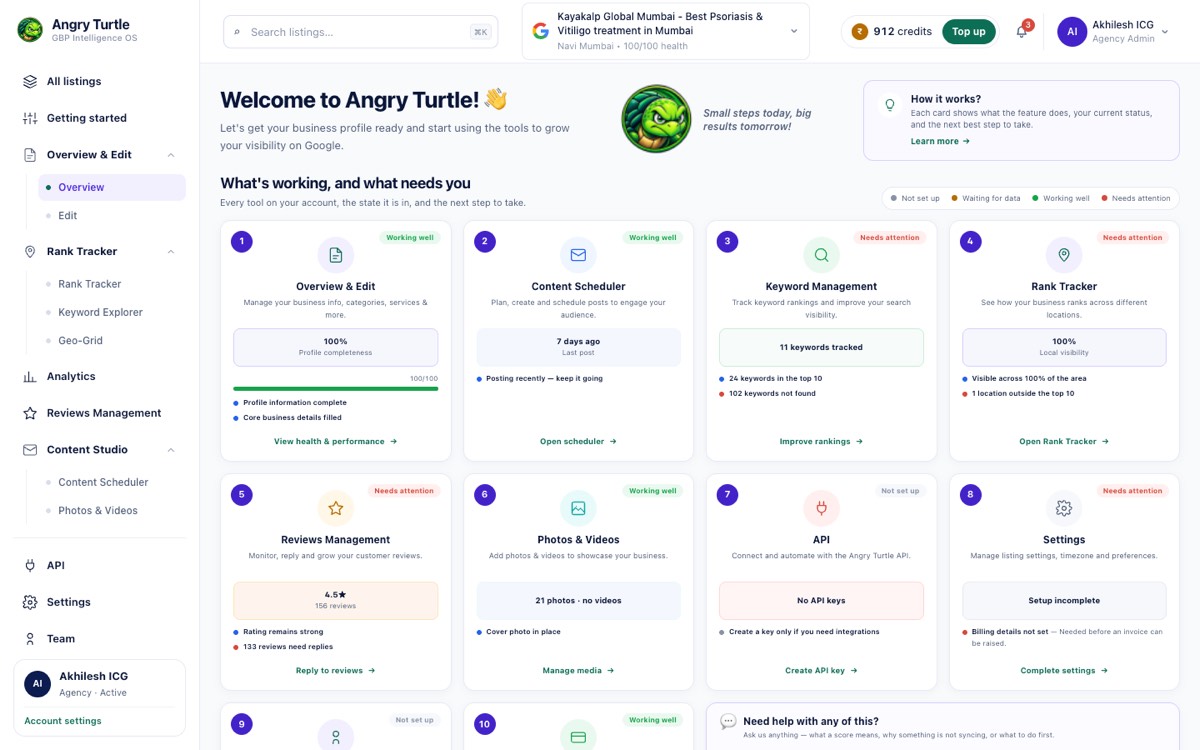

Related reading
Ready to have this run for you?
Book a free audit — we'll show you where you stand in 48 hours.