 Angryturtle
An Uberall Alternative for Indian Enterprises
·
Five weighted dimensions, one score, twenty-plus directories
Uberall built its name on location marketing for large, multi-location enterprises: chains, franchises, and brands with hundreds of storefronts spread across countries. Its platform centres on listings management, a store locator, and location-level analytics, aimed at the kind of enterprise that needs central control over how a thousand branches present themselves across the map.
That's a legitimately hard problem, and Uberall's enterprise customers are proof it solves it at scale for the markets it was built around. The question for an Indian enterprise is whether "scale across markets Uberall was built around" also means scale across India's specific directory and search behaviour, and that's where the numbers start to diverge. Angryturtle's citation engine covers 20+ platforms with JustDial, Practo, Sulekha, and IndiaMART built in as core targets. Rank OS scores every listing from 0 to 100 across five weighted dimensions. Neither of those two things maps cleanly onto a listings-management platform whose distribution network and analytics were designed for Western enterprise chains first.
What enterprise location marketing usually means
Enterprise location marketing platforms like Uberall typically centre on a few core jobs: pushing consistent business data out to a distribution network, running a store locator widget for the brand website, and aggregating performance analytics across every location in a central dashboard. For a retail chain with outlets across the US and Europe, that's the right shape of product.
Indian enterprises face a version of the same problem with different underlying data. A bank with 400 branches, a hospital chain with 30 locations across five states, or a QSR franchise with outlets in a dozen cities all need the same central control, pointed at India's directory stack: JustDial for general discovery, Practo for healthcare, IndiaMART for B2B, Zomato for food service. A distribution network built for Western aggregators doesn't automatically extend into that stack.
Where the enterprise-scale gap shows up
Citation and NAP consistency stall on Indian directories specifically. The volume Uberall handles well, thousands of location records pushed consistently, doesn't help if the destination directories aren't the ones an Indian customer actually checks.
Store locator and analytics assume a discovery pattern that doesn't map to Hinglish and vernacular search. A store locator widget on a brand website is useful for a customer who already knows the brand. It does nothing for the "near me" and regional-language query volume that drives a large share of Indian local discovery, which routes through Google and category platforms rather than a brand's own site.
GBP-specific depth is limited relative to a platform built around that one API. Enterprise platforms manage listings across many networks at once, which by design means shallower depth on any single one, including Google Business Profile, compared to a tool purpose-built around GBP's write API specifically.
What enterprise scale looks like when it's India-native
Angryturtle's Agency OS and enterprise tooling were built for the same governance problem, unlimited profiles, role-based access, portfolio-wide visibility, but with India's directory layer as the default target rather than an extension. The citation engine treats JustDial, Practo, Sulekha, IndiaMART, and Zomato as core platforms across 20+ sites total.
Every location in that portfolio rolls up into a Rank OS score, 0 to 100, from five weighted dimensions: relevance, review health, freshness, entity authority, and AI-overview readiness. For an enterprise account, that turns a portfolio of 400 branches into a filterable, sortable list, not 400 separate dashboards, with bulk actions and CSV export built for exactly that scale.
Direct GBP editing pushes changes straight to Google across name, description, hours, categories, and service areas, with photos, posts, products, and review replies publishing live. That write-path depth is the single strongest differentiator against most local platforms, most of which are read-only or partial on GBP because they weren't built around that API specifically.
The governance question enterprise buyers actually ask
Enterprise procurement for a location marketing platform tends to ask a specific set of questions: can this scale to our number of locations, does it support role-based access and SSO, can it produce a consolidated report for the board, and does the vendor's data partnerships actually cover our markets.
Uberall answers the first three well for the markets its distribution network reaches. The fourth is where an Indian enterprise needs to look closer, because the same "yes, we scale to thousands of locations" answer means something different depending on whether the underlying directory relationships were built for this market or extended into it after the fact. Our enterprise multi-location governance guide covers what to actually check during that evaluation, beyond the sales deck.
Angryturtle's enterprise tier includes unlimited profiles, volume pricing, SSO, and role-based governance, scoped to India from the ground up rather than adapted to it. See enterprise local SEO for the specifics.
AI-answer readiness at enterprise scale
As AI Overviews, Gemini, and ChatGPT increasingly answer "best X near me" queries directly, an enterprise with hundreds of locations needs to know not just where each branch ranks in the local pack, but whether each branch's profile is a citable answer in those AI systems. That's a portfolio-wide question, not a single-location one, and it needs to be trackable across an entire portfolio the same way rank and reviews already are.
Ask Maps / AIO readiness checks a question bank against actual AI visibility for each listing and feeds the result into Rank OS's AI-readiness dimension, so an enterprise account can see AI-citation readiness across a whole portfolio the same way it sees rank and review health. Our AI overviews guide covers the underlying mechanics in more depth.
Who should stay on Uberall
Enterprises whose location footprint is primarily outside India, or genuinely global with India as one market among many where Uberall's existing distribution and analytics already deliver value, have a real case to stay. Ripping out an enterprise platform that's working across most of a global footprint to fix an India-specific gap rarely makes sense as a wholesale switch; the more common outcome for those brands is running Uberall globally and a dedicated India-specific layer locally.
Who should look at Angryturtle instead
Indian enterprises, franchise networks, and multi-location brands in healthcare, banking and financial services, and education, where hundreds of branches need governance built around India's directory stack rather than adapted to it, are the clearest fit. So is any enterprise account that specifically wants AI-answer readiness tracked at the same portfolio scale as rank and reviews.
Frequently asked questions
Can Angryturtle actually handle enterprise scale, hundreds of locations? Yes. The enterprise tier supports unlimited profiles, volume pricing, SSO, and role-based access, with bulk actions and portfolio filtering built for that scale. See enterprise local SEO.
Does Uberall cover Indian directories like JustDial and Practo? Its distribution network and data partnerships are built primarily around global and Western markets. Indian category-specific directories aren't part of that default coverage.
How does Rank OS work across a large portfolio? Every listing gets its own 0-100 score from five weighted dimensions, and the portfolio view lets an account filter and sort across the whole set rather than reading each dashboard individually.
Does Angryturtle support role-based access for large teams? Yes, across Agency Admin, SEO, Project Manager, and Client roles, with the enterprise tier adding SSO.
Can Angryturtle run alongside a global platform like Uberall? Yes, this is common for global brands: a global platform for markets outside India, and Angryturtle specifically for the Indian portfolio's citation, GBP, and AI-readiness layer.
What's the enterprise pricing structure? Enterprise pricing is scoped to the account. See pricing → for the current tier structure.
Related: Yext alternative · BrightLocal alternative · Uberall vs Yext · White-label local SEO
Stop guessing where you rank locally.
Rank OS scores your Google Business Profile the way Google's local algorithm does — relevance, review health, freshness, entity authority and AIO readiness — and shows you exactly what to fix.
Book a live demo →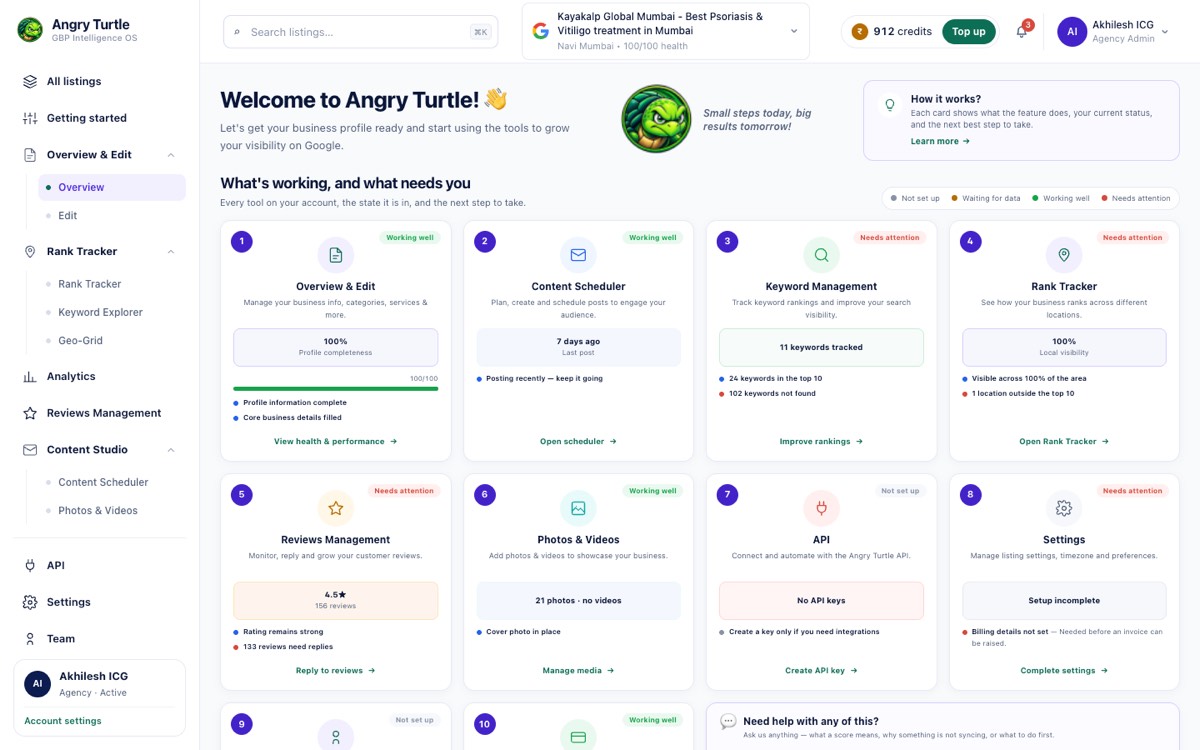

Related reading
Ready to have this run for you?
Book a free audit — we'll show you where you stand in 48 hours.