 Angryturtle
Uberall vs Yext: Which Suits an Indian Multi-Location Brand
·
Uberall vs Yext, the short version
Uberall and Yext both sell enterprise location and listings management, and both get shortlisted by the same kind of buyer: a multi-location brand or bank comparing platforms before a procurement decision. Uberall's product centres on listings distribution, a store locator, and location analytics for global multi-location chains. Yext started as a listings and knowledge-management platform and has expanded into a broader "answers" and site-search product built around structured entity data. Whichever order the search comes in — Uberall vs Yext or Yext vs Uberall — the comparison itself doesn't change; only the buyer's starting point does.
For an Indian multi-location brand running that comparison, the more useful question usually isn't Uberall versus Yext in the abstract. It's whether either platform's distribution network and depth of GBP support was built with India's directory stack, JustDial, Practo, Sulekha, IndiaMART, in mind, or extended into it after the fact. That's the angle the rest of this page takes, section by section, rather than a generic feature checklist.
Uberall: built for global scale, not India's directory stack
Uberall's product is right for what it was built for: a large multi-location enterprise pushing consistent listing data, running a store locator, and reading performance analytics across a global footprint. Its distribution partnerships and analytics were designed around that scale, and enterprises running hundreds of Western-market locations get real value from that design.
The gap for an Indian buyer sits in the destination directories. Uberall's distribution network reaches the aggregators and directories relevant to the markets it was built for. JustDial, Practo, Sulekha, and IndiaMART carry the local weight in India, and a citation pushed cleanly to Uberall's Western partner network doesn't reach those platforms by default. Store locator widgets and brand-site analytics also assume a discovery pattern anchored to a brand's own site traffic, which underweights the "near me" and vernacular query volume that drives a large share of Indian local search.
A hospital chain evaluating Yext
A hospital chain with 40 locations across six Indian cities is comparing Yext against two other platforms. Yext's pitch centres on structured entity data, one canonical record per location that feeds out to search engines, maps, voice assistants, and the chain's own site search, all built on the idea that a single accurate source of truth prevents the inconsistency problems multi-location brands usually run into.
The pitch holds up structurally. Where the hospital chain's evaluation runs into friction is depth on two fronts that matter specifically to healthcare in India: how deep the GBP write access actually goes (hours, categories, service areas, not just name and address), and whether Yext's citation network extends into Practo, which for a hospital chain carries more local search weight in India than most general directories. Yext's structured-data model is genuinely strong for entity consistency across search engines broadly; it wasn't built with Practo or JustDial specifically in its network.
How the pricing models differ in shape
Neither vendor publishes list pricing openly enough to quote a number here, and this page won't guess at one. What is publicly visible is the shape each pricing model takes, which matters more than the number for a buyer sizing a decision.
Uberall sells primarily on an annual contract, scoped per location, with the contract typically bundling listings distribution, the store locator, and analytics as one package rather than separable line items. Yext also prices per location on an annual basis, but its packaging tends to separate the "answers"/knowledge-graph layer from base listings management, so a buyer can end up paying for entity infrastructure it may not use if the actual need is narrower — plain listings accuracy. Both models assume a multi-year enterprise relationship rather than a monthly, cancel-anytime arrangement. An Indian operator sizing either quote should ask specifically what's bundled versus billed as an add-on, since that's where the real cost difference between the two tends to show up, not in the headline number. For what Angryturtle charges instead, see pricing → — self-serve monthly tiers alongside managed per-location pricing, without an annual-contract minimum.
Where an Indian operator should look carefully
Ask both vendors directly, before signing anything, exactly which Indian directories their distribution network reaches natively versus through a third-party reseller layer, because "listings management" can mean very different depth depending on the answer. Ask how GBP write access is scoped — some platforms sync only name, address, and phone, leaving categories, service areas, and special hours to be managed manually inside Google's own dashboard regardless of what the platform's marketing implies. And ask what happens to historical review replies and post history if the contract ends, since migrating away from an entity-management platform is rarely as simple as exporting a spreadsheet.
Where Angryturtle's write-path depth changes the comparison
Both Uberall and Yext manage listings from outside the Google Business Profile API, through their own distribution and entity systems, and sync into Google as one of several output channels rather than the primary surface. Angryturtle was built directly on the GBP API as its core surface: name, description, phone, address, business hours including special and holiday hours, categories through a live Google category picker, and service areas, with changes pushing straight to Google. Photos, posts, products, and review replies publish live too, not queued for a sync cycle.
That write-path depth pairs with a citation engine built around 20+ platforms with JustDial, Practo, Sulekha, IndiaMART, and Zomato as core targets, and a Rank OS score, 0 to 100, from five weighted dimensions: relevance, review health, freshness, entity authority, and AI-overview readiness. Neither Uberall nor Yext produces an equivalent single score with tunable weights; both report metrics and status rather than a prioritised, weighted verdict.
Comparison at a glance
| Capability | Uberall | Yext | Angryturtle |
|---|---|---|---|
| Core design | Global listings distribution | Structured entity data | GBP-native platform |
| India directory coverage | Limited | Limited | JustDial, Practo, Sulekha, IndiaMART, Zomato |
| GBP write depth | Partial via sync | Partial via sync | Full write-back, live to Google |
| Pricing shape | Annual contract, per location | Annual contract, per location + add-ons | Monthly self-serve or per-location managed |
| Scoring model | Status/analytics dashboard | Status/analytics dashboard | Rank OS, 0-100, five weighted dimensions |
| AI-answer readiness | Not a focus | Not a focus | Ask Maps / AIO |
| Best fit | Global multi-location enterprise | Entity-consistency-first brands | India-first multi-location or agency accounts |
What neither platform tracks: AI-answer readiness
Neither Uberall nor Yext was built around the question of whether a location's profile is a citable answer inside Google AI Overviews, Gemini, or ChatGPT. Both were designed before that became a meaningful share of local discovery, and both are still primarily reporting on rank and listing status rather than AI-answer visibility specifically.
Angryturtle's Ask Maps / AIO readiness module checks a per-listing question bank against actual AI-answer visibility and rolls the result into Rank OS's AI-readiness dimension. For a multi-location brand evaluating either Uberall or Yext today, this is worth asking both vendors about directly, because it's not a line item either platform's marketing tends to lead with. Our AI overviews guide covers why this signal is starting to matter as much as local pack rank.
The honest boundary
None of this means Uberall or Yext is a poor product — both serve the buyers they were built for well, and a global chain with a handful of Indian locations may reasonably conclude the India gap is a small cost worth absorbing rather than a reason to switch platforms entirely. The boundary is narrower than a head-to-head verdict: if the bulk of a brand's locations sit in Indian metros and the directories that actually move local search there, this comparison points toward a platform built around that stack from the start, and away from bolting an India layer onto a system designed for a different market.
What actually decides this for an Indian multi-location brand
Strip away the feature comparisons and the decision usually comes down to one question: does your location footprint sit mostly inside India, mostly outside it, or genuinely global. A brand with the bulk of its locations in the US or Europe and a handful in India gets real value from Uberall's or Yext's global reach, with the India gap being a smaller cost worth absorbing. A brand whose footprint is mostly or entirely Indian metros is optimising for the wrong directory network with either platform.
For that second group, the practical fix is either supplementing a global platform with an India-specific citation and GBP layer, or replacing it outright with a platform built around India's directory stack from the start. See multi-location local SEO services and enterprise local SEO for how that decision plays out at different scales.
Frequently asked questions
Is Uberall or Yext better for an Indian business? Both were built primarily for markets outside India, and neither has deep default coverage of JustDial, Practo, Sulekha, or IndiaMART. For a business whose locations sit mostly in India, that gap matters more than most of the feature differences between the two platforms.
Can I run Angryturtle alongside Uberall or Yext? Yes, for a global brand with a mostly non-Indian footprint, running a global platform for markets outside India and Angryturtle specifically for the Indian portfolio's GBP, citation, and AI-readiness layer is a common setup.
Does Angryturtle offer the same enterprise governance as Uberall or Yext? Yes. Role-based access, SSO, unlimited profiles, and volume pricing are available at the enterprise tier, alongside Agency OS for portfolio-wide filtering and bulk actions. See enterprise local SEO.
What's the single biggest technical difference between these platforms and Angryturtle? Write-path depth on the Google Business Profile API specifically. Angryturtle was built around that API as its primary surface; Uberall and Yext manage listings through their own systems and sync to Google as one of several channels.
Do either Uberall or Yext track AI-answer visibility? Neither has AI-answer readiness as a core focus of its product. Angryturtle's Ask Maps / AIO module checks this specifically at the listing level.
How do pricing models compare between Uberall and Yext? Both price primarily on a per-location annual contract basis rather than a monthly self-serve model; Yext's packaging tends to separate the answers/knowledge-graph layer from base listings management as its own line item, where Uberall bundles listings, locator, and analytics together. See Angryturtle pricing → for self-serve and managed tiers, including enterprise pricing scoped to account size.
Related: Uberall alternative · Yext alternative · BrightLocal alternative · Industries we serve
Stop guessing where you rank locally.
Rank OS scores your Google Business Profile the way Google's local algorithm does — relevance, review health, freshness, entity authority and AIO readiness — and shows you exactly what to fix.
Book a live demo →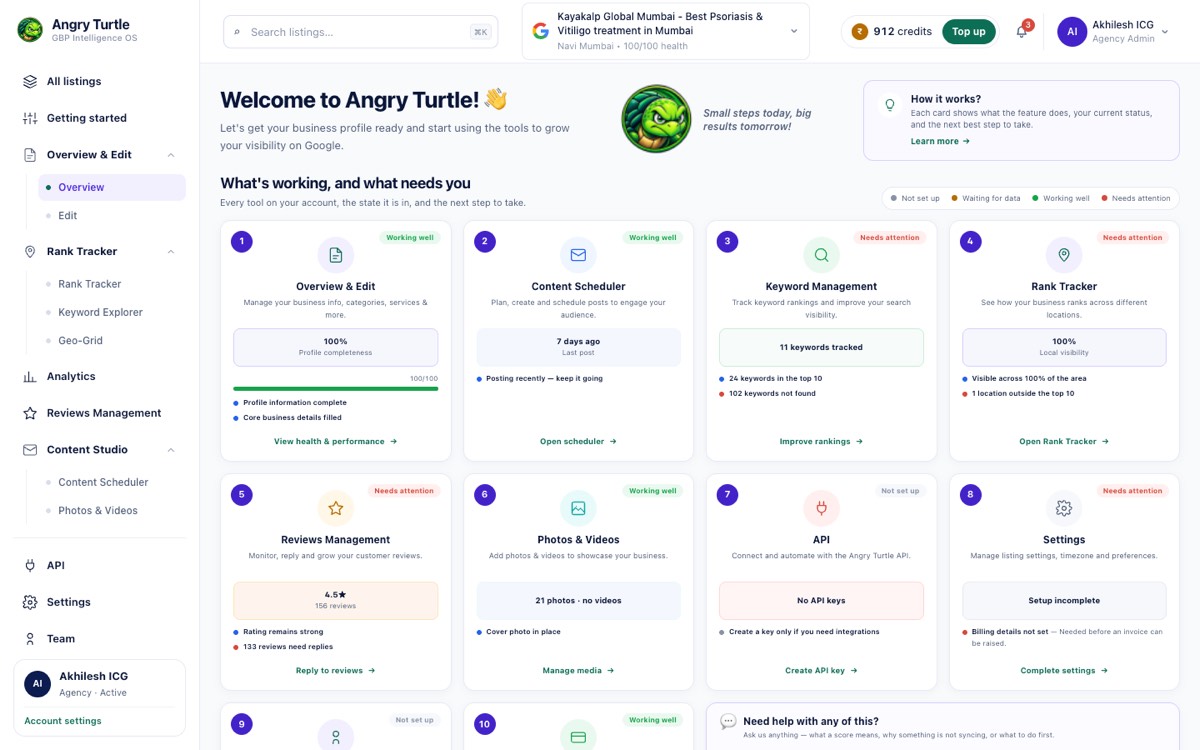

Related reading
Ready to have this run for you?
Book a free audit — we'll show you where you stand in 48 hours.