 Angryturtle
A Synup Alternative for Indian Multi-Location Brands
·
Synup manages listings well. It doesn't act on India's directory layer
Synup is a listings management platform built for multi-location brands and the agencies serving them. It handles bulk location data updates, listing sync across a distribution network, review aggregation, and reporting dashboards designed for the agency-to-client relationship. For a US or UK-based multi-location brand managing dozens of locations through one console, that's a solid feature set, and it's why Synup has held a real position in that market.
For an Indian multi-location brand, the console works the same way, but the directory network underneath it doesn't cover the sites that carry local authority here. JustDial, Practo, Sulekha, and IndiaMART sit outside most Western listings platforms' default distribution, Synup included, which means the bulk-update convenience doesn't extend to the directories that actually influence rank for an Indian search query.
The multi-location brief Synup was built for
Synup's core audience is agencies and franchise brands managing many locations at once, and its product reflects that: bulk data uploads, a client-facing dashboard, white-label reporting. For a brand with fifty locations across one country and a familiar directory stack, that architecture removes a lot of manual work.
The same architecture, pointed at fifteen clinics across five Indian cities, runs into the citation gap immediately. Bulk-updating listing data across a directory network that doesn't include Practo means the update never reaches the platform where patients in those cities are actually searching. The dashboard reports "synced," but synced to the wrong set of directories doesn't move rank.
Review aggregation follows the same pattern. Synup pulls in reviews from the major platforms its integration covers. Indian reputation is distributed further, Practo for clinics, Zomato for restaurants, 99acres and MagicBricks for real estate, and a review aggregation tool that doesn't reach those misses a meaningful share of what customers are actually saying.
What an India-first citation and review layer looks like
Angryturtle's citation engine treats JustDial, Practo, Sulekha, IndiaMART, and Zomato as core targets across 20+ platforms, not an add-on. Details are on citations and NAP management. For a multi-location brand, that means the bulk-update problem Synup solves for Western directories gets solved for the Indian stack instead.
Reviews work the same way. Reviews AI monitors and drafts responses across the platforms relevant to the category, Practo for healthcare, Zomato for hospitality, Google everywhere, and publishes replies live rather than leaving them queued in a dashboard. Our glossary entry on reputation management covers how these signals interact with rank.
The scoring layer Synup doesn't have
Synup's dashboards report status: synced or not synced, review count, rating trend. What they don't produce is a single number that says where a listing actually stands and what to fix next. That gap matters more as a portfolio grows, because a regional manager checking in on thirty locations doesn't have time to read thirty separate status panels.
Rank OS scores every listing from 0 to 100 across five weighted dimensions, relevance, review health, freshness, entity authority, and AI-overview readiness, and surfaces the top actions that would move the score, with the expected point lift per action. Across a portfolio, that turns thirty dashboards into one ranked worklist: fix these five listings first, and here's why.
Bulk management vs. execution
Synup's real value is in the bulk-management layer: one place to push updates across many locations, one dashboard for a client to check status. What happens after that dashboard flags an issue is still the operator's job, someone logs in, finds the problem listing, and fixes it manually.
Angryturtle's Agency OS covers the same bulk-management ground, filterable by health, views trend, review frequency, and assigned account manager, with bulk actions and CSV export. The difference sits on the other side of the flag: when a citation is missing or a listing needs a category correction, the platform or the managed team executes the fix rather than adding it to a queue for someone else to work through. GBP edits push directly to Google, and citation gaps get filled through the citation engine rather than surfaced as an open item.
For franchise and agency clients specifically, that difference compounds. A white-label reporting dashboard that shows "12 listings need attention" is useful information. A system that also closes eight of those twelve without anyone touching a keyboard is a different category of product. See white-label local SEO for how the agency layer works end to end.
Reporting that a client can actually act on
Agencies reselling Synup typically hand clients a reporting dashboard and interpret it for them in a monthly call. That interpretation work, translating "review response rate dropped 12%" into "here's what we're doing about it", is where an account manager's time actually goes.
Angryturtle's consolidated client reports pull Insights, Optimization, Competitors, and Rank OS into one white-label document, and because the platform is built to act rather than just report, a chunk of what would otherwise need explaining in that call has already been fixed by the time the report goes out. Our local SEO measurement guide covers how to read the underlying metrics if you want the detail behind the score.
Who should stick with Synup
Agencies and multi-location brands operating primarily in markets where Synup's existing directory network carries real weight, and where the client relationship is built around a dashboard-and-explain model rather than execution, have a reasonable case to stay. If your locations are outside India and Synup's aggregator partnerships already cover your actual directory stack, switching mainly for India-specific citation coverage wouldn't solve a problem you have.
Who should look at Angryturtle instead
Multi-location brands and agencies operating in Indian metros, particularly in healthcare, hospitality, and franchise verticals where category-specific Indian platforms carry real weight, are the strongest fit. So are agencies that want bulk portfolio management and execution in one system rather than a dashboard that still requires someone to act on every flag.
Frequently asked questions
Does Synup cover Indian directories like JustDial and Practo? Its default distribution network is built primarily around Western data aggregators. Indian category-specific platforms sit outside that by default.
How is Angryturtle different for agencies managing many client locations? Agency OS offers the same bulk-management view, filterable by health, views, and review frequency, but pairs it with execution: citation fixes, GBP edits, and review responses happen rather than just getting flagged.
Does Angryturtle white-label reports the way Synup does? Yes. Reports pull Insights, Optimization, Competitors, and Rank OS into one white-label document; see white-label local SEO.
Can Angryturtle handle review monitoring across Practo and Zomato, not just Google? Yes, category-specific platforms are covered where relevant, alongside Google, through Reviews AI.
Is there a score that summarises listing health across a whole portfolio? Yes, Rank OS scores every listing individually and rolls up into portfolio-wide views for agencies and enterprise accounts.
What does switching from Synup to Angryturtle cost? See pricing → for current self-serve and managed tiers.
Related: Yext alternative · BrightLocal alternative · Enterprise local SEO · Multi-location local SEO services
Stop guessing where you rank locally.
Rank OS scores your Google Business Profile the way Google's local algorithm does — relevance, review health, freshness, entity authority and AIO readiness — and shows you exactly what to fix.
Book a live demo →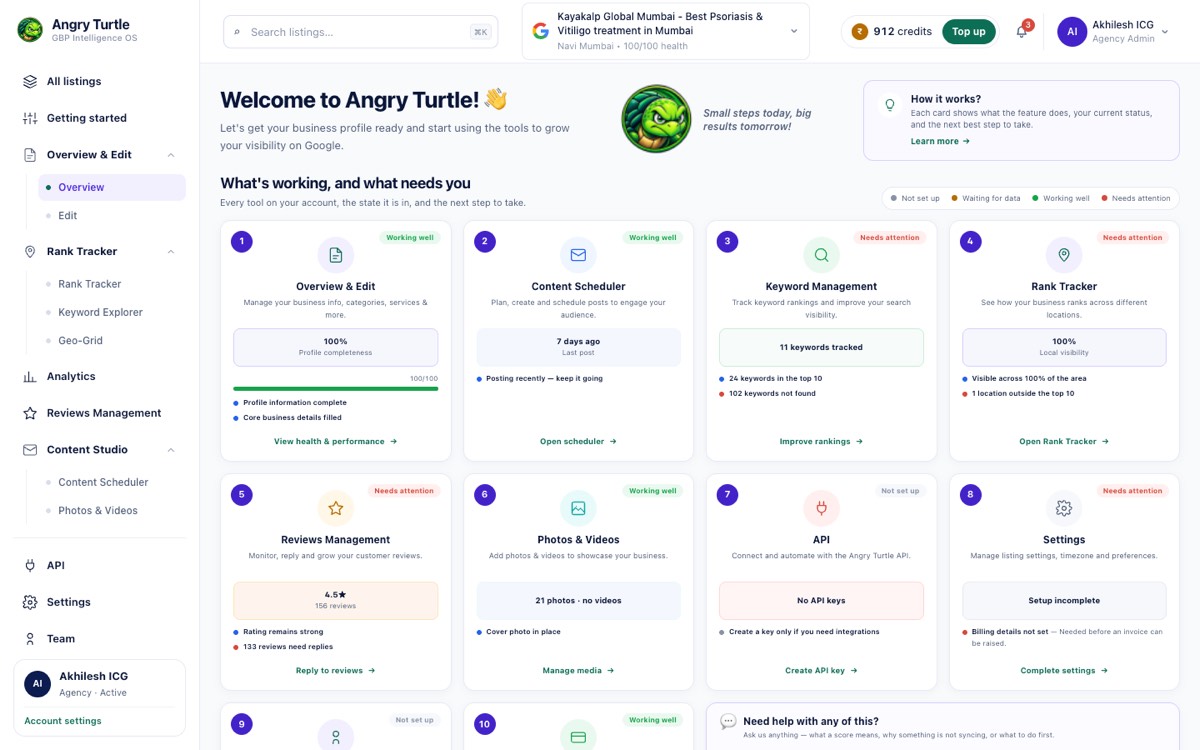

Related reading
Ready to have this run for you?
Book a free audit — we'll show you where you stand in 48 hours.