 Angryturtle
Birdeye vs Yext vs Angryturtle: Which GBP Management Platform Is Right for Indian Businesses?
Birdeye and Yext are US-headquartered enterprise platforms with limited India-specific features (few Indian directories in their networks, USD pricing, limited vernacular support). Angryturtle is India's only AI-native GBP intelligence platform built specifically for Indian healthcare, real estate, retail, and hospitality businesses — with Indian directory integration, ₹ pricing, vernacular support, and an AI Overview-specific Ranking Readiness Score.
Three different products get compared on this page because they solve three different starting problems. Birdeye is built around reputation and customer experience. Yext is built around knowledge distribution across a large publisher network. Angryturtle is built around one Google Business Profile at a time — scoring it, prioritizing the fix, and pushing that fix live. None of the three is a drop-in replacement for the other two; the right one depends on which problem is actually the bottleneck.
Birdeye
Birdeye is a US-headquartered reputation-management and customer-experience platform. Its core strengths sit in review management, customer survey tooling, social media scheduling, and a citation network built around US-market directories. Teams already running Birdeye globally, including Indian subsidiaries of US multinationals, tend to keep it for exactly that reason: it's already deployed, the workflows are familiar, and swapping platforms has a real switching cost.
The weakness for Indian businesses is the same shape as most Western reputation platforms: a citation network centered on US directories, with limited coverage of Practo, JustDial, and Zomato specifically, and no India-specific answer-engine features. Pricing is quoted in USD, which adds currency risk for an Indian buyer even before the coverage gap is factored in. For a full breakdown of Birdeye specifically, see the Birdeye alternative page.
Yext
Yext is a US-headquartered knowledge-management platform built for multi-location brands that need one source of truth distributed across a large number of publishers and platforms. Its strengths are real: a large global publisher network, structured-data distribution at scale, and enterprise analytics that roll performance up across dozens or hundreds of locations at once. A retail chain or hotel group with a hundred-plus locations spanning several countries, India included, gets genuine value from centralising that distribution in one system.
The gap for Indian businesses is integration depth, not intent. Yext's standard publisher network doesn't include Practo or JustDial as native integrations, and premium tiers are priced in USD, which matters more the smaller the Indian book of locations gets. It's also built primarily for US and European markets, with India treated as one region among several rather than a first-class market. The Yext alternative page covers this comparison on its own in more depth.
Angryturtle
Angryturtle currently manages 319 Google Business Profiles across eight industries, which is a useful scale marker when weighing an India-built platform against two US-headquartered incumbents: the Indian directory layer is not an afterthought here, it is the primary environment the product was built for.
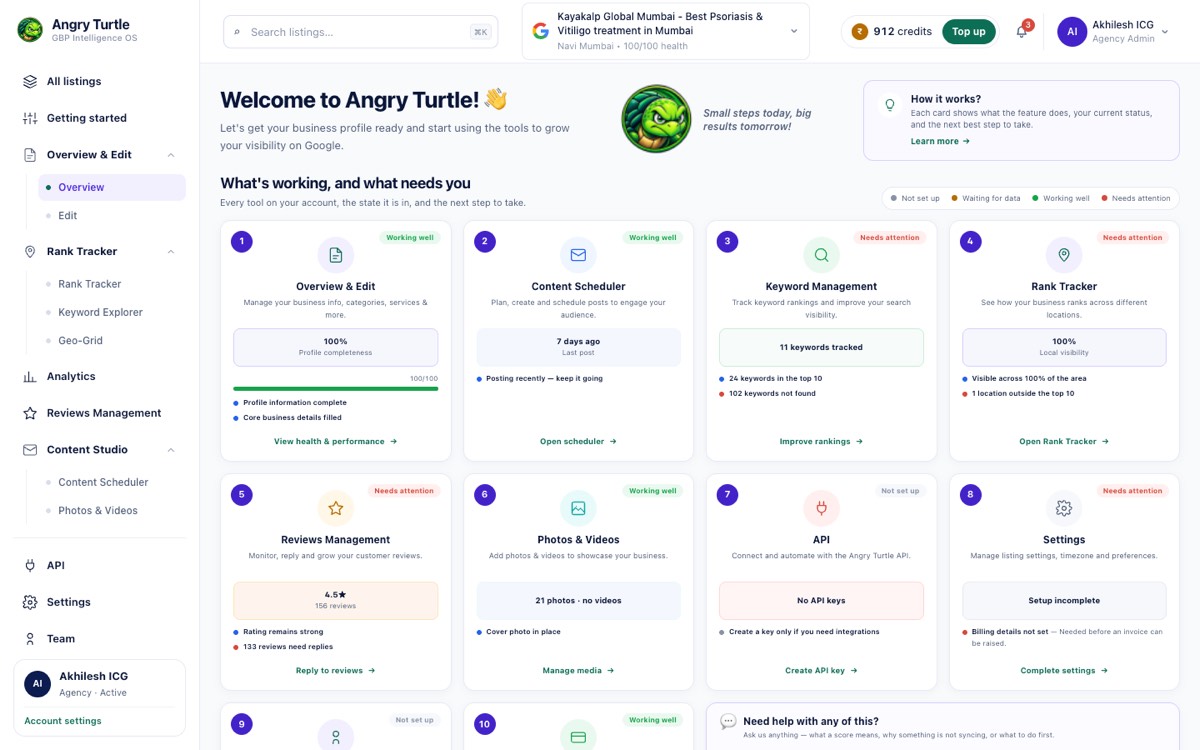
Angryturtle is an India-built AI-native GBP intelligence and management platform on a Laravel and Livewire stack, positioned specifically against BrightLocal, Yext, Whitespark, and Birdeye. It leads with four things the site marks as unique against all of them: Rank OS, a transparent 0-100 score across five weighted dimensions; a tunable Local Presence Score at the profile-element level; demand-cluster and opportunity sizing pulled from Google Ads Keyword Planner data; and AI-drafted review replies that publish to Google in one click.
Underneath those four sits full write-back to Google — name, description, phone, address, hours, categories, service areas, photos, posts, and Q&A can all be edited inside the platform and pushed live, not just flagged for someone else to change. Its citation engine is India-native, covering JustDial, Sulekha, Practo, and IndiaMART alongside the broader set most tools already reach, built on the same NAP consistency principle every platform in this category relies on. And its Ask Maps module checks whether a profile is a citable answer when Google's AI Overviews or a chatbot is asked a local question, which is the AIO readiness dimension feeding directly into the Rank OS score.
Angryturtle is available self-serve — Solo at ₹999/month, Agency from ₹3,499/month, Enterprise on custom pricing — with an optional managed service layered on top for teams that want execution handled by a specialist rather than run in-house.
Feature comparison
| Feature | Birdeye | Yext | Angryturtle |
|---|---|---|---|
| India-specific directory network (JustDial, Practo) | Limited | Limited | Yes |
| Rupee pricing | No, USD | No, USD | Yes |
| Rank OS / tunable profile score | Not offered | Not offered | Yes, 5 weighted dimensions |
| AI-answer readiness (AIO) scoring | Not offered | Not offered | Yes, Ask Maps |
| Demand-cluster / opportunity sizing | Not offered | Not offered | Yes |
| Direct GBP write-back | Partial | Partial | Full |
| Review reply automation | Manual/templated | Manual/templated | AI-drafted, one-click publish |
| Global publisher network scale | Moderate | Large | India-native plus global |
| Delivery model | Self-serve SaaS | Self-serve SaaS | Self-serve or managed |
When each one actually makes sense
Birdeye tends to make sense for an Indian subsidiary of a US multinational that has already deployed it globally and just needs India added into the same system, rather than run separately. It's a weaker fit for an India-native SMB, a healthcare business, or anyone whose visibility depends heavily on Indian directory integrations Birdeye doesn't natively reach.
Yext tends to make sense for a large multinational retail chain or hotel group with well over a hundred locations globally, India included, that needs centralised knowledge management across markets. It's a weaker fit where Indian directory depth or rupee-denominated SMB pricing is the actual requirement.
Angryturtle fits Indian healthcare, real estate, retail, hospitality, and B2B businesses of any size, from a single-location clinic to a multi-location hospital chain, built around India's specific directory ecosystem, AI-answer readiness for Indian search patterns, and a scoring model that's visible rather than opaque. It's the right fit whenever the Indian directory layer and GBP execution, not global brand-knowledge distribution, are the actual bottleneck.
The structural gap in Western platforms
The underlying limitation of US-based GBP platforms in the Indian market isn't a missing feature so much as a missing map. Their citation networks were built around directories like Yellow Pages, Yelp, and Foursquare, none of which carries meaningful weight for Indian local search or Indian AI-citation behavior. JustDial, Practo, Zomato, IndiaMART, and Sulekha require India-specific integrations that Western platforms haven't built, because India hasn't been their primary market. A platform that can't distribute data to Practo and JustDial has no path to improving how often a business gets mentioned when ChatGPT or Perplexity answers an India-local query — a dynamic covered in more depth at AI citations across ChatGPT, Perplexity, and Gemini and at the AEO India playbook.
Frequently asked questions
Is Angryturtle suitable for enterprise-level multi-location management? Yes. The platform supports multi-location Indian businesses across healthcare, real estate, retail, and hospitality, with India-specific directory integrations and AI-answer readiness scoring built for enterprise-scale portfolios. See enterprise local SEO for the specifics.
Can I switch from Birdeye or Yext to Angryturtle? Yes. Onboarding includes connecting the existing Google Business Profile and running an initial Rank OS scoring pass to establish a baseline before any managed optimisation begins. Nothing needs to be undone on the outgoing platform first.
Does Angryturtle replace the need for a local SEO agency? Not necessarily — it depends on the buyer. Angryturtle works self-serve for teams that want to run the platform themselves, and it also offers an optional managed GBP service with a specialist team executing reviews, content, and profile management on top of the same platform.
Why doesn't Birdeye or Yext just add Indian directories? That's a question for those companies, not this one, but the practical pattern is consistent across most Western-built local SEO platforms: directory integrations get built where the primary customer base already is, and India hasn't historically been that market for either company.
Compare the two Western platforms individually against Angryturtle: Birdeye alternative and Yext alternative. For the scoring engine referenced throughout this page, see Rank OS, and for what a managed team on top of the platform looks like, see managed local SEO.
More comparisons
A score you can argue with, not a black box
Rank OS gives every profile a 0–100 score built from five weighted dimensions — Relevance, Review Health, Freshness, Entity Authority and AIO Readiness — and the weights are tunable. Underneath it sits a ranked list of the fixes that move the number, each with the point lift it unlocks.
Ready to have this run for you?
Book a free audit — we'll show you where you stand in 48 hours.