 Angryturtle
What Is AEO (Answer Engine Optimisation) and AIO Readiness?
Answer Engine Optimisation (AEO) is the practice of structuring a business's digital presence — website content, Google Business Profile, citations, schema markup — so that AI-powered search systems can cite it as an answer. AIO Readiness is the narrower, measurable version of that idea: how well a specific local business's presence is configured to appear inside Google's AI Overviews right now, this month, for the queries that matter to it.
The two terms get used almost interchangeably in practice, but the distinction is useful. AEO is the discipline. AIO Readiness is the score.
Why AI Overviews change the local search calculation
Google AI Overviews increasingly appear for local-intent queries — "best cardiologist in Pune," "which IVF clinic in Bengaluru has the highest success rate," "hotels near Connaught Place." When an AI Overview appears above the local pack, it satisfies part of the search intent before the user ever scrolls down. Click-through to the map results drops. That's not speculation; it's the mechanical effect of putting an answer above a list of links.
The businesses named inside that AI Overview get the opposite effect: exposure at the very top of the page, often before a single traditional result loads. For a category with high evaluation intent — "best," "which," "top rated" — that citation slot is now the highest-value piece of real estate on the page, ahead of position one in the local pack.
What actually determines AIO readiness
Five things move the needle, in roughly descending order of impact for most Indian local categories.
Review count and velocity come first. Businesses with a thin review base rarely get cited in AI Overviews for competitive queries — a clinic with 12 reviews is not going to out-cite one with 300, regardless of how well its website is built. The exact threshold varies by category and city, but the pattern holds consistently: more reviews, added at a steady pace rather than in a single burst, correlates with more frequent citation. Angryturtle tracks this pattern across client GBP profiles rather than claiming a universal number, because the threshold for a Bengaluru dermatologist and a Tier 2 coaching institute are not the same.
GBP completeness matters almost as much. AI systems extract business attributes — hours, specialties, services, accepted payment methods — directly from Google Business Profile structured data. A profile with gaps in these fields simply has less machine-readable material for an AI system to pull from, independent of how good the business actually is.
Website structured data is the third factor. LocalBusiness schema with a complete attribute set — name, address, phone, opening hours, price range, aggregate rating — makes the website's own data machine-readable, which matters because AI systems cross-reference the website against the GBP and against directory listings.
Topical authority is the fourth. A clinic whose website and GBP consistently address one specific area — IVF, say, rather than "general gynaecology and IVF and cosmetic procedures and diet counselling" — is more likely to get cited for queries in that specific area. Breadth without depth reads as generic to an AI system the same way it reads as generic to a human searcher.
NAP consistency is the fifth. AI systems cross-reference multiple sources when deciding whether to trust an entity. A business whose name, address, or phone number differs even slightly between its GBP, its website, and a directory listing creates ambiguity, and ambiguous entities get skipped in favour of ones an AI system can verify cleanly.
Common mistakes that stall AIO readiness
The most frequent mistake isn't neglect — it's uneven effort. A business invests in reviews for six months, stops, and wonders why citation rates plateau. AIO readiness rewards consistency more than intensity; a steady drip of new reviews and GBP posts outperforms an occasional push.
The second mistake is treating schema as a one-time technical task. Schema needs to reflect current hours, current pricing, and current service lists — stale structured data can actively mislead an AI system rather than help it, which is worse than having none.
The third is chasing every possible topic on one GBP category and one set of service pages instead of picking a lane. A multi-specialty clinic that tries to rank for every specialty at once usually ends up cited for none of them.
AIO readiness and adjacent concepts
AIO readiness is the local-business-specific application of AEO more broadly, and it overlaps heavily with entity authority — the trust signal an AI system builds up about a business over repeated encounters with consistent data. It also depends on the mechanics covered in AI Overview and, for businesses with more than one location, on brand entity governance across branches. Reviews specifically are covered in more depth under review velocity, and the structured-data side is covered under local schema.
Angryturtle's AIO Readiness work runs both audit and build sides of this: reviewing where a profile currently stands against the five factors above, then executing the GBP completeness, schema, and citation work needed to move it. GBP AI Optimization → | Entity Authority → | GBP Management Services →
Related glossary terms
A score you can argue with, not a black box
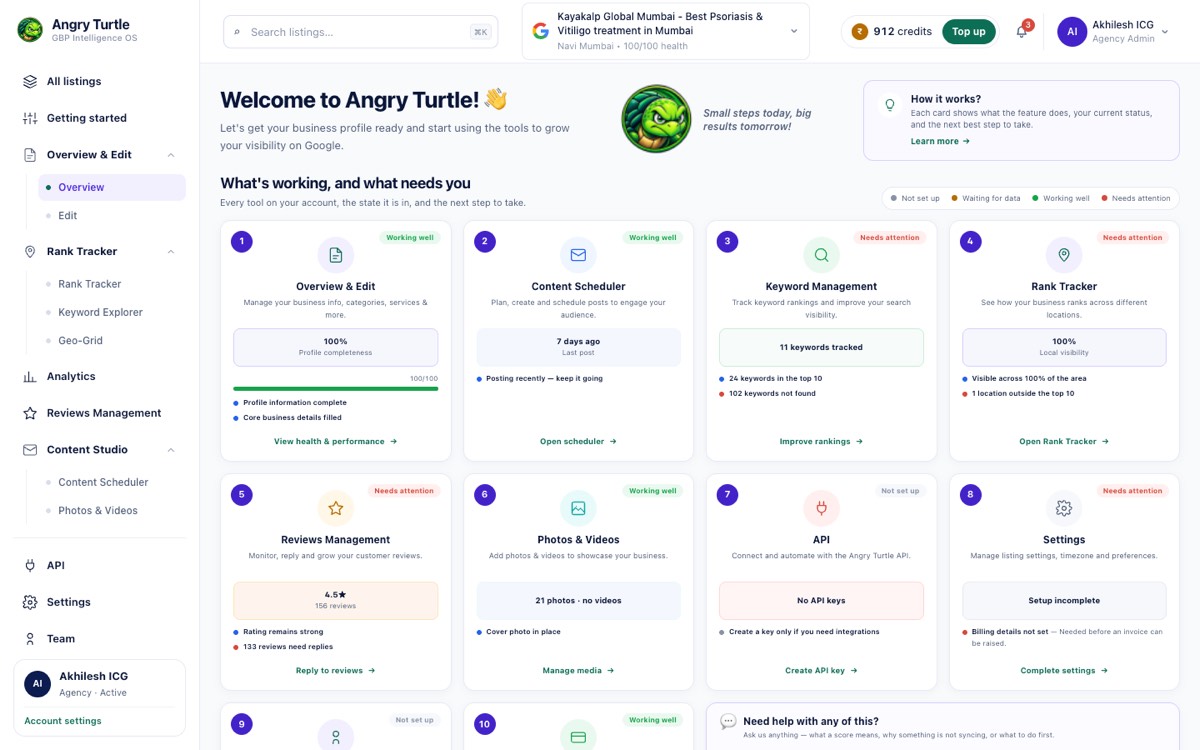
Rank OS gives every profile a 0–100 score built from five weighted dimensions — Relevance, Review Health, Freshness, Entity Authority and AIO Readiness — and the weights are tunable. Underneath it sits a ranked list of the fixes that move the number, each with the point lift it unlocks.
Ready to have this run for you?
Book a free audit — we'll show you where you stand in 48 hours.