 Angryturtle
Organic SEO vs local SEO
Two separate ranking systems on the same results page, commonly treated as one job.
"We rank number one for our main keyword" and "we're not getting enough calls" are two sentences that show up in the same conversation more often than they should. They aren't contradictory. They're describing two different ranking systems that happen to share a search results page, and a business can win one decisively while barely registering in the other.
Two systems, one results page
Search "cardiologist Bandra" and the page that comes back isn't a single ranked list. The local pack sits near the top, a small map with three business cards pulled from Google Business Profile data. Below it, the ordinary organic results run on an entirely separate ranking, pulling from your website rather than your GBP listing. Local pack vs organic results covers that specific split in more depth; this page is about the broader distinction between local SEO as a discipline and organic SEO as a discipline, which extends past just this one search results page.
What organic SEO actually optimises
Organic SEO is the familiar, larger discipline: content quality, backlinks, technical site health, page-level relevance to a search query, and overall site authority. It's not inherently local at all. A blog post, a comparison page, a product guide, none of these need any connection to a physical address to rank organically, and plenty of high-traffic organic content has nothing to do with local intent whatsoever.
Organic ranking can be durable in a way local ranking often isn't. A well-linked, well-written page can hold its position for years without a single edit, as long as its backlink profile stays strong and nothing shifts underneath it algorithmically.
What local SEO actually optimises
Local SEO is narrower and more operational. It's the work of making a specific physical location, or a service area, rank well for searches carrying local intent: Google Business Profile completeness, category accuracy, review volume and freshness, citation consistency across directories, and proximity signals Google weighs for "near me" queries. Relevance in local SEO is one of the three documented pack-ranking factors, alongside distance and prominence, and none of the three map cleanly onto how organic ranking works at all.
Freshness behaves almost backwards between the two. A GBP that goes quiet, no posts, no new photos, no recent reviews, starts losing pack visibility within weeks. An organic page with a strong backlink profile can go untouched for years and keep ranking. The two systems reward attention on completely different timelines.
Where a business can win one and lose the other
A business with an excellent, well-optimised website and strong backlinks can still be invisible in the local pack if its GBP category is wrong or its address doesn't match its citations elsewhere. The reverse happens just as often: a business with a thin, barely-maintained website but a well-categorised, actively-reviewed GBP profile can sit at position one in the pack while its site ranks nowhere near page one organically for the identical search. Neither outcome is a bug. They're two separate ranking systems doing exactly what they're built to do, independently of each other.
Which one actually drives more clicks depends on the query
On mobile, which carries most local search traffic in India now, the local pack often fills the entire visible screen before a user scrolls. Someone searching for an urgent, nearby need, a locksmith, a pharmacy, an emergency vet, frequently taps a phone number or "Directions" straight from the pack card without ever reaching an organic result. Research-heavy queries behave differently. "Best CBSE school in Whitefield" invites comparison-reading in a way "electrician near me" doesn't, and that pulls more click share toward organic content further down the page.
AI Overviews complicate this split further, since a growing share of local-adjacent queries now surface a generated answer above both the pack and organic results, drawing from a mix of both sources rather than sitting cleanly in either camp. AI Overviews and local business covers what that third layer means for visibility that used to belong entirely to one system or the other.
Which businesses genuinely need both
A single-location clinic or salon usually gets more practical return from local pack investment than from organic content, since almost every relevant search for that business carries local intent and triggers the pack directly. A multi-location chain, or a business in a category with real research-phase behaviour, legal services, real estate, higher-ticket healthcare, generally needs both working, because the pack captures the "ready to call now" searcher while organic content captures the one still comparing options earlier in the decision. Losing either leaves a genuine gap in the funnel rather than just a missed bonus.
Measuring the two separately
GBP Insights reports profile views, website clicks, calls, and direction requests, and that data speaks specifically to pack performance. Insights & Performance pulls that first-party data with month-on-month comparisons rather than a static snapshot. Organic traffic gets measured the standard way, through Search Console and analytics, and the two datasets rarely get looked at side by side even though "is my pack presence strong" and "is my website earning organic clicks" are genuinely different diagnostics that deserve separate answers, not one blended number.
What Angryturtle scores, and what it deliberately doesn't
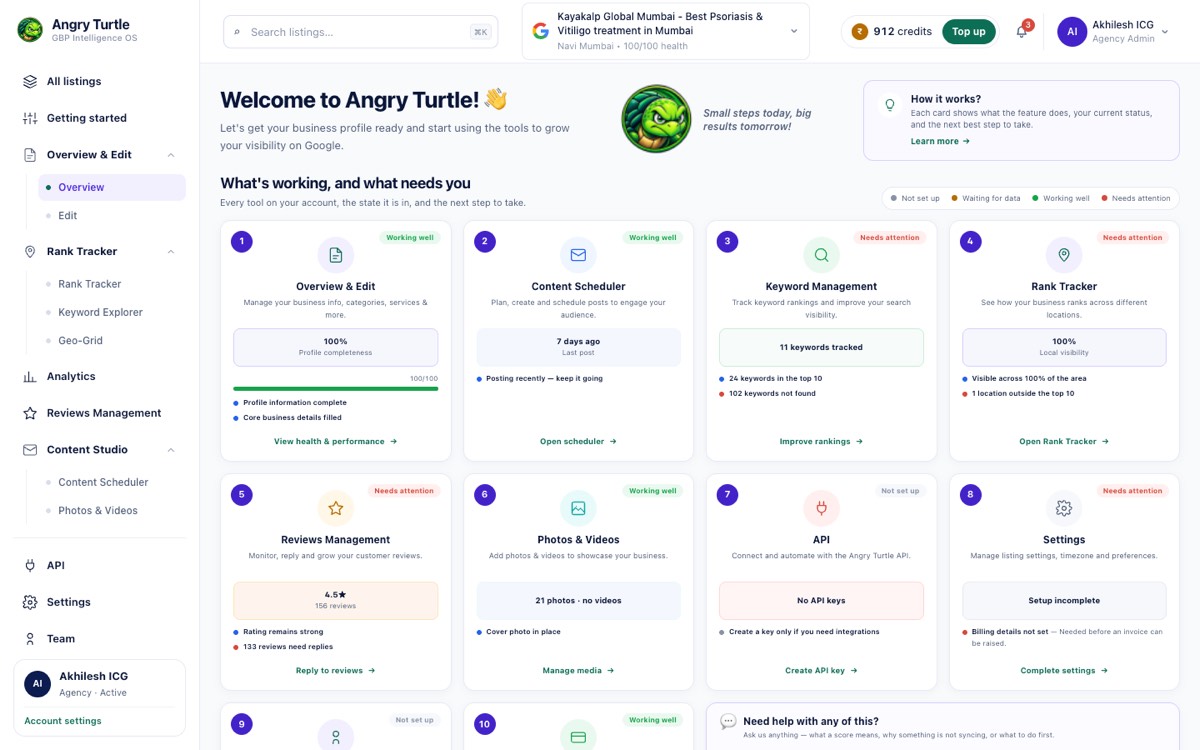
Rank OS scores the GBP side of this specifically: relevance, review health, freshness, entity authority, and AIO readiness, all built from Google Business Profile data. It isn't a general organic SEO tool, and it doesn't pretend to replace one. A business also chasing organic content growth, backlinks, or technical site fixes needs that work done separately, ideally by someone tracking both scores side by side rather than assuming a strong local pack score says anything about organic health, or the other way around.
FAQ
If my website ranks well organically, will I also show up in the local pack? Not automatically. Strong organic performance can indicate a well-optimised, authoritative site, which helps prominence a little, but it doesn't substitute for GBP-specific factors like category accuracy, proximity, and review activity that the pack weighs directly.
Is local seo a subset of organic seo, or a separate discipline? It shares some underlying principles, like the value of relevance and authority, but it runs on a different data source, Google Business Profile rather than the website, and a different ranking algorithm. Treating it as a subset tends to lead to under-investing in the GBP-specific work that actually moves pack rank.
Can a business rank in the local pack without a website at all? Yes. A complete, active, well-reviewed Google Business Profile can rank in the pack with no website behind it. A website reinforces the same signals and gives customers another way to learn about the business, but it isn't strictly required for pack visibility.
Why does my competitor rank organically but not in the pack, or the other way around? Because the two rankings measure different things. A competitor with strong content and backlinks but a poorly categorised or under-reviewed GBP will show exactly that split, organic strength without pack presence, or the reverse for a competitor who's invested heavily in their profile but never built out their website.
Which one should a small business with limited time focus on first? For most single-location, walk-in or call-driven businesses, local SEO usually returns more per hour of effort, since almost every relevant search for that business type carries local intent. Businesses with a genuine research phase in their sales cycle should weigh organic content sooner rather than treating it as optional.
See how your Google Business Profile scores on the local side specifically, book a free audit and get a read on what's actually holding pack visibility back.
More comparisons
A score you can argue with, not a black box
Rank OS gives every profile a 0–100 score built from five weighted dimensions — Relevance, Review Health, Freshness, Entity Authority and AIO Readiness — and the weights are tunable. Underneath it sits a ranked list of the fixes that move the number, each with the point lift it unlocks.
Ready to have this run for you?
Book a free audit — we'll show you where you stand in 48 hours.