 Angryturtle
Local SEO vs AEO: 6 Key Differences Every Indian Business Owner Should Know
Local SEO and AEO share most underlying signals but differ in six key ways: (1) measurement (rank vs Share of AI Voice), (2) content format (keyword-optimised vs answer-capsule formatted), (3) schema priority (LocalBusiness vs FAQPage + HowTo), (4) directory strategy (citation building vs category-specific platforms), (5) review role (prominence signal vs eligibility threshold), (6) goal (traffic vs brand citation visibility).
A local SEO checklist and an AEO checklist look similar enough on paper that a lot of businesses assume doing one covers the other. It doesn't, quite. The gap only shows up once you compare what a team actually does on a Tuesday morning under each label — which tool they open, what they measure, and what "done" looks like at the end of the task.
Task 1 — checking whether it's working
Local SEO work gets checked with a rank tracker. Open the tool, look at position for "dentist near Koramangala," see whether it moved up or down since last week. The number is stable enough to trend over time, and most tools update daily or weekly.
AEO work doesn't have an equivalent single number to glance at. Checking it means running a defined set of real customer questions against AI Overviews, ChatGPT, and Perplexity and recording whether each one produced a citation — a Share of AI Voice check, usually monthly rather than daily, because AI responses vary more from one run to the next than rank position does. There's no dashboard that pings you when a citation disappears the way a rank drop shows up automatically in most SEO tools.
Task 2 — writing a page
For local SEO, a page gets written with the target keyword in the H1, the first paragraph, the meta description, and worked naturally through the body — the classic on-page structure that's been standard for over a decade.
For AEO, the same page needs its opening sentences to work as a standalone, extractable answer. The first sentence or two of a section should state the answer directly rather than building up to it through three paragraphs of context, because an AI system pulling a citation grabs the most directly quotable passage, not the best-written one. A page can rank well under local SEO on-page rules and still be a poor AEO source if the actual answer is buried in paragraph four.
Task 3 — deciding what schema to add
Local SEO's schema checklist is short: LocalBusiness (or its more specific subtype), with address, phone, hours, and coordinates, plus AggregateRating for review signal. That's the entity declaration search engines have expected for years.
AEO's schema checklist is longer and different in kind: FAQPage for question-and-answer extraction, HowTo for step-based content, and depending on the page, Speakable or DefinedTerm. FAQPage specifically is the schema type most directly tied to AI citation, and it's also the one most local SEO checklists skip entirely, because it was never required for local pack ranking.
Task 4 — deciding where to list the business
Local SEO's directory work is about volume and consistency — the same name, address, and phone across dozens of citation sites, because consistent NAP across many directories builds entity trust with search engines generally.
AEO's directory work is narrower and more targeted: making sure the specific high-authority platforms that AI tools actually browse for a given category are complete and current. For a healthcare business that's Practo; for food, Zomato; for general local services, JustDial. A complete profile on the two or three platforms an AI system actually cites from matters more here than being listed on forty low-authority directories that no AI system browses for citation purposes.
Task 5 — handling reviews
Local SEO treats reviews as one of the ranking pillars alongside relevance and proximity — more reviews, better ratings, incrementally better local pack position. Every review helps a little, continuously.
AEO cares about the same reviews but reads them differently: as evidence an AI system weighs when deciding whether a business is a credible answer to "best [category] near me." There's no published threshold that flips a switch — a business with a stronger review profile than the competitors currently ranking for the same query is in a better position, and that's a comparative bar, not a fixed number. Responding to reviews, keeping the response rate up, and encouraging detail in the review text (not just a star rating) all feed into this differently than they feed into pure local pack ranking.
Task 6 — what "success" gets reported as
A local SEO report is a rank sheet: keyword, position, change since last period, estimated traffic value. It's a format clients already understand because they've seen it for years.
An AEO report has to explain something less familiar: which of a defined query set produced a citation this month, which didn't, and what changed since the last check. It's a newer kind of report, and clients sometimes need the format explained the first time they see it — there's no equivalent to "we moved from position 6 to position 2" when the actual outcome is "we went from cited in 12 of 30 test queries to 17."
Where this actually leaves a local business
None of this means doubling the workload. Most of the AEO tasks above are additions to an existing local SEO workflow, not replacements for it — the GBP work, the review generation, the citation building all stay exactly as they were. What changes is a handful of specific new habits: writing answer-first content instead of build-up content, adding FAQPage schema where it didn't exist before, checking directory completeness on two or three specific platforms instead of forty generic ones, and running a monthly citation check instead of relying solely on rank position as the only visibility signal that matters.
For the conceptual version of this same split — what SEO and AEO are actually optimising for, rather than what changes in the weekly task list — AEO vs SEO covers that ground. And if the terminology itself, including where GEO fits relative to both, is the confusing part, GEO vs AEO vs SEO untangles the three terms directly.
FAQ
Does a business need a separate team for AEO, or can the existing local SEO person just add it on? For most single-location and small multi-location businesses, the existing local SEO person or agency can absorb the additional tasks — answer-first content, FAQPage schema, a monthly citation check — without a separate hire. Larger, multi-location, or highly competitive accounts often benefit from someone specifically tracking Share of AI Voice, since that measurement doesn't fit neatly into an existing rank-reporting cadence.
How often should Share of AI Voice actually be checked? Monthly is a reasonable default for most businesses, since AI responses vary more run to run than rank position does and a weekly check would mostly capture noise rather than signal. Businesses in fast-moving competitive categories may want it checked more often around specific campaigns or seasonal peaks.
Is FAQPage schema worth adding even if a business isn't actively pursuing AEO? Generally yes — it's low-cost to implement, it doesn't conflict with any local SEO signal, and it improves eligibility for both featured snippets in classic search and AI citation. There's little downside to adding it even for a business that's primarily focused on local pack rank.
Can a business be strong in local pack rank and weak in AI citation at the same time? Yes, and it's more common than most business owners expect, because nothing in a standard rank report would surface that gap. A business can hold position 1 or 2 in the local pack for years while an AI Overview above it consistently cites a different business, simply because that business's content happens to answer the specific question more directly.
Get your local SEO and AEO tasks handled together →
Internal links used: AEO vs SEO · GEO vs AEO vs SEO · Managed Local SEO · AEO Services · AI Search Readiness Audit · Share of AI Voice Tracking · Local business schema blog · Review schema markup blog · Review generation strategy blog · Reviews and AI search visibility · NAP consistency glossary · FAQPage schema glossary · HowTo schema glossary · Local pack glossary
More comparisons
A score you can argue with, not a black box
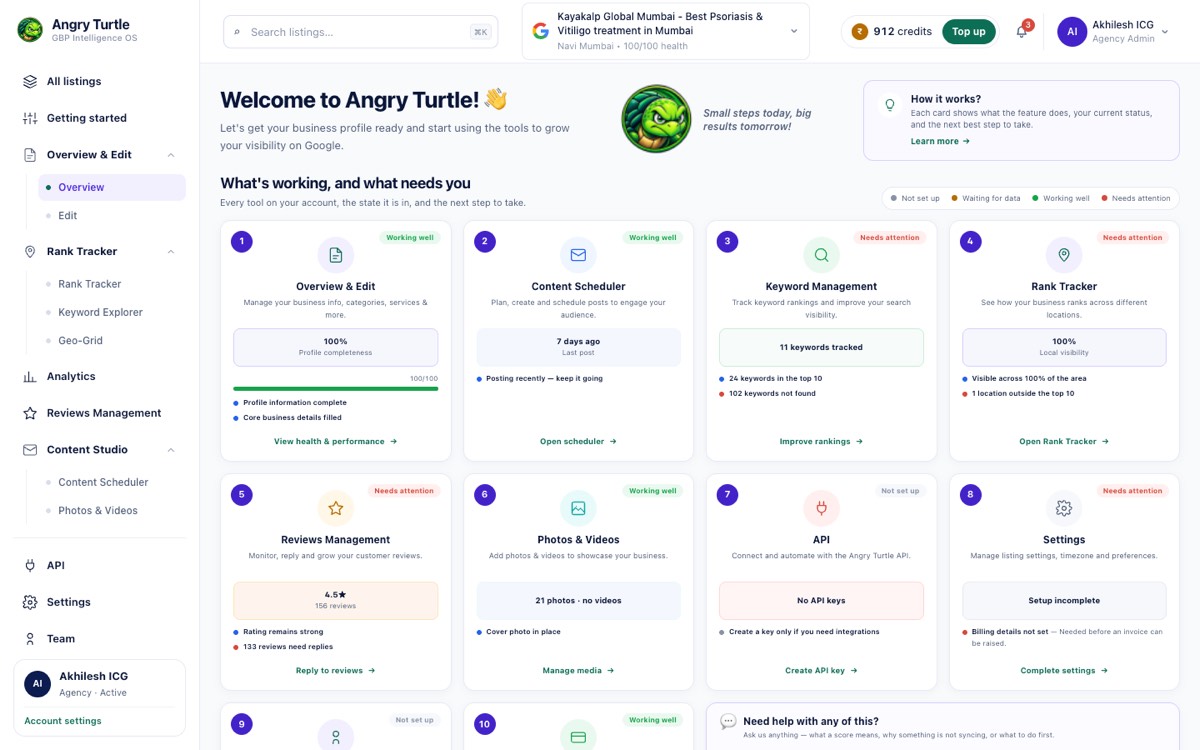
Rank OS gives every profile a 0–100 score built from five weighted dimensions — Relevance, Review Health, Freshness, Entity Authority and AIO Readiness — and the weights are tunable. Underneath it sits a ranked list of the fixes that move the number, each with the point lift it unlocks.
Ready to have this run for you?
Book a free audit — we'll show you where you stand in 48 hours.