 Angryturtle
How to Get More Google Reviews
A step-by-step, policy-safe method for building steady Google review volume and velocity without gating or incentivising customers.
How to get more Google reviews without breaking Google's rules
If you want to get more Google reviews, the short version is this: ask every happy customer at the moment they're happiest, make it a one-tap process, and never touch the pool of who gets asked. That's it. There's no trick beyond consistency, and the businesses that skip the ethical part usually get caught, penalized, or quietly distrusted by the customers who do notice.
Review volume and review velocity aren't vanity numbers. Google's local pack ranking leans on them, and inside Angryturtle's Rank OS scoring model, Review Health is one of five weighted dimensions that make up a listing's overall score, worth as much as relevance itself. A business with 40 reviews trickling in over three years reads differently to both Google and a customer than one with 40 reviews from the last two months. Velocity signals that the business is active right now, not that it had a good quarter once.
Why review volume and velocity matter more than most owners think
Two businesses can have the same 4.6 rating and get treated very differently in the local pack. The one with 180 reviews and a handful landing every week outranks the one with 45 reviews and a review from last October. Google reads recency and frequency as freshness signals, the same category as how often you post updates or refresh photos.
Volume also does something else: it buries the occasional bad review under real weight. A single 2-star review out of 12 total tanks your average. The same review out of 200 barely moves it, and a prospective customer scrolling past sees a pattern rather than an outlier.
The ethical system, step by step
Ask every happy customer, not a filtered subset. The moment matters more than the wording. Right after a delivery lands, right after a service ticket closes, right when a patient checks out feeling better, that's when the ask lands. Wait a week and the moment is gone.
Make the ask frictionless. A direct Google review link, shortened, sent by WhatsApp or SMS the same day, works better than an email that sits unread. Pair it with a QR code at the counter, on the invoice, on the delivery slip, wherever a customer's eyes land right after the transaction. In India, WhatsApp follow-ups outperform email by a wide margin simply because that's where people actually read messages.
Train staff to ask out loud, not just rely on a printed sign. A cashier saying "if you liked it, a quick Google review helps us a lot" converts far better than a QR code nobody notices. Put the same link in email signatures and on printed receipts so the ask shows up in more than one place without becoming repetitive to any single customer.
Ask customers to mention the specific service they used, whether that's a knee replacement consult, an AC repair, or a two-bedroom listing viewing. Reviews that name real services do two things: they read as more credible to future customers scanning for relevance, and they reinforce the keyword clusters and demand signals Google already associates with your listing.
Aim for steady velocity over dramatic spikes. Twelve reviews a month, every month, builds a trend line Google can trust. Forty reviews in one week because you ran a contest, then nothing for two months, looks exactly like what it is.
What not to do, ever
Never gate reviews. Gating means filtering customers with a pre-screen question ("were you satisfied?") and only sending the happy ones to Google while diverting anyone unhappy to a private form. Google's guidelines prohibit this outright, and it's easy for Google (and increasingly for customers) to spot the pattern of a listing that only ever collects perfect reviews from a business with known complaints elsewhere.
Never buy reviews, and never incentivize them with discounts, freebies, or cash. Paid reviews violate Google's policies directly and Google actively removes them when detected, sometimes taking the whole profile's credibility down with them. Angryturtle won't build or recommend a workflow that does either of these, full stop. The system above works without them.
How Angryturtle helps with review collection
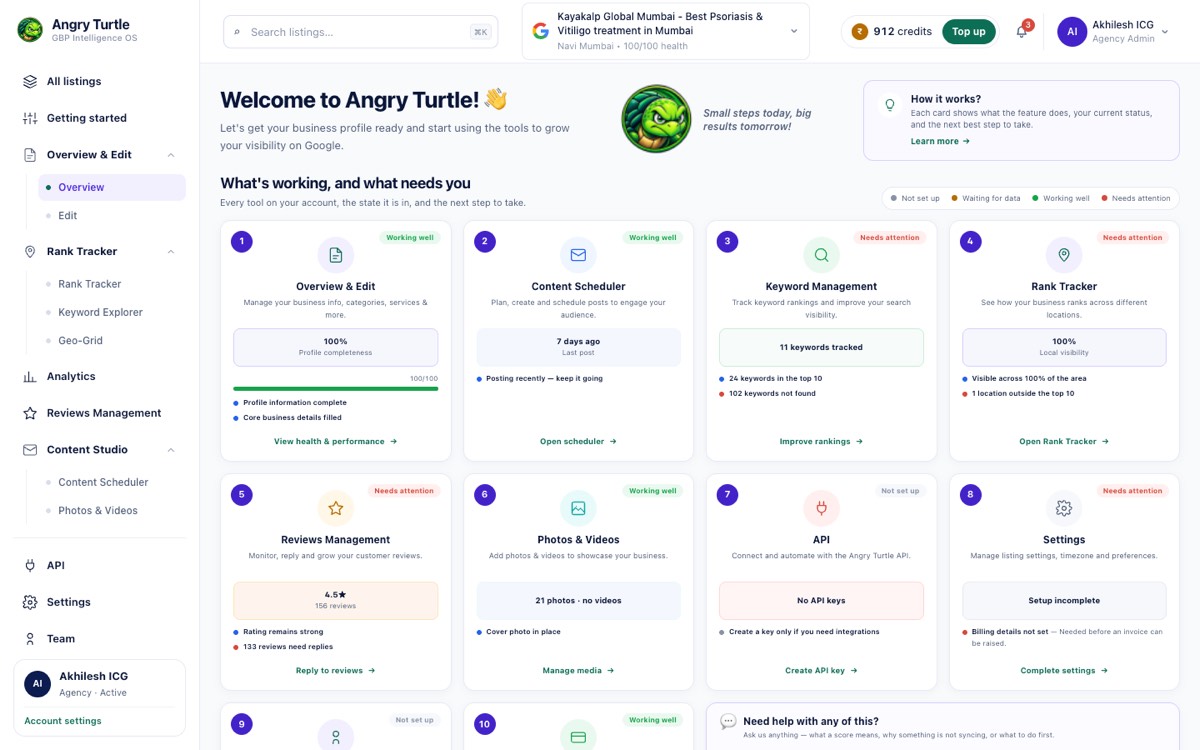
The self-serve platform gives every listing a QR code and shareable link built specifically for review collection, so the frictionless step above doesn't require any custom setup. Review velocity shows up directly inside Rank OS, tracked over time next to the other four scoring dimensions, so an owner or agency can see whether last month's push actually moved the number or just felt busy.
Every incoming review also gets an AI-drafted reply, written in the business's own voice with a personalized greeting, ready to publish in one click rather than sitting unanswered for a week. That closes the loop on the reviews product side. For businesses managing this alongside everything else on their profile, Rank OS ties review health back into the full scoring picture, and teams that would rather not run the collection cadence themselves can hand it to Angryturtle's managed GBP services, where a human team runs the WhatsApp/SMS cadence and drafts replies on the client's behalf. Both the self-serve tool and the managed service run on the same ethical system described above, no gating, no incentives, nothing that risks a policy strike.
FAQ
How many Google reviews should a small business aim for per month? There's no fixed Google-mandated number, but consistency matters more than any single target. A dozen genuine reviews a month, sustained, beats a burst of fifty followed by silence.
Can I ask customers directly for a 5-star review? You can ask for a review. Asking specifically for a 5-star rating, or wording the request to only reach happy customers, crosses into gating territory and violates Google's guidelines. Ask for honest feedback and let the rating fall where it falls.
Does replying to reviews affect ranking? Google has said engagement signals like owner responses contribute to how a profile is perceived, and a reviewer who sees a thoughtful reply is more likely to trust the business regardless of ranking. Angryturtle's AI-drafted replies make it realistic to respond to every review instead of only the ones that feel urgent.
What happens if Google detects incentivized or gated reviews? Google can remove the flagged reviews, and in repeated or severe cases, suspend the listing entirely. Recovering a suspended profile takes far longer than building reviews the slow way would have taken in the first place.
Is WhatsApp really better than email for review requests in India? Open rates on WhatsApp run far higher than email for most Indian consumers, and the message lands in the same app customers already use daily. That's why the ethical system above leads with WhatsApp and SMS rather than email as the primary channel.
More how-to playbooks
A score you can argue with, not a black box
Rank OS gives every profile a 0–100 score built from five weighted dimensions — Relevance, Review Health, Freshness, Entity Authority and AIO Readiness — and the weights are tunable. Underneath it sits a ranked list of the fixes that move the number, each with the point lift it unlocks.
Ready to have this run for you?
Book a free audit — we'll show you where you stand in 48 hours.