 Angryturtle
How to Manage Multiple Google Business Profiles Without Losing Consistency
A practical system for keeping dozens of Google Business Profiles consistent, ranked and reviewed without a spreadsheet falling apart at listing 15.
Quick answer
To manage multiple Google Business Profiles without losing consistency, you need three things running together: bulk editing across every listing, a per-location score that tells you which profile needs attention first, and reviews handled at scale rather than one inbox at a time. Most Indian brands and agencies try to do this in a spreadsheet plus the native GBP app, and it breaks somewhere between profile 8 and profile 15. This playbook walks through the system that holds up past that point, and where a platform like Angryturtle fits into it.
Why managing multiple GBPs is harder than it looks
One listing is easy. Ten listings across three cities is a different job.
The first problem is consistency. Name, category, hours, and description have to match across every location, but franchise owners and regional managers keep making small unilateral edits. A clinic in Andheri lists itself under "Physician" while the same chain's Powai branch is under "Medical clinic." Neither is wrong exactly, but Google reads it as inconsistent signal, and your rank tracking across locations stops meaning anything.
Per-location relevance is the second problem, and it's the one spreadsheets handle worst. A hotel chain's Gurgaon property should target "business hotel near cyber city," while its Goa property should target something else entirely. Bulk tools that push identical descriptions and posts to every listing solve the consistency problem and immediately create a relevance problem.
Review volume scales badly too. Ten locations, each getting five to ten reviews a month, is fifty to a hundred reviews needing a reply within a reasonable window. Miss that window on enough profiles and your response rate — a factor Google and customers both notice — quietly drops across the whole portfolio, not just the neglected one.
Then there's cannibalization. Two branches six kilometers apart, both optimized for the same keyword, can end up competing with each other in the map pack instead of the actual competitor down the street. Nobody sets out to build this. It happens because each location was optimized in isolation, by whoever happened to be the local manager that year.
A step-by-step system for managing profiles at scale
1. Connect every profile in one place
Before anything else, get all locations linked under one account view rather than logging into each listing separately. This is the difference between managing 20 profiles and managing 20 tabs. Google's own Business Profile Manager supports this natively for chains you own outright; agencies managing client locations need a platform that accepts bulk location invites and keeps them under one login, with permissions split by who should see what.
2. Standardize the fields that should never vary
Name, category, phone format, and website URL should be identical in structure across locations (the address obviously changes, the rest shouldn't drift). Pull every profile into one view, spot the outliers, and push the correction in bulk rather than location by location. Hours need the same treatment, especially around holidays — a chain that forgets to update Diwali hours on twelve of twenty listings looks unreliable exactly when search volume is highest.
Categories deserve their own pass. Google's category list changes, and the "closest match" a manager picked three years ago may no longer be the best option. Check this yearly at minimum, per location, because category is one of the heavier-weighted relevance signals in local ranking.
3. Score each location separately, not the portfolio as a whole
A single portfolio-wide health number hides the two locations actually losing you visitors. What works better is scoring every profile on its own, across relevance, review health, freshness, entity signals, and AI-answer readiness, then ranking locations by which one needs the next fix. Rank OS does this per listing rather than as one blended average, which is the only way a 40-location portfolio tells you where to actually spend Tuesday morning.
4. Handle reviews as a volume problem, not an inbox problem
At scale, review reply can't be a manual task assigned to whoever's free. It needs a workflow: draft a reply automatically using the review's actual content and the location's tone, route anything with a complaint or a legal flag to a human before it publishes, and push the rest live without someone retyping the same "thank you for visiting" forty times a week. AI-drafted replies work here specifically because the alternative isn't "a human writes a better reply," it's "nobody replies for six days."
5. Build and maintain citations across the directories that matter locally
Google isn't the only place that has to agree on your name, address, and phone number. In India that means JustDial, Sulekha, IndiaMART, and for healthcare specifically, Practo — plus the sector-relevant directories for whichever industry you're in. Citation consistency across these sites is a ranking signal in its own right, and at ten-plus locations, checking each directory manually for each listing isn't something a team does by hand for long. This is where a citation engine that runs the check across the whole portfolio and flags mismatches earns its keep, rather than a person opening JustDial forty separate times.
6. Report per location, then roll it up
A client or a regional VP wants two different views of the same data: how did this specific branch do this month, and how did the whole portfolio move. Build the reporting so per-location detail rolls up into a portfolio summary automatically, instead of maintaining two separate spreadsheets that drift apart by month three.
If your team also runs city-specific local SEO work alongside GBP management, our multi-location local SEO services page covers how that layers on top of the profile-management system above.
How Angryturtle handles this
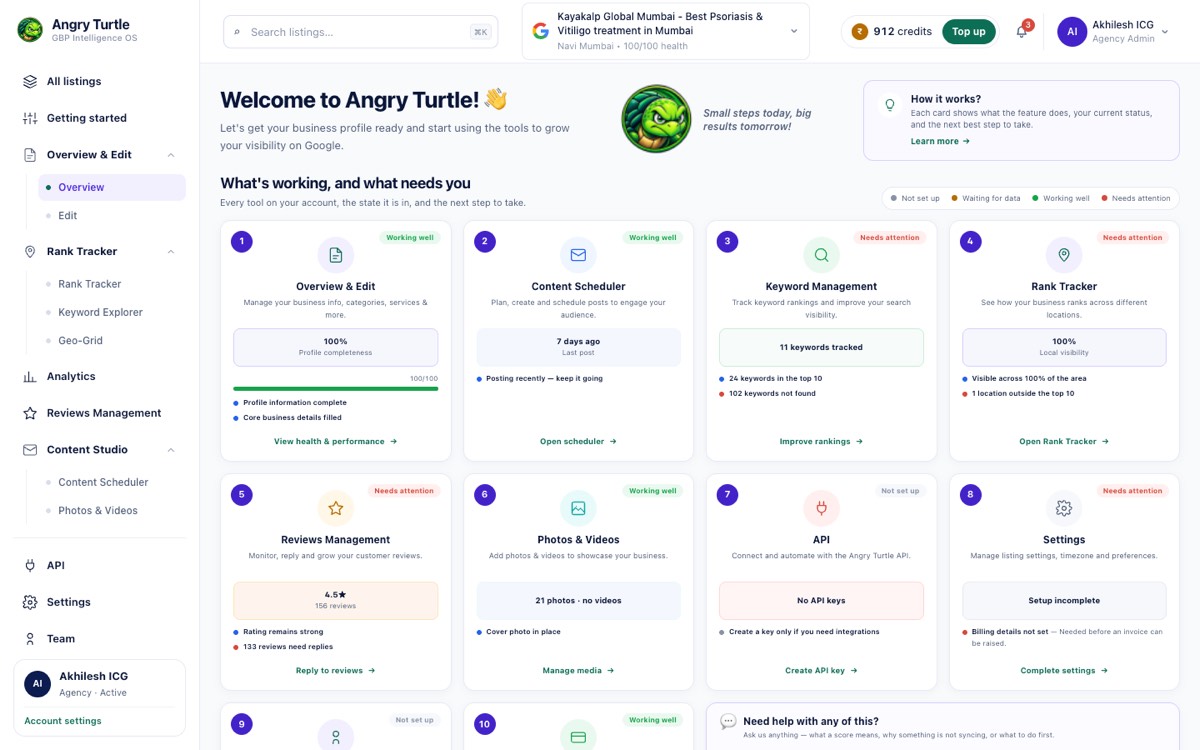
Angryturtle is built as a platform that acts on a Google profile, not one that only reports on it — edits made in the tool push straight back to Google rather than sitting in a dashboard waiting for someone to copy them over manually. That matters more at ten profiles than at one, because the gap between "here's what's wrong" and "it's fixed" is where multi-location management actually falls apart.
The platform works two ways, and neither is the only option. A solo owner running one or two locations can use the self-serve product directly. An agency running dozens of client listings gets the same engine with white-label reporting, role-based access, and bulk operations across the whole book of clients, on the Agency OS. Enterprise chains with unlimited locations get volume pricing and SSO on top of the same core. None of this requires handing the whole thing over to a managed team, though that option exists too for teams who'd rather not run it themselves.
Bulk edits to name, hours, categories, and posts happen from one place and sync to Google, using the same write-back editing that powers single-listing edits, just applied across a portfolio. Every profile gets its own Rank OS score instead of one averaged number, so the team knows which location to fix first. Reviews get AI-drafted replies at the volume a multi-location business actually generates. And citation checks run across the Indian directories that matter, not just a generic international list.
For a deeper look at how location data itself needs to be structured before any of this works cleanly, see our glossary entry on location data management.
FAQ
How many Google Business Profiles can one person realistically manage manually? Most teams start feeling the strain somewhere around 8 to 10 listings, once reviews and hours updates start competing for the same person's attention. Past that, a bulk-management system stops being optional.
Does bulk-editing hours or categories risk a Google suspension? Not if the edits are legitimate and made through the standard Business Profile APIs. Suspension risk comes from things like keyword-stuffed names, fake addresses, or a sudden pattern of edits across many listings that look automated or deceptive, not from routine, accurate bulk updates.
Can I get exact ranking positions guaranteed across all locations? No tool can guarantee a specific rank, and any that promises one isn't being straight with you. What a good system gives you instead is visibility into which levers move a location's score and consistent execution on those levers over time.
Is Google's product listing feature usable for a multi-location catalogue? Not really as a true catalogue. Google exposes products through the Posts API rather than a dedicated catalogue API, so what shows up on the profile is closer to a running feed of items than a searchable product list. Plan content accordingly rather than treating it like an e-commerce catalogue.
Does managing profiles in bulk mean losing local relevance? Only if the bulk tool pushes identical content everywhere. Done properly, bulk management standardizes what should be identical (NAP, hours format, category structure) while leaving room for per-location posts, descriptions, and keyword targeting to stay specific to that neighborhood.
More how-to playbooks
A score you can argue with, not a black box
Rank OS gives every profile a 0–100 score built from five weighted dimensions — Relevance, Review Health, Freshness, Entity Authority and AIO Readiness — and the weights are tunable. Underneath it sits a ranked list of the fixes that move the number, each with the point lift it unlocks.
Ready to have this run for you?
Book a free audit — we'll show you where you stand in 48 hours.