 Angryturtle
Answer Engine Optimization for Franchise Businesses in India
AEO for franchise businesses in India requires two-tier management: brand-level entity authority (consistent naming, national press, schema brand hierarchy) and location-level AI citations (per-franchisee GBP management, independent review building, location-specific schema). The primary challenge is maintaining brand consistency across many independently operated locations while building location-specific AI signals that earn "near me" recommendations.
The Franchise AI Search Challenge
Indian franchise networks face a structural AI search challenge that independent businesses don't: the brand must be recognisable as a single entity while each location must be independently competitive for local AI citations.
When a user asks AI "best quick service restaurant near me in Andheri West," the AI system isn't looking for the brand — it's looking for the best specific location near the searcher. The franchise in Andheri West needs its own AI citation strength: its own review count competitive with the other options nearby, its own active GBP, its own location-specific schema.
But if the brand is inconsistently named, categorised, or described across 50 franchise locations, AI systems may not recognise them as connected — fragmenting the brand entity that drives brand-level AI citations for queries like "tell me about [franchise brand]."
The dual mandate of franchise AEO:
- Brand-level entity clarity — AI systems recognise the brand as a single, coherent entity
- Location-level AI citation strength — each location earns "near me" citations independently
Brand-Level Franchise AEO
Canonical brand entity establishment:
Name format: "[Brand Name] — [Location]" for all franchise locations. This format keeps the brand name consistent while disambiguating locations.
Schema hierarchy: Organisation schema on the main brand website, with each franchisee location's schema having parentOrganization linking to the brand.
National press and brand-level citations: Press coverage, franchise awards (Economic Times Franchise Plus, Franchising India awards), and industry association listings (FICCI, CII) at the brand level build brand entity authority that benefits all franchisee locations.
Brand website location pages: Individual pages for each franchisee location on the main brand website — each with location-specific content and LocalBusiness schema.
Brand entity consistency rules (non-negotiable):
- Every location uses the same primary GBP category
- Business name format is identical across all locations
- Brand description is standardised (only location-specific fields vary)
- Website/GBP consistency is monitored centrally on a weekly basis
Location-Level Franchise AEO
Location-level AI citations are earned independently at each franchise. The brand cannot substitute for location-level signals.
Per-location requirements:
- Individual GBP verified and complete per location
- Reviews competitive with the other businesses AI systems actually cite in that territory (independently built)
- Monthly review velocity at each location (8–15+ new reviews/month)
- Location-specific content on the brand website's location page
The review building franchise challenge:
Franchise brands often make the mistake of directing all review generation to the flagship location or the brand's central profile. This builds one very well-reviewed location while satellite locations remain far behind their local competitors — invisible for "near me" queries from their territory.
Solution: Per-location review targets in the monthly franchise performance dashboard, set relative to each territory's actual local competitors, not a single national number. Franchisees below velocity target receive direct support.
The DCG Framework for Franchise AEO
Diagnosis:
Franchise AEO audit covers:
- Brand entity consistency across all locations (name, category, description)
- Per-location review count relative to the businesses AI systems cite in that specific territory
- Per-location GBP completeness
- Per-location NAP consistency across directories
- Share of AI Voice per territory
Cost Optimization:
Priority 1: Audit and correct brand entity consistency — free, highest leverage. Priority 2: Identify lowest-performing territories by review count relative to their local competitors. Focus review building support there. Priority 3: Standardise per-location schema with the parentOrganization template.
Growth:
Territory SAV tracking. Franchise performance reviews including AI visibility metrics. Brand-level press and award campaigns that build entity authority across all locations simultaneously.
Indian Franchise Sectors and AI Search
QSR (Quick Service Restaurants): Zomato is the primary AI citation source. Each franchisee location must have a separately claimed Zomato listing with accurate hours, menu, and photos. Zomato ratings at each location matter independently.
Salon and beauty franchises: JustDial is primary AI source for salon queries. Each salon location needs a JustDial listing. Urban Company also ranks for salon and beauty queries in metros.
Educational franchise (coaching): JustDial education section is primary. Each franchisee branch needs independent JustDial and Google reviews.
Healthcare franchise (dental chains, eye care chains, diagnostic chains): Practo and Google are co-primary. Each branch needs independent Practo listings (per doctor at each location) and independent Google review building.
Fitness franchise (gyms, yoga studios): JustDial, Sulekha for fitness queries. Google reviews primary. Each location independently.
Franchise AI Search Governance Framework
Central (Brand manages):
- GBP account ownership (all franchisee GBPs under brand account)
- Brand website location pages
- Canonical NAP master document
- Schema templates
- Brand-level content and press
- Monthly per-location SAV and review report
Regional (Area managers manage):
- State-specific language GBP content inserts
- State-specific directory management
- Regional press and community initiatives
Local (Franchisee manages):
- Daily review responses
- Monthly review generation (using brand-provided templates and QR codes)
- Local GBP post submission (from brand-approved content calendar)
FAQ Section
Q: What happens to a franchisee's GBP if they exit the franchise network? A: If the brand owns the GBP account (recommended), the profile can be transferred to a new franchisee or managed directly. If the franchisee owns the GBP, exit agreements should specify that the GBP remains with the brand or is transferred. This is a franchise agreement matter that should be addressed before any dispute arises.
Q: How many reviews does a franchise location need before AI citations kick in? A: Same as independent businesses in that category — there's no fixed threshold, and the working bar is set by local competition, not by franchise brand status. A brand with 5,000 reviews nationwide doesn't help a franchisee location with a thin local review base win "near me" AI citations against better-reviewed neighbours.
Q: Is franchise AEO worth the investment when individual franchise revenue is limited? A: For most franchise networks, per-location AEO is the highest-ROI marketing spend because: (1) AI citations drive footfall with no per-click cost, (2) well-reviewed locations consistently outperform poorly-reviewed ones in the same network, (3) the compounding benefit of review accumulation grows indefinitely.
Get franchise network AEO from Angryturtle →
Internal links: Franchise Local SEO · Enterprise Local SEO · Multi-Location Local SEO Guide
Franchise & AI Search — Questions Answered
Q1. Why do franchise businesses need per-location AI search management?
Answer capsule: Franchise businesses need per-location AI search management because AI citations for "near me" queries are earned at the location level, not the brand level. A franchise brand with 5,000 total reviews nationwide doesn't help a specific franchisee with a thin local review base earn "near me" AI citations in their territory if nearby competitors are better reviewed. Review count, GBP completeness, and AI citations are all earned and assessed independently per location.
Expanded answer: The structural reason: when a user asks AI "best pizza restaurant near Andheri West," the AI system identifies businesses near Andheri West — it doesn't assess national brand review counts. It assesses the specific Andheri West franchise's review count, GBP, and local signals against the other options in that specific area.
This has a direct operational implication: franchise brands that centralise all review building at flagship locations while satellite franchisees fall behind their local competitors are systematically creating AI search blind spots in franchise territories.
The franchise AEO accountability model: Each franchisee has a monthly review target (minimum 8–12 new reviews/month for most categories), set relative to the actual competitive field in their territory. Review count and velocity are tracked in the franchise performance dashboard alongside revenue, NPS, and operational metrics. Franchisees below target receive support escalation.
Q2. How does brand entity consistency affect franchise AI citations?
Answer capsule: Brand entity consistency — identical naming format, category, and description across all franchise locations — enables AI systems to recognise all locations as belonging to the same brand entity. Inconsistent naming ("Brand A" on some GBPs and "Brand-A" or "Brand A Outlet" on others) fragments the brand entity in AI systems' understanding, reducing brand-level AI citations for "tell me about [Brand]" queries.
Expanded answer: AI systems build brand entity understanding from the collective signals across all locations. If 30 of 50 franchise locations use "[Brand Name] — [Location]" and 20 use inconsistent naming formats, AI systems may not recognise all 50 as part of the same brand entity.
This matters most for brand-level queries: "How many locations does [Brand] have in India?", "Which city has the most [Brand] outlets?", "What is [Brand]'s specialty?" — these brand-entity queries require AI to have a coherent, consolidated brand entity understanding.
Practical enforcement: The franchise agreement should specify the exact GBP naming format. Any GBP name that deviates from the format should be corrected within 5 business days of identification. Central brand monitoring (weekly GBP audit across all locations) catches deviations.
Q3–Q10 (Franchise Q&As 3–10 — condensed):
Q3. Is there a minimum review count for franchise location AI citations in India? No published minimum exists for any franchise category. The real bar is set by whichever locations — franchise or independent — are currently winning AI citations in a given territory, and that bar varies sharply by category and city: QSR in a dense metro sits far more competitive than a coaching franchise in a quieter market, for instance. The reliable approach is checking the review counts of whoever's actually cited for your target query and city, then setting the per-location target from there. Brand-wide totals don't substitute for that local check.
Q4. Should franchise businesses have location-specific social media pages? For large franchise networks (20+ locations): typically no — maintaining consistent, quality social media across 20+ individual location pages is operationally complex. Brand-level social media with location-tagged posts is more manageable. For smaller networks (5–10 locations): location-level social media pages can meaningfully contribute to local entity signals.
Q5. How does franchise AEO affect franchisee ROI? Franchise locations with AI citation presence (competitive review standing, active GBP) consistently outperform locations without on walk-in traffic and new customer acquisition. In categories where customers use AI to choose ("best salon near me," "best coaching near me"), AI-invisible locations lose customers to AI-visible competitors — including non-franchise competitors in the same territory.
Q6. What happens if a franchisee creates their own GBP outside the brand system? Franchisee-created GBPs outside the brand system create brand entity fragmentation (two GBPs for the same location), NAP inconsistency (if franchisee uses their own name variant), and entity ambiguity (AI may treat brand GBP and franchisee GBP as different businesses). Franchise agreements should prohibit unauthorised GBP creation and mandate using brand-managed GBPs.
Q7. How should franchise brands handle AI citations that mention one location but not others? This is normal — AI citations are location-specific. The better-reviewed, better-optimised location is cited. The response: identify what the cited location is doing better (review count, GBP completeness, proximity to searcher) and replicate those conditions at under-cited locations. Don't try to suppress the cited location — improve the others.
Q8. What is the ideal GBP structure for an Indian QSR franchise? Category: "Fast Food Restaurant" or specific cuisine ("Pizza Restaurant," "Burger Restaurant"). Description: "[Brand Name] in [area], [city]. Serving [cuisine type] with dine-in, takeaway, and [platform]-delivery. Open [days/hours]." Products: Top 5 menu items with photos and prices. Attributes: UPI accepted, parking, seating capacity, online delivery. Reviews: benchmark against the top-3 QSR locations actually cited for your metro and category, not a fixed number.
Q9. How does franchise AEO differ between food and non-food franchises? Food franchises: Zomato and Swiggy listings are co-primary AI sources alongside GBP. Recipe and dish-level content earns additional AI citations. Non-food franchises (services, education, retail): JustDial and industry-specific directories dominate. Review generation strategy differs — food is higher frequency per customer, enabling faster velocity; service franchises may have lower purchase frequency requiring longer build timelines.
Q10. Should franchise management software include AI search tracking? Yes — the most effective franchise management systems track AI search metrics alongside operational KPIs. Monthly SAV per territory, review count per location, and AI-referred session data per location should be dashboard metrics. This accountability infrastructure is what separates franchise networks that systematically win AI search from those that leave it to chance.
A score you can argue with, not a black box
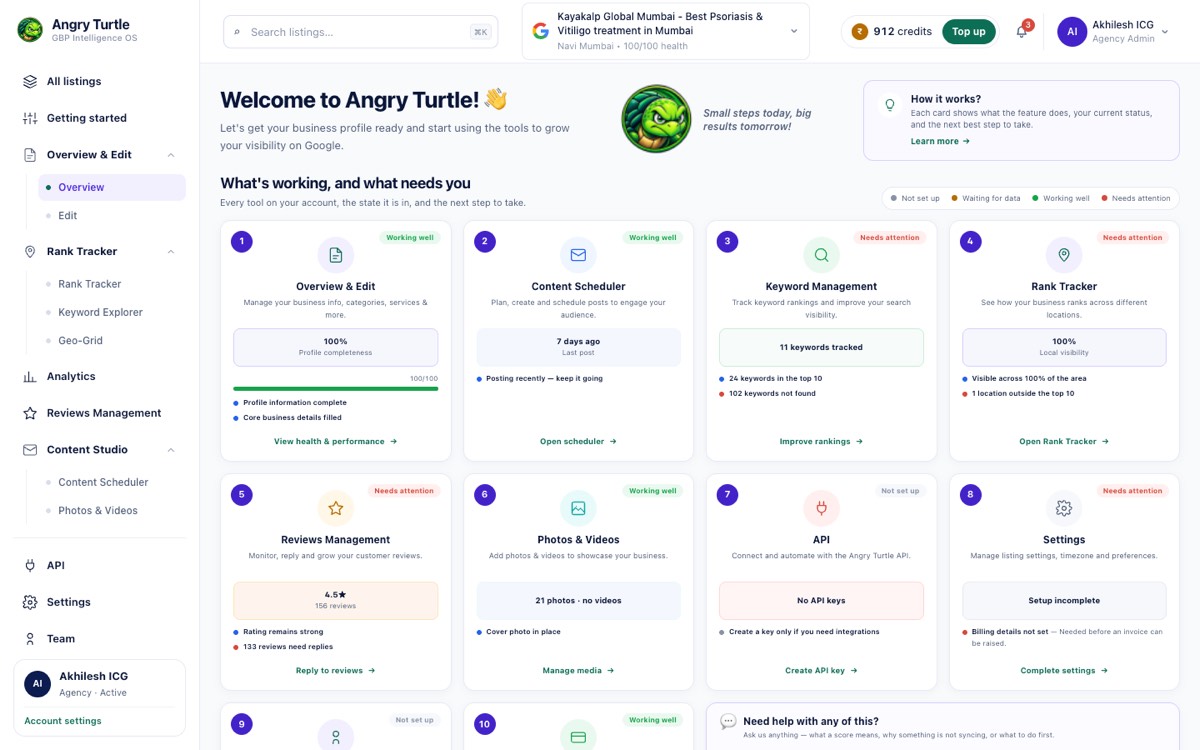
Rank OS gives every profile a 0–100 score built from five weighted dimensions — Relevance, Review Health, Freshness, Entity Authority and AIO Readiness — and the weights are tunable. Underneath it sits a ranked list of the fixes that move the number, each with the point lift it unlocks.
Ready to have this run for you?
Book a free audit — we'll show you where you stand in 48 hours.