 Angryturtle
GBP AI Optimization
How to optimize your Google Business Profile for AI search citations. GBP fields, categories, services, reviews, and schema that make your profile AI-citable. Managed by Angryturtle.
·
Your Google Business Profile is not a directory listing anymore. It's the primary structured dataset Google's AI systems reach for when they need to identify, describe, and cite a local business — read before your website, before your reviews, before anything else, because it's verified and structured in a way nothing else about your presence is. Get the GBP wrong and everything built on top of it — schema, content, citations — is reinforcing a weak foundation. This is what "AI GBP" optimization actually means in practice: not a different platform, the same profile, read by a different kind of system with different priorities.
GBP as the anchor entity
The hierarchy runs GBP first, website schema second, directory citations third, reviews fourth. All four layers matter, but GBP is where an AI system starts, because it's the one source Google's own systems have direct, verified access to without needing to crawl anything. A business with an incomplete GBP is handing Google's AI low-confidence entity data, and no amount of website polish downstream compensates for that starting point.
Which fields actually carry weight
Primary category matters most. It's how AI systems classify what kind of entity you are, and the classification is strict, not approximate — "Dermatologist" maps precisely to "dermatologist near me" queries, while "Doctor" is too broad to match a specialty query with confidence no matter how complete everything else is. Checking quarterly for a newly available, more specific GBP category is worth the ten minutes it takes.
Services function as extractable, matchable keywords. A clinic listing "Laser Hair Removal" as its own service line is in the eligible set for that exact query; one that buries it inside "skin treatments" isn't, even if it performs the same procedure. The description earns its weight from how it opens, not its length — a direct-answer capsule in the first sentence ("Sharma Skin Clinic is a dermatology clinic in Koramangala, Bengaluru, specialising in acne, laser hair removal, and cosmetic procedures") is extractable in a way "Welcome to our world-class skincare journey" simply isn't, regardless of what follows it.
Attributes work as filters at the query level: "Wheelchair accessible: yes" makes a profile eligible for that specific filtered search; leaving it blank doesn't just fail to help, it excludes the profile from that query entirely. GBP Q&A content is indexed and read where it's active, though Google is deprecating it as a standalone feature, so it's worth treating as a legacy signal rather than a primary investment going forward. And reviews, while not technically a GBP field, are tied to the entity and function as the clearest legitimacy signal Google's systems have — count and recency both matter, though there's no published threshold from Google for either, and no independent study establishes one. Treat review signal as a gradient, not a gate.
Classic GBP optimization vs optimizing GBP for AI
The two disciplines share a starting point and then diverge in what they weight. Classic GBP optimization for the local pack cares most about proximity, category relevance, and review volume feeding a ranking algorithm that returns a ranked list of three businesses on a map. AI GBP optimization cares about whether a single answer can be extracted and stated with confidence — a chatbot or an AI Overview doesn't return a ranked list of three, it commits to naming one or two businesses as the answer, and that requires a higher bar of extractable clarity than simply ranking well.
Concretely: a profile can rank in the local pack for "dentist Koramangala" with a decent category, solid reviews, and proximity working in its favour, even if its description is generic and its services are lightly filled in. That same profile might rank fine on the map while never being the one an AI system names when someone asks "which dentist in Koramangala does same-day crowns" — because nothing in the profile states that specific service in extractable language. Local pack ranking rewards being good enough across several factors; AI citation rewards being unambiguous on the exact factor the question is asking about. A profile optimized only for the classic ranking factors can rank well and still be invisible to an AI system asking a specific question, which is the gap this whole discipline exists to close.
Checking this against your actual profile, not a generic checklist
Rather than inferring how citable your GBP is from a general rule of thumb, Ask Maps runs a per-listing question bank against your specific profile — testing whether it's a strong, citable answer for the actual questions Google Maps' AI, AI Overviews, and ChatGPT are likely to ask about a business in your category and city. The output names specific gaps rather than producing a single opaque number: this listing answers "do you treat acne scars" well and has nothing usable for "do you offer teleconsultation." That result rolls into the AIO Readiness dimension of Rank OS, the five-dimension model — relevance, review health, freshness, entity authority, and AIO Readiness — weighted at 15 points by default and adjustable.
A worked example: a boutique hotel in Udaipur
Take a 12-room boutique hotel in Udaipur, ranking reasonably in the local pack for "hotels near Lake Pichola" thanks to decent reviews and proximity, but with a GBP description that reads "Experience luxury and tranquility at our heritage property" and a services list that says only "Accommodation." When someone asks an AI system "which hotel near Lake Pichola has a rooftop restaurant," that hotel doesn't get named, even though it has one — because nothing in the profile states it in language an AI system can extract with confidence.
The fix isn't a redesign, it's specificity: rewriting the description to open with what the property actually is and where ("a 12-room heritage hotel on Lake Pichola in Udaipur, with a rooftop restaurant and lake-view rooms"), and adding "Rooftop Restaurant" and "Lake View Rooms" as their own service or amenity entries rather than leaving them implied inside general copy. None of that changes local pack ranking much, since proximity and reviews were already doing that work. It's specifically the AI-citation gap that closes, and it closes because the missing information was never a ranking problem, it was an extraction problem.
What goes wrong when this gets skipped at multi-location scale
The single-location version of this mistake costs one hotel one query. The multi-location version compounds it. A chain that copies one location's polished description across ten branches, changing only the address line, ends up with ten profiles that read identically to an AI system trying to distinguish them — and when a system can't tell what's different about a specific branch, it either picks one arbitrarily, favouring whichever has stronger reviews or fresher posts, or avoids naming any of them with confidence. A franchise or chain that wants each branch to be citable for its own specific strengths — one location's extended hours, another's specific service a competitor down the street doesn't offer — has to write that difference into each profile individually rather than treating the brand-level description as good enough for every location wearing it.
From a named gap to a live edit
A gap identified but not fixed doesn't move anything, which is why the GBP editor matters as much as the diagnosis. It shows a visual preview of exactly how a change will render on Google, layered over a full editor covering name, description, phone, website, address, hours (including holiday hours), categories through a live Google category picker, and service areas — and the change pushes straight to Google. Photos, posts, products, and review replies publish live the same way. Most tools in this space are read-only or write back to some fields and not others; full write-back across all of these fields is the single differentiator Angryturtle has built the platform around, because a recommendation someone has to go implement manually is a recommendation that often just doesn't happen. It typically takes a few hours for an edit to reflect on Google's side — that's Google's own processing time, not a delay Angryturtle can shorten.
Schema as the mirror, not a separate signal
The strongest AI citation setup has website schema that mirrors GBP data exactly rather than introducing a second, slightly different version of the same facts: business name identical in LocalBusiness schema, address formatted the same way down to punctuation, phone number matching, and sameAs links pointing back to the GBP profile URL and every relevant directory tracked through citation and NAP tooling. When GBP and schema agree, an AI system gets two consistent, mutually reinforcing sources instead of one. When they disagree — a different name format, a phone number that's a digit off — that inconsistency actively reduces NAP consistency and citation confidence rather than sitting neutral. Related detail on this is in schema markup for AI search and GBP optimization for AI search.
Multi-location GBPs: one entity per location, not a copy-paste job
For a business with several locations, AI citation happens per location, not at the brand level — the same multi-location SEO principle that governs organic local search applies just as directly to AI citation. "Best dermatologist in Indiranagar" and "best dermatologist in Koramangala" are different queries pointing at different GBP entities, and each one needs its own specific category, its own service list, and its own seeded Q&A — copying one location's profile onto another loses the specificity that made the original citable. Review velocity is location-specific too; a strong Koramangala branch doesn't lend any of its review strength to a struggling Indiranagar branch, because the AI system is evaluating each entity independently. Schema sameAs links follow the same rule — each location page should point to its own GBP, not a shared brand-level one. This is the exact problem a franchise network runs into at scale, and it's covered further in the learning centre's guide to managing multiple locations.
Demand clusters: what to say, not just where to say it
Optimizing the fields above only helps if the description, services, and content answer questions people are actually asking. Angryturtle's demand clusters group a category's search behaviour into industry-aware clusters with a momentum reading — scaling, broadening, concentrating, decaying — built from your own GBP performance data, alongside a potential score from Google Ads Keyword Planner. A cluster that's scaling and under-covered in your current service list or Q&A is where the next GBP update should focus, ahead of a cluster that's already saturated.
Reviews as a two-part signal
AI-drafted review replies, personalised and published to Google in one click, keep response rates current — worth a quick human read before publishing, particularly for anything sensitive. Separately, Angryturtle runs a Brand Identity vs Brand Image comparison: what your GBP description and marketing claim you are, against what your reviews actually say customers experience. A mismatch here — claiming "fast service" while reviews keep mentioning long waits — is worth fixing in your own description before an AI system extracts and repeats the contradiction.
What to check before deciding self-serve or managed
Run an AI search readiness audit before deciding anything else — it shows the actual current Ask Maps and Rank OS state of a specific profile rather than a generic estimate. If the gaps are a handful of category, service, and description fixes, a self-serve plan and an afternoon of editing usually closes them. If the gaps span multiple locations, involve schema that needs coordinated changes across a website and every GBP, or the business genuinely doesn't have anyone with the time to keep re-checking Ask Maps results as demand clusters shift, that's the point where a managed service earns its cost rather than software alone.
What this doesn't do
This is GBP and local-entity optimization, not website SEO — it checks your website's NAP against your GBP but doesn't crawl or rank your site pages independently. It's not a backlink tool. GBP Q&A specifically is a legacy feature Google is deprecating, so treat any advice that leans heavily on it as dated. Some attributes and service-area edits are constrained by what Google's API actually exposes, and performance history is limited to roughly 18 months with a reporting lag — none of that is something a third-party tool can override, because it's a constraint of Google's own API, not of the tool sitting on top of it. And AI-drafted descriptions or replies should get a human check before publishing, especially for anything going live on a real profile.
It's also worth being honest that AI citation and local pack ranking aren't the same goal, and optimizing hard for one doesn't automatically deliver the other. A business chasing AI citation exclusively while ignoring proximity and review volume can end up with an extremely well-described profile that still doesn't show up in the map pack, because the classic ranking factors haven't gone away — they've just stopped being the whole picture.
FAQ
Does GBP directly affect AI Overview content? Yes. It's the primary structured source Google's AI systems use to identify and describe local businesses, and complete, accurate GBP data measurably improves citation eligibility.
Which single GBP field matters most for AI citation? Primary category. It determines which searches your entity is even eligible to appear in — an imprecise category excludes a profile from valuable queries regardless of how strong everything else is.
Do GBP posts actually help with AI citations? Indirectly, through the freshness signal. AI systems favour entities that read as recently active, and consistent posting is one of the clearest ways to demonstrate that.
Is there a specific review count needed for AI citation? No published threshold exists from Google, and no independent study has established one either. Review count and recency function as a gradient that improves citation likelihood, not a fixed gate.
Does completing GBP Q&A still matter, given it's deprecating? It still contributes indexed content where it remains active, but it's a diminishing-return investment. Put fresh effort into the description, services, and attributes instead, where the long-term signal is stronger.
Is AI GBP optimization the same thing as regular local SEO? No, though they overlap heavily. Local pack ranking and AI citation both start from the same profile but reward different things — ranking rewards being good enough across proximity, category, and reviews together; citation rewards being specific enough on the exact point a question is asking about.
Does a multi-location business need to write ten different descriptions from scratch? Not from scratch, but each one needs its own specific details — the services, hours, or amenities that actually differ at that branch — rather than a shared brand description with only the address swapped out.
How do I see this checked against my actual listing? Get GBP managed for AI search, or run an AI search readiness audit to see your current Ask Maps and Rank OS results before deciding on managed versus self-serve. See pricing for both tracks or book a demo to walk through a specific profile.
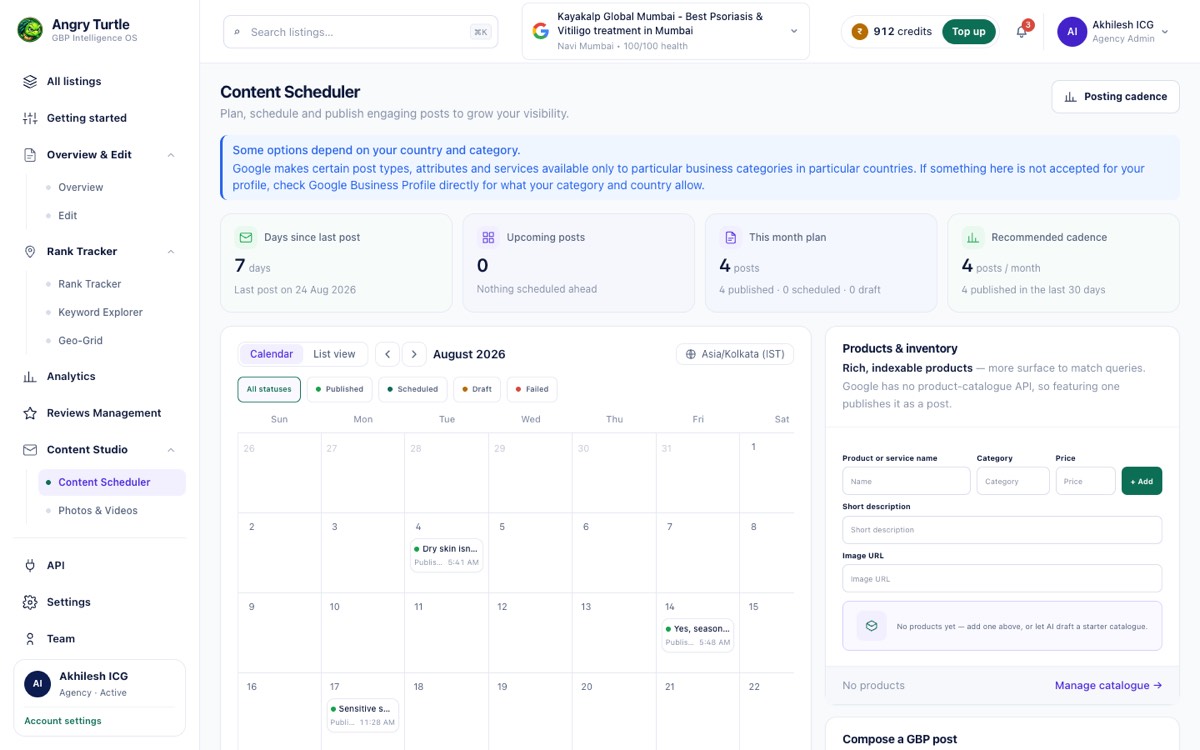
Write it, schedule it, and it publishes to Google
Posts, photos, products and review replies are composed here and publish live to the Google profile — timezone-correct to the listing. Most tools in this category are read-only or stop at a recommendation.
Ready to have this run for you?
Book a free audit — we'll show you where you stand in 48 hours.