 Angryturtle
AEO/GEO for Local (Getting AI-Cited)
How to position your local business for AI Overview citations and LLM recommendations. The practical AEO/GEO checklist for Indian businesses.
Lesson 3: AEO/GEO for Local — Getting Cited by AI
Learning objectives
By the end of this lesson you'll understand what AEO and GEO mean specifically for local businesses, the concrete signals that raise AI citation probability, how to structure content so AI systems can actually extract it, and how to work through a practical readiness checklist.
From the local pack to the AI answer
Traditional local SEO optimises for the local pack — the three business listings Google shows in Search and Maps. AI search introduces a visibility surface that sits in front of that: being named directly inside an AI-generated answer before the searcher ever scrolls to the local pack at all.
When Google's AI Overview answers "which IVF clinic in Mumbai has the best patient reviews," the clinics it names get seen before the searcher reaches the local pack, sometimes without the searcher scrolling that far at all. AEO — Answer Engine Optimisation — and GEO — Generative Engine Optimisation — are the disciplines built around earning that specific citation. AEO generally refers to optimising for Google's own AI Overviews and AI Mode; GEO refers to the broader work of getting cited by LLMs like ChatGPT, Perplexity, and Gemini directly. The mechanics overlap heavily, which is why this lesson treats them together, but the two blog pillars linked throughout this lesson split them apart in more depth — AI Overviews for local business in India covers the Google-specific surface, and AI citations across ChatGPT, Perplexity, and Gemini covers the LLM-specific one.
The readiness signals, and why each one matters
A complete Google Business Profile matters because AI systems extract structured GBP data directly rather than inferring it from unstructured prose — an incomplete profile, missing services or attributes, is simply less citable regardless of how good the business actually is. LocalBusiness schema on the website matters for the same reason from a different source: structured data makes entity information machine-readable, and AI crawlers extract it directly rather than parsing paragraphs to infer it.
FAQ pages built as genuine question-answer pairs are among the most AI-citable content formats that exist, because the structure itself mirrors how an AI system needs to extract and present an answer. Consistent entity information across every platform — GBP, website, Practo, JustDial, Zomato — matters because AI systems cross-reference multiple sources when forming confidence in an answer, and inconsistency between sources creates exactly the kind of ambiguity that lowers citation confidence. And external validation — press mentions, association directory listings (IMA, CREDAI, ICAI, or the equivalent for your category) — signals that the business is recognised beyond its own self-description, which AI systems treat as a meaningfully stronger signal than a business simply describing itself well.
Review signal plays a role here too, though it's worth being precise about how: there's no published review-count threshold from Google, OpenAI, or any other AI provider naming an exact number a business needs to cross. Review signal behaves as a gradient, not a gate — stronger review volume and velocity generally correlate with stronger citation likelihood, but there's no fixed line where citation suddenly becomes possible. Treat this the same way review generation treats velocity: as something to keep improving, not a target number to hit once and stop.
The mechanism: why AI systems cite what they cite
An AI system answering a local query is doing retrieval, not memorisation — it's pulling from a set of grounded sources at answer time rather than reciting something it learned once during training. That means the sources it can actually retrieve from need to be structured in a way that supports fast, confident extraction: direct factual statements rather than marketing language, specific numbers rather than vague claims, and machine-readable structure (schema, clean FAQ formatting) rather than prose the system has to interpret. A business with excellent services but a website written entirely in brand-voice marketing copy is handing the AI system very little it can confidently extract and cite — the substance might be there, but the form isn't built for retrieval.
A worked example: rewriting a page for extraction
A Chennai orthopaedic clinic's website opened its homepage with "Welcome to our clinic — your partner in a pain-free life." Rewritten for AI extraction, the opening became: "Chennai Ortho Clinic is an orthopaedic practice in Adyar, Chennai, established 2014, with three orthopaedic surgeons and a dedicated physiotherapy unit." Nothing about the clinic's actual capability changed — the rewrite just replaced a welcome message with a direct, specific, verifiable statement an AI system could confidently lift and cite. The same principle extended to the FAQ page: "What does knee replacement recovery involve at your clinic?" replaced a vaguer heading like "Our recovery philosophy," because the question-phrased heading matches how a real patient — and an AI system relaying that patient's query — actually frames the search.
Structuring content for extraction, concretely
Open every page and every major section with a direct, factual statement rather than a greeting, a question, or a teaser — "Sharma Skin Clinic is a dermatology clinic in Koramangala, Bengaluru, established 2016" extracts cleanly; "Welcome to Sharma Skin Clinic, your destination for world-class skincare" doesn't. Use specific, verifiable claims wherever they exist — "a team of three board-certified dermatologists" is extractable in a way "our experienced team" simply isn't, because the second phrase carries no fact an AI system can lift and state with confidence. And structure sections with question-phrased H2 or H3 headings where the content genuinely answers a question a patient or customer would ask — "What does a GBP suspension appeal require?" is directly extractable for that exact query in a way "our reinstatement process" is not, even when both headings introduce the same underlying content.
The AEO/GEO readiness checklist
Google reviews building steadily rather than stalled at a low count. GBP complete across services, attributes, description, photos, and Q&A. LocalBusiness schema live on every location page, not just the homepage. An FAQ page with at least ten genuine question-answer pairs. Direct, factual opening sentences on every service page rather than a welcome message. NAP identical across GBP, the website, and the top five relevant directories. At least one form of external validation — an association listing or a press mention.
What practitioners get wrong
The most common mistake is treating AEO/GEO as a separate initiative running alongside local SEO rather than an extension of the same underlying work — a business with strong GBP completeness, strong reviews, and consistent NAP has already done most of the heavy lifting; the incremental AEO-specific work is schema, FAQ structure, and rewriting a handful of opening sentences, not a wholesale second strategy. The second is chasing a specific review-count number as if it were a published gate, when the actual guidance is to keep improving velocity rather than stop once an arbitrary number is hit. The third is writing an FAQ page with the right questions but marketing-voice answers padded with brand language instead of direct, factual sentences — the question format alone doesn't make an answer extractable if the answer itself is vague.
FAQ
Is AEO the same thing as GEO, or are they different disciplines? They overlap heavily in practice but target slightly different surfaces — AEO generally refers to Google's own AI Overviews and AI Mode, GEO to LLM platforms like ChatGPT, Perplexity, and Gemini. The readiness work described in this lesson (schema, FAQ structure, direct factual content, consistent entity data) benefits both surfaces simultaneously, which is why most practitioners treat them as one combined effort day to day.
How do I check whether my business is actually appearing in AI answers today? Ask the relevant AI tools directly with realistic local queries a customer might use, and track the results over time — see measuring AI search visibility for a structured approach to this rather than one-off manual checks.
Does GBP optimisation for AI citation look different from GBP optimisation for local pack ranking? Not fundamentally — completeness, accurate categories, and strong review signal help both. See GBP optimisation for AI search for where the AI-specific emphasis differs slightly, mainly around structured attribute completeness and Q&A content.
Does schema markup guarantee AI citation? No single element guarantees citation on its own — schema, reviews, NAP consistency, and content structure all contribute together, and no combination is a guarantee. See schema markup for AI search for the full technical detail, covered in more depth in the next lesson of this track.
Next lesson: Structured data and schema →
A score you can argue with, not a black box
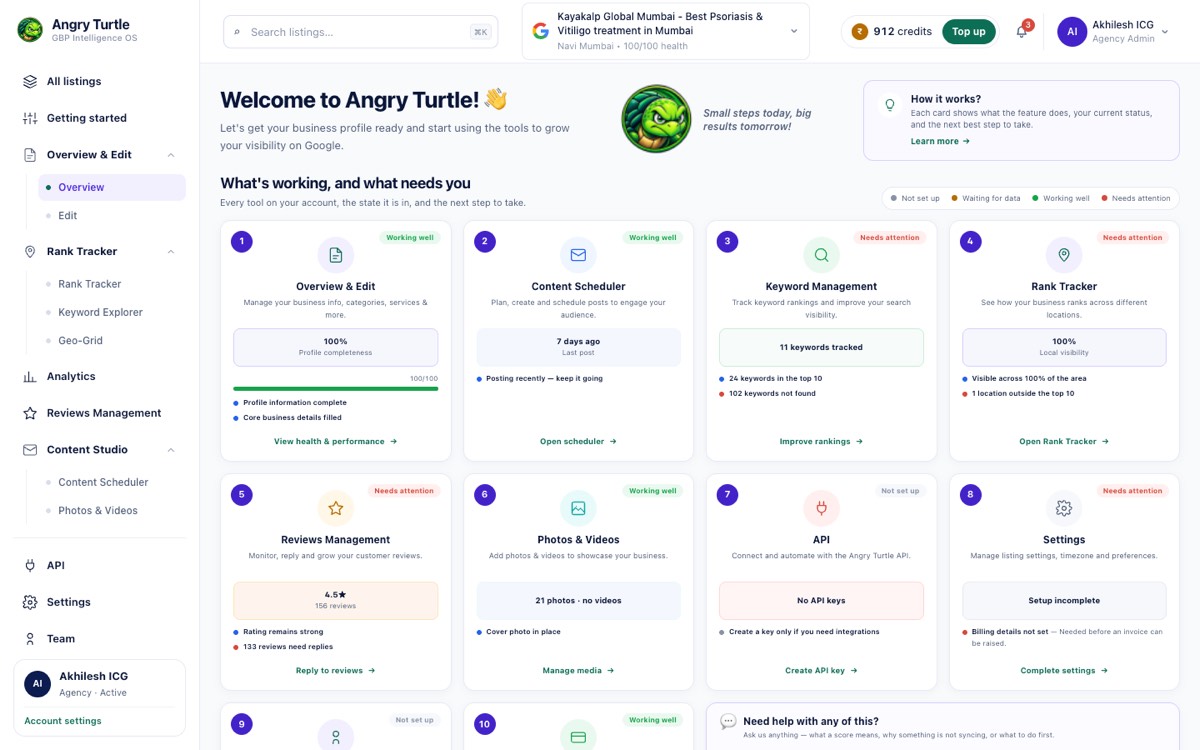
Rank OS gives every profile a 0–100 score built from five weighted dimensions — Relevance, Review Health, Freshness, Entity Authority and AIO Readiness — and the weights are tunable. Underneath it sits a ranked list of the fixes that move the number, each with the point lift it unlocks.
Ready to have this run for you?
Book a free audit — we'll show you where you stand in 48 hours.