 Angryturtle
LLM Citations & GEO (Generative Engine Optimisation)
Generative Engine Optimisation, usually shortened to GEO, is the practice of structuring a business's digital presence — its website content, Google Business Profile, directory citations, and structured data — so that it gets cited and referenced by large language model-powered systems: ChatGPT with browsing, Perplexity, Google Gemini, Microsoft Copilot, and comparable tools.
GEO sits next to AEO, not underneath it or above it. AEO is the narrower discipline focused specifically on Google's AI Overviews. GEO covers the wider set of AI systems — many of them not built by Google at all — that people are starting to consult for recommendations, comparisons, and local business discovery.
Why GEO matters for local businesses right now
A growing slice of consumers, concentrated among urban, educated, 25-45-year-olds in Indian metros, has started typing questions like "Which is the best IVF clinic in Bengaluru?" or "Recommend a good chartered accountant near Connaught Place" directly into ChatGPT or Perplexity instead of Google. These systems synthesise an answer from a mix of web sources and training data, and the businesses that show up prominently in whatever sources get pulled are the ones that get named.
This isn't a hypothetical future channel. It's already diverting a measurable share of high-intent local queries away from traditional search, even if the total volume is still small next to Google Search itself.
How LLMs decide what to cite for local queries
LLMs don't have a live connection to GBP data the way Google's own systems do. What they rely on instead:
Website content — what the business says about itself, in its own words. Review platform content — what customers say on Google, Practo, Zomato. Directory listings — JustDial, IndiaMART, Sulekha, all of which get crawled and indexed by the same systems LLMs pull from. News and media mentions — press coverage and industry features. And structured data — schema markup that turns entity information into something machine-readable rather than something a model has to infer from prose.
Practical GEO actions for local SEO
Consistent entity information across every touchpoint matters more here than it does for traditional SEO, because LLMs cross-reference multiple sources when forming an answer, and inconsistency between sources creates ambiguity that lowers citation odds. See NAP consistency and entity authority for the mechanics behind this.
Review volume spread across multiple platforms helps too, since LLMs draw on Practo, Google, Zomato, and JustDial rather than treating one platform as authoritative. Clear, factual website content beats vague marketing copy — a business whose site states plainly "We are a dermatology clinic in Koramangala, Bengaluru, specialising in acne, laser treatments, and skin rejuvenation" is far more citable than one buried behind heavy JavaScript rendering with no explicit location or specialty stated anywhere in the visible text.
FAQ pages with tight question-answer pairs are among the most reliably citable content formats an LLM can lift from — see FAQPage schema for how to mark these up so they're machine-readable, not just readable. And press coverage in outlets like The Hindu, Times of India, Economic Times, or Business Standard, or in relevant trade publications, adds another layer of source credibility that increases citation likelihood.
Where GEO overlaps with, but isn't, hallucination risk
A business with thin, inconsistent digital presence doesn't just miss out on positive citations — it becomes more likely to be described inaccurately when an LLM does mention it, because the model has less reliable data to draw from and fills gaps with plausible-sounding guesses. See hallucination and grounding for how that risk works and how a stronger source presence reduces it.
The GEO timeline for India
AI-driven local discovery is still early in India as of 2025-26 — the volume is real but nowhere near Google Search's scale yet. Businesses building GEO-compatible digital presence now, rather than waiting for the channel to mature, are positioning themselves to benefit disproportionately once adoption accelerates, the same way early Google Business Profile adopters had an edge before local search became universally understood.
Angryturtle's GEO service and get-cited-by-ChatGPT offering both work from this same source-presence logic — strengthening the exact inputs LLMs actually draw from, rather than trying to game a system that has no direct dashboard to optimise against.
Related terms: AEO readiness → · AI Overviews local → · Entity authority → · LLM citation → · Grounding → · Structured data →
India context: A Chennai IVF clinic with strong Practo reviews, a clear website statement of its specialties, and coverage in a regional health publication started appearing in ChatGPT's answers to "best IVF clinic Chennai" queries within a few months of tightening its entity consistency — well before it had invested in any paid AI-visibility tooling.
Related glossary terms
Which demand is growing, and which is decaying
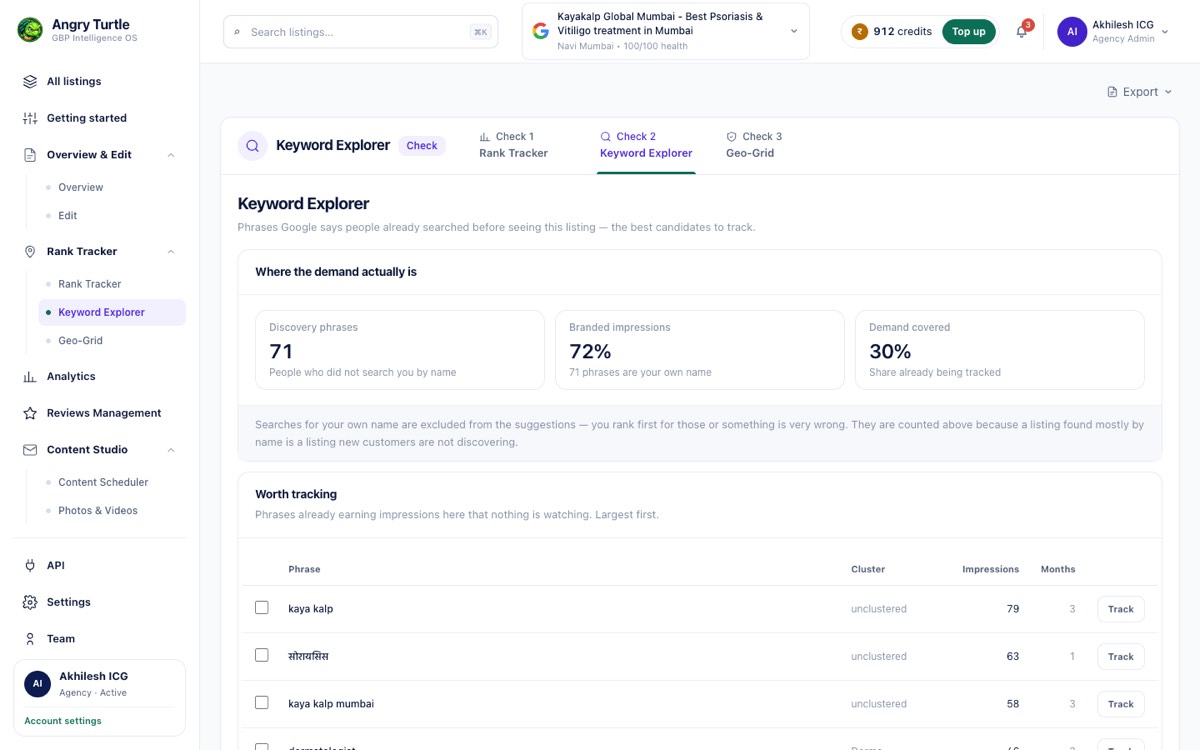
Search terms group into industry-aware demand clusters, each with a momentum read — scaling, broadening, concentrating or decaying — computed from your own Business Profile data rather than a generic keyword tool.
Ready to have this run for you?
Book a free audit — we'll show you where you stand in 48 hours.