 Angryturtle
How Google Ranks Local Businesses (Relevance/Distance/Prominence)
Learn how Google's local algorithm works. Relevance, distance, and prominence explained with practical examples for Indian businesses.
Lesson 2: How Google ranks local businesses
Google has said publicly, more than once, that exactly three factors decide local ranking: relevance, distance, and prominence. That's the whole model. Every review, every citation, every category choice you make eventually funnels into one of those three buckets. Once you see local ranking through this lens, a lot of confusing advice online — "post more," "get more reviews," "fix your category" — turns out to be the same three levers described differently.
Relevance: does your business match the query
Relevance is Google's read on whether your business is actually what the searcher is looking for. It comes mostly from your GBP's category and services, not from your website copy.
A dentist listed under the primary category "Dentist" is highly relevant for "dentist near me." The same dentist listed under "Doctor" or "Medical Clinic" is much less relevant for that exact query, even though a human would obviously understand the connection. Google's matching is closer to literal than it is to intuitive — see GBP categories for how granular this gets.
Fixing relevance is mostly a one-time correction: choose the most specific primary category available, list every service individually rather than bundling them, and write a description that uses the actual words customers search rather than internal jargon. Once relevance clears the bar for a query, adding more of it stops moving the needle much — the competitive fight shifts to prominence.
Distance: the pillar you can't change
Distance measures how close your business is to the searcher, or to the location implied in their query, and it's rooted in what Google calls proximity. Unlike the other two pillars, you can't do anything about your address. A bakery 300 metres from someone will generally beat an identical bakery 1.5km away, all else equal.
What you can control is precision. A pin dropped on the wrong side of the street, or a service area drawn too broadly for a business that can't realistically travel that far, both distort this signal against you. And "all else equal" matters — a strong enough prominence advantage regularly overcomes a distance disadvantage, which is the next pillar.
Prominence: where the actual work happens
Prominence is Google's estimate of how well-known and trustworthy a business is, on Google and off it. This is the pillar that responds to sustained effort, and it's where almost all local SEO management time should go after relevance is fixed.
Review count and rating feed prominence directly. So does review velocity — how many new reviews are arriving per month, not just the total sitting there. So does NAP citation consistency across directories, GBP profile completeness, and ongoing engagement like posts, photo uploads, and Q&A activity.
A worked comparison: two dental clinics in Gurgaon
Picture two clinics roughly equidistant from a searcher in Sector 56, Gurgaon. Clinic A has 250 reviews at 4.7 stars, a fully completed GBP, and posts weekly. Clinic B has 30 reviews at 4.2 stars and a profile that's missing half its attributes.
On distance, they're tied. On relevance, both are correctly categorised as "Dentist," so also roughly tied. Prominence is where they separate — and it separates decisively. Clinic A takes the local pack slot; Clinic B doesn't, regardless of how good either clinic actually is at dentistry. This is why prominence-building work — the subject of most of the rest of this curriculum, starting with complete profile optimisation — carries so much of the ranking outcome.
How the three pillars interact
None of the three operates in isolation. Relevance behaves like a gate rather than a scale — you either clear it for a given query or you don't, and once you're through, extra relevance signals produce diminishing returns.
Distance behaves like a handicap. A business further from the searcher needs a bigger prominence edge to compensate, which explains the occasional case of a well-run business 1.5km away outranking a mediocre one three streets closer. This exact scenario — losing the local pack to a competitor who shouldn't logically beat you — is common enough that it has its own dedicated answer.
Prominence is what breaks ties in every competitive market, and in dense metro categories — healthcare, coaching, salons — it's rarely even close to a tie. It's usually the whole game.
Where beginners go wrong
The single most common mistake is optimising the pillar that's already fine while ignoring the one that's actually broken. A business owner spends a weekend rewriting their GBP description for the fifth time — a relevance tweak — while sitting on 40 reviews that haven't been responded to and a category that hasn't been checked in two years.
The second is treating prominence signals as a one-time task. A burst of ten reviews collected during a launch month and never repeated shows up as a spike, then a plateau, then decline — Google reads the plateau, not the memory of the spike.
The third is assuming distance is fixable through better GBP settings. It isn't. A service-area business can expand its declared radius, but a fixed-location business's address is what it is; that energy belongs in prominence instead.
Prioritising your own effort
Check relevance first, because it's fast to fix and everything else is wasted if it's wrong — wrong category, missing services, and no amount of reviews will fully compensate. Once relevance is confirmed correct, move essentially all ongoing effort into prominence: reviews, citations, GBP completeness, and content cadence. Accept distance for what it is and stop spending time trying to influence something outside your control.
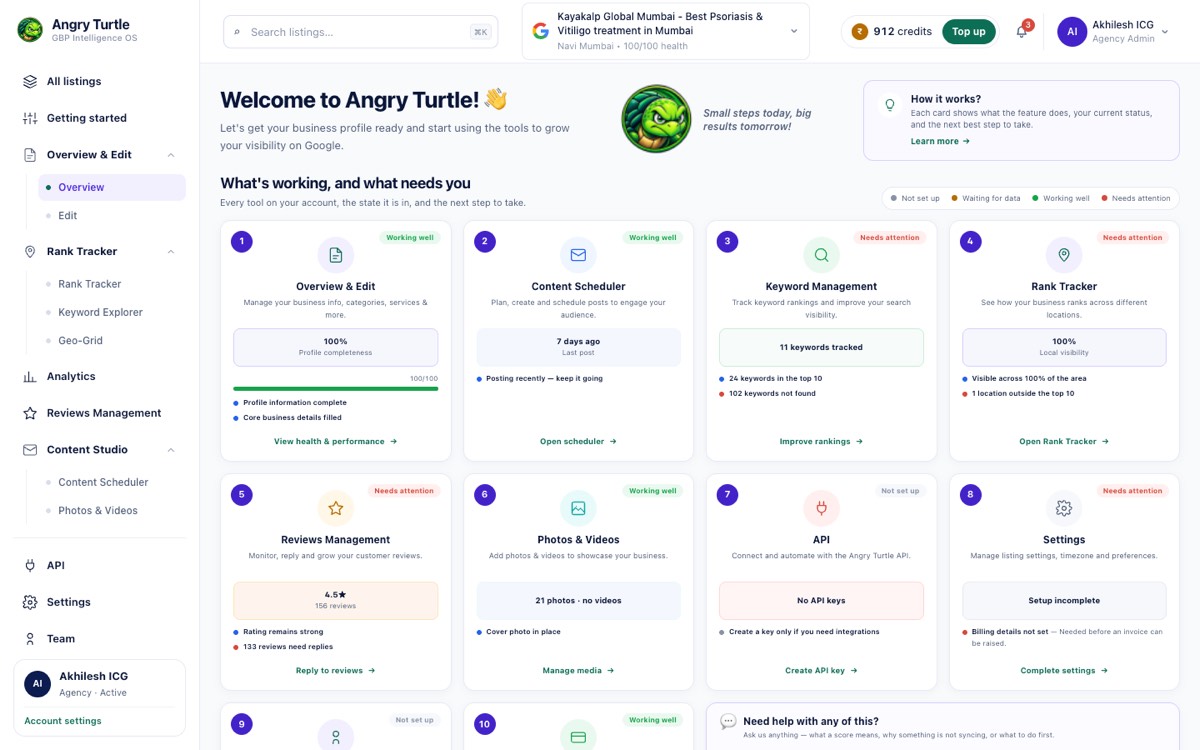
Angryturtle's Rank OS scores exactly these three pillars for a live profile and ranks the specific fixes by expected point lift, which turns "prominence is important" into a concrete, ordered to-do list rather than a vague direction. The score itself draws partly on demand cluster data, so it reflects real local search demand rather than a generic checklist.
FAQ
Which of the three pillars matters most? Prominence, in almost every competitive category. Relevance is a threshold you either meet or don't, and distance is fixed. Once relevance is correct, prominence is where ongoing local SEO effort produces measurable ranking change — see complete profile optimisation for where that work starts.
Can a business further away ever outrank a closer one? Yes, regularly. If the further business has a much stronger prominence profile — significantly more reviews, better velocity, a fully completed GBP — it can overcome a real distance disadvantage against a closer but poorly managed competitor.
Does my website affect local ranking? Indirectly. A linked, authoritative domain and consistent NAP between site and GBP support prominence and relevance, but the GBP itself carries most of the direct ranking weight — detailed in GBP vs. website vs. directories.
How often should I check my primary category? At minimum whenever Google adds new categories relevant to your business, and any time you notice a competitor using a category you're not. Checking quarterly is a reasonable habit.
Is prominence just about review count? No. Review count matters, but so does rating, review velocity, citation consistency, GBP completeness, and ongoing engagement like posts and photo updates. Review count alone without recent activity or a completed profile still leaves prominence weaker than it could be.
Next lesson: GBP vs. website vs. directories →
A score you can argue with, not a black box
Rank OS gives every profile a 0–100 score built from five weighted dimensions — Relevance, Review Health, Freshness, Entity Authority and AIO Readiness — and the weights are tunable. Underneath it sits a ranked list of the fixes that move the number, each with the point lift it unlocks.
Ready to have this run for you?
Book a free audit — we'll show you where you stand in 48 hours.