 Angryturtle
NAP & Citations 101
Learn what NAP consistency is, why it matters for local SEO, which Indian directories to prioritise, and how to audit and fix citation errors.
Lesson 4: NAP & citations 101
NAP is Name, Address, Phone — the three data points that identify a business to Google the way a passport identifies a person to an immigration officer. It has to match, exactly, everywhere it appears. Not close enough. Exactly. This lesson covers why that pedantic standard exists, what a citation actually is, and how to fix the inconsistencies almost every Indian business accumulates over a few years of moving offices, changing numbers, and rebranding slightly.
Why exact matching, and not "close enough"
Google's systems match business entities across the web algorithmically, not by human judgment. "Sharma Dental" and "Sharma Dental Clinic" read as two different strings to a matching algorithm, even though any person would immediately understand they're the same business. When your name, address, or phone varies across platforms, Google either treats the mismatched listings as separate low-confidence entities or discounts the weaker citation entirely — and in the worst case, creates duplicate listings that actively compete against your real one.
This is the mechanism, not a technicality: NAP consistency is Google's proxy for "this business is real and stable," and every mismatch is a small vote against that confidence. Enough small votes against, and prominence — one of the three ranking pillars from how Google ranks local businesses — takes a real hit.
Structured vs. unstructured citations
A structured citation sits in a directory's defined fields — your JustDial listing, your Practo profile, your entry on IndiaMART. These carry the most weight because the data is unambiguous and machine-readable. India also has a layer of citation aggregators that push NAP data out to dozens of smaller directories at once, which is efficient but means a single wrong field can propagate widely before anyone notices.
An unstructured citation is your NAP mentioned in running text somewhere — a local news writeup, a blog post, a wedding vendor listicle that happens to mention your studio's address and number. These help too, just less predictably, because the format varies.
A worked example: the NAP drift of a Bengaluru clinic
A dermatology clinic in Koramangala opened in 2019 as "Sharma Skin Clinic," 42 5th Cross, 5th Block, Koramangala. Over five years, three things happened quietly: the clinic added "& Cosmetology" to its name on the signboard and updated only the GBP to match. The landline was dropped for a mobile number, updated on Google but not on JustDial or Practo. And the clinic added a second floor consulting room, which never made it into the address field on two of the six directories where the business is listed.
Today, a Google search for the clinic's phone number surfaces three different numbers across different platforms, and two different name variants. Each mismatch dilutes the citation signal that should be reinforcing the GBP. None of this was negligence exactly — it's just what happens to NAP over years of small, reasonable business changes, unless someone owns the job of keeping it synchronised.
The Indian citation priority stack
Not every directory deserves equal effort. Build in order of authority and relevance.
Tier 1, build immediately: Google Business Profile, JustDial, IndiaMART, Sulekha, Bing Places, Apple Maps, and your Facebook Business Page.
Tier 2, build within the first month, and vertical-specific: healthcare goes to Practo, Lybrate, and 1mg; real estate to 99acres, MagicBricks, and Housing.com — see real estate local SEO for how this plays out for property businesses specifically; restaurants to Zomato and Swiggy; hospitality to MakeMyTrip and Booking.com.
Tier 3, for completeness once the first two are solid: Grotal, AskLaila, Hotfrog India, and general regional directories.
Auditing what you already have
Start by writing down your canonical NAP — the one correct version of your name, address, and phone, exactly as it should read everywhere. This becomes the reference standard against which everything else gets checked.
Then search Google for your business name plus city, and separately for your phone number, noting every directory that surfaces. Open each listing and compare it field by field against the canonical version. Claim anything unclaimed. Correct anything mismatched. And for the Tier 1 and Tier 2 directories where no listing exists at all, create one.
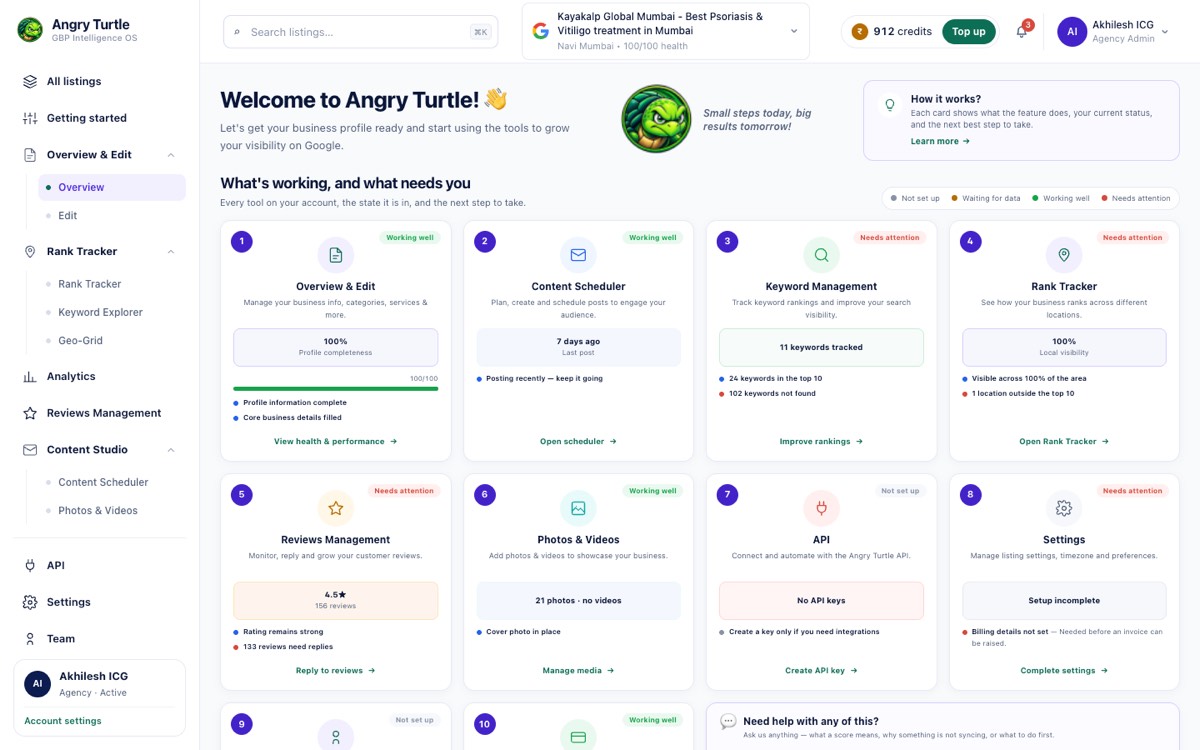
Doing this manually across even a dozen directories takes a full afternoon per location, which is part of why Angryturtle's citation and NAP product automates the discovery and consistency check across 20-plus platforms rather than leaving it as a recurring manual chore. Checking how your citation footprint compares to nearby rivals also matters — see the competitor tracking product for that side of the picture, covered in more depth in local competitor analysis.
The errors that show up most often in India
An old phone number is the single most common problem — updated on the GBP after a number change but left stale on eight other directories. A business name variation is close behind: the name on the GST certificate, the name on JustDial, and the name on the GBP description can drift into three subtly different strings over a few years. Truncated addresses are common too, where a directory's form field cut off a block number or pin code years ago and nobody went back to fix it. And an old address after a premises move is the most damaging of all, since it can actively send customers to the wrong location.
FAQ
How different does a NAP mismatch have to be before it matters? Any difference matters to a matching algorithm, even ones a human would consider trivial — "Rd" vs "Road," a missing suite number, a landline dropped for a mobile. Treat "identical" literally, not approximately.
Do citations directly move my local pack ranking? Not directly — they feed prominence, one of Google's three ranking pillars covered in how Google ranks local businesses, rather than acting as an independent ranking factor. Their effect is real but indirect.
Which directories should a healthcare business in India prioritise? Google Business Profile and JustDial first as Tier 1, then Practo, Lybrate, and 1mg as vertical Tier 2 additions — the full breakdown of industry-specific local SEO for healthcare covers vertical nuances beyond citations too.
What if I've moved locations and can't find every old listing? Search systematically for your old address and old phone number specifically, not just your business name, since some stale listings won't show up under a name search if the directory's internal indexing is address-based.
Is it worth paying to be listed on every directory that offers a paid tier? Generally no. A smaller number of accurate, high-authority citations outperforms a large number of low-quality ones, and paid placement on an obscure directory rarely moves prominence meaningfully compared to fixing existing Tier 1 and Tier 2 errors. The comparison between doing this yourself and having it managed is covered in done-for-you vs. DIY local SEO.
Next lesson: Keyword research for local intent →
A score you can argue with, not a black box
Rank OS gives every profile a 0–100 score built from five weighted dimensions — Relevance, Review Health, Freshness, Entity Authority and AIO Readiness — and the weights are tunable. Underneath it sits a ranked list of the fixes that move the number, each with the point lift it unlocks.
Ready to have this run for you?
Book a free audit — we'll show you where you stand in 48 hours.