 Angryturtle
Claiming & Verifying Your GBP
Step-by-step guide to claiming and verifying a Google Business Profile in India. Covers video verification, postcard, duplicate checking, and common mistakes.
Lesson 1: Claiming and verifying your Google Business Profile
Welcome to Track F2. If Track F1 was about understanding local search, this track is about actually running a GBP day to day — starting at the very beginning, because you can't optimise a profile you haven't claimed yet, and roughly a third of the businesses we see setting this up for the first time discover a profile already exists that they didn't create.
Why an unclaimed profile might already exist
Google generates business listings from third-party data sources constantly — a mention in a directory, a data feed, even a customer tagging a location on Maps can seed a skeleton profile that nobody at the business knows about. Before doing anything else, search your business name and address on Google Maps directly.
If something turns up, click "Claim this business" and follow the GBP verification flow rather than creating a fresh listing. Creating a second profile at the same address produces two competing entries — duplicate listings — that split your reviews, dilute your relevance signal, and are genuinely painful to merge later. If nothing turns up, proceed straight to creating a new profile at business.google.com.
Setting up a new profile correctly the first time
Sign in at business.google.com using an account the business itself owns — not a personal Gmail belonging to whoever happens to be setting this up, since that person may leave the business someday and take access with them. Click "Add your business to Google," and enter your exact legal or commonly known name, nothing added — no city name, no "best," no service keyword tacked on.
Select the most specific primary category genuinely applicable to what you do; a mismatch here undermines the relevance pillar from how Google ranks local businesses before you've even opened for business. Choose whether you're a physical location or a service-area business, enter your address or coverage area, add your phone number and website, and proceed to verification.
Verification in India: what actually happens
Video verification is the dominant method here. You'll record one continuous, uncut clip — no more than two minutes — that shows the exterior of the business with the signboard held steady and legible for several seconds, a walk through the entrance, the interior with equipment, desks, or staff visible, and finally something bearing the business name in print, like a letterhead or a business card. Upload it through the verification flow and expect a response within roughly a week.
Rejections happen for predictable reasons: the signage wasn't legible, the video was visibly cut or edited rather than one continuous take, the exterior was skipped entirely, or the footage was too dark or shaky to review confidently. Re-recording carefully the first time avoids most of these.
Postcard verification remains available as a slower fallback — Google mails a physical postcard with a PIN code to the registered address, typically arriving within two to four weeks, after which the PIN is entered in the dashboard to complete verification.
What to do the moment verification clears
The "Verified" badge appearing means the listing is now publicly live on Maps — and also means it's now visible enough that any gaps become genuinely costly. Move immediately to completing every remaining field, which is the entire subject of the next lesson, complete profile optimisation. Set up the website and booking links, and if this location is one of several the business operates, add it to a Location Group right away — covered in managing multiple locations — rather than letting it sit as an orphan profile.
A worked example: a new clinic in Sector 62, Noida
A dermatology clinic opening in Sector 62, Noida searches Maps first and finds nothing — genuinely new location, no prior data trail. The owner creates the profile under the clinic's registered business Google account rather than the dermatologist's personal Gmail, selects "Dermatologist" as the primary category rather than the broader "Doctor," and records a video walking from the street-facing signboard through reception into the treatment rooms, ending on a framed medical registration certificate with the clinic name visible.
Verification clears in five days. Within the hour, the team uploads ten photos, writes the description, adds the booking link to their existing appointment system, and lists their first six services individually. Because relevance was set correctly from day one and completeness followed within hours of verification, the clinic starts accumulating prominence signals — reviews, posts, engagement — from week one rather than losing a month to a half-finished profile sitting quietly in the background.
The mistakes that cause the most damage
A keyword-stuffed business name — "Best Dermatologist Noida — Dr Sharma Skin Clinic" instead of just "Dr Sharma Skin Clinic" — is one of Google's more reliably enforced policy violations and a common trigger for the suspensions covered in handling suspensions & appeals.
An inaccurate category — "Hospital" for a ten-bed clinic, or "Doctor" when "Dermatologist" is sitting right there in the list — quietly undermines relevance for the entire life of the profile until someone catches it.
Creating a duplicate because the search-first step got skipped is avoidable and, once done, costly to unwind. And listing a home address or a virtual office as a walk-in location, rather than configuring the profile properly as a service-area business, risks the listing entirely.
FAQ
What if I don't have physical signage yet at a brand-new location? Delay video verification until signage is up if at all possible — a profile verified without a visible sign is more likely to be flagged and re-reviewed later. Postcard verification is a workable alternative if the address itself is confirmed but signage isn't ready.
Can an agency verify a GBP on behalf of a client? Yes, but the underlying Google account and Location Group should remain owned by the business itself, with the agency granted Manager access rather than full ownership — this protects the client if the agency relationship ever ends, a distinction covered further in managing multiple locations.
How long does GBP verification typically take in India? Video verification usually resolves within about a week; postcard verification takes two to four weeks for the physical mail to arrive, plus time to enter the PIN. See how long does GBP verification take for more specific timing scenarios.
What happens if my verification video gets rejected? Google typically indicates the reason. Re-record addressing that specific issue — legible signage, one continuous take, full exterior shown — rather than resubmitting the same footage, which tends to produce the same rejection.
Is it a problem to use a personal phone number during setup and switch it later? Not during setup itself, but plan to move to a dedicated business line as soon as practical, since every subsequent citation you build elsewhere needs to match this number exactly — the mechanics of that are in NAP & citations 101.
Next lesson: Complete profile optimisation →
A score you can argue with, not a black box
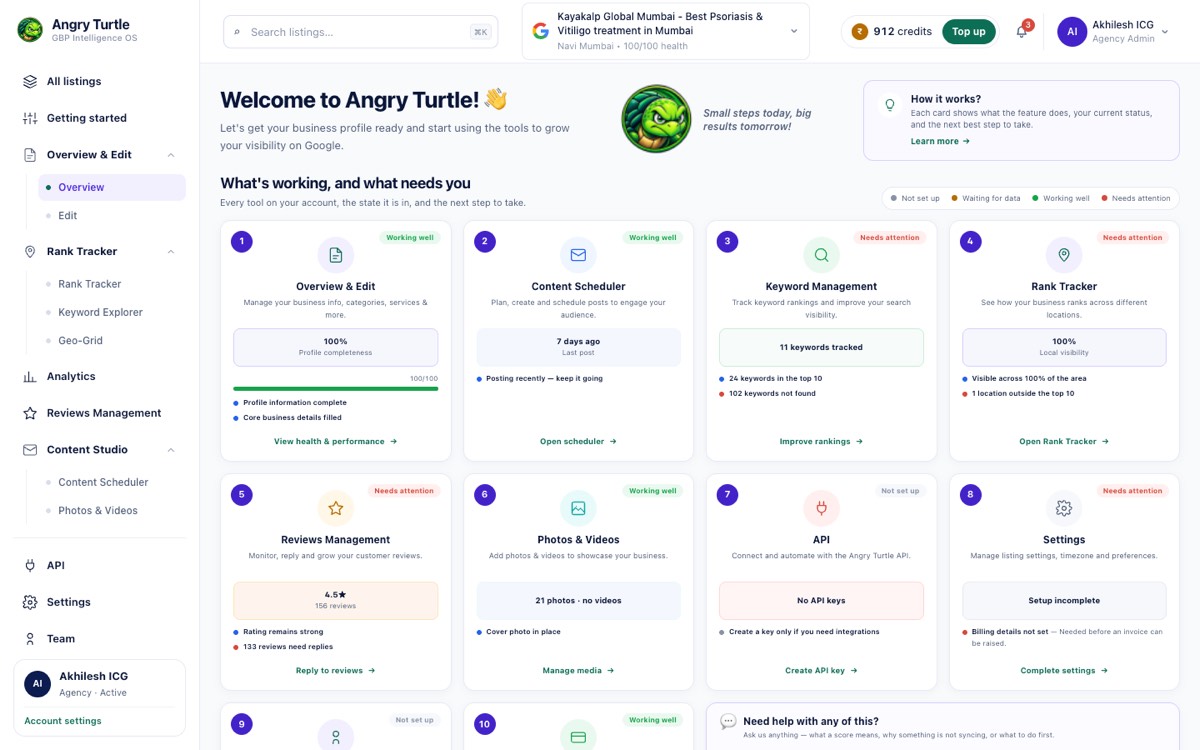
Rank OS gives every profile a 0–100 score built from five weighted dimensions — Relevance, Review Health, Freshness, Entity Authority and AIO Readiness — and the weights are tunable. Underneath it sits a ranked list of the fixes that move the number, each with the point lift it unlocks.
Ready to have this run for you?
Book a free audit — we'll show you where you stand in 48 hours.