 Angryturtle
What Is Local SEO? (India Context)
Learn what local SEO is, how it differs from traditional SEO, and why it matters for Indian businesses. Beginner-friendly guide with India-specific examples.
Lesson 1: What is local SEO?
Local SEO is the work of getting a business to show up when someone nearby searches for what it sells. Not the blue links. The map, the three-pack of listings above them — the local pack — and the knowledge panel that pops up when someone searches your name directly. If you run a clinic in Koramangala, a dentist in Bandra, or a hardware shop in Indore, this is the search real estate that decides whether a stranger walks through your door today.
Type "dentist near me" or "bank branch Andheri" into Google and watch what loads first. A map with three pins, a short list under it, then everything else. That block captures more clicks than anything below it for most service and retail categories. Local SEO is the discipline of making sure your business is one of those three pins, and that what people see when they get there makes them call rather than scroll past.
Local SEO vs. traditional SEO
Traditional SEO ranks web pages. It cares about backlinks, content depth, site speed, and the technical plumbing of a domain. Local SEO ranks a business entity, and the asset that carries most of the weight is not the website — it's the Google Business Profile.
| Traditional SEO | Local SEO | |
|---|---|---|
| What ranks | A web page | A business entity |
| Main asset | The website | The Google Business Profile |
| Core signals | Links, content, technical health | Reviews, GBP completeness, citations, NAP |
| Geography | National or global | A city, a neighbourhood, sometimes a 2km radius |
| Searcher intent | Researching | Ready to call or visit |
Here's the part that surprises people who've done SEO for years but never local: a business with a plain, unremarkable website and a well-run GBP will consistently outrank a business with a beautifully designed site and a neglected profile. Local search doesn't read your homepage carefully. It reads your GBP.
The three surfaces where this plays out
The local pack sits at the top of Search results for anything Google reads as a local query — three listings, each with a name, star rating, category, and buttons for calling or getting directions.
Google Maps is the same underlying data, browsed differently — someone opens the app, searches "pharmacy," and scrolls a longer list of pins.
The knowledge panel appears when someone searches for your business by name specifically. It pulls straight from your GBP: hours, photos, reviews, the works. If your profile is thin, the panel that represents your brand to a searcher who already knows your name is thin too.
Why this matters more in India than it might elsewhere
A few things about Indian search behaviour make this worth taking seriously.
Smartphone-first search means most near me searches in India happen mid-errand, with intent to act within the hour. Someone typing "AC repair near me" in Whitefield at 11am on a Tuesday is not doing research. They're calling whoever answers first with a decent rating.
There's also a directory layer that doesn't exist the same way in most Western markets — JustDial, Sulekha, Practo, 99acres, IndiaMART. These sit alongside Google rather than replacing it, and a lot of local SEO work in India means keeping your business identical across Google and this directory ecosystem, a topic covered fully in NAP & citations 101.
And the local pack itself dominates click share for entire categories here. Search "coaching institute" in almost any tier-2 city and the local pack, not the organic results below it, is where the click goes.
A worked example: two clinics in Pune
Take two dermatology clinics, both in Baner, Pune, roughly the same distance from a searcher typing "dermatologist near me."
Clinic A has 340 Google reviews at 4.6 stars, a GBP with every service individually listed (acne treatment, laser hair removal, chemical peels), fifteen photos, and a post published roughly every ten days. Clinic B has a nicer building and a genuinely capable dermatologist, but 12 reviews at 3.9 stars, one generic "skin care services" line in the services section, and three photos uploaded when the profile was created two years ago and never touched since.
Clinic A appears in the local pack. Clinic B, despite arguably better medicine, doesn't. The searcher never learns Clinic B exists, because Google's local ranking system — covered in the next lesson — never surfaces it. This is the practical stakes of local SEO: not marketing polish, but literal visibility.
What beginners get wrong
The most common mistake is treating the website as the priority and the GBP as an afterthought — a box to tick once and forget. It's backwards. The GBP needs continuous attention: new photos, fresh posts, review responses, service updates. A website redesign that takes three months produces less local search benefit than three months of consistent GBP management.
A second mistake is assuming local SEO is a one-time setup. It behaves more like a subscription than a purchase — the businesses that stay visible are the ones still posting, still collecting reviews, and still checking their citations six months later, not the ones who did a big push once.
A third: confusing "my business is well-known" with "my business ranks locally." Brand recognition and local pack rank are correlated but not the same thing — a smaller, newer clinic with a sharper GBP will regularly out-rank an established name that's been coasting. Angryturtle's Rank OS exists specifically to put a number on that gap rather than leave it as a guess.
The typical local search journey
A need comes up — a toothache, a leaking tap, a school admission deadline. The person searches "[service] near me" or "[service] in [area]." The local pack loads. They glance at ratings, maybe read three or four recent reviews, and pick within about a minute. Then they call or tap directions.
Every one of those steps is something your GBP either supports or fails to support. A missing phone number kills the call step outright. Old reviews sitting at the top with no recent activity kill the trust step. This is why local SEO isn't really "marketing" in the traditional sense — it's closer to keeping a storefront clean and staffed, except the storefront is digital and Google decides who sees it.
What to do next
Before moving on, search your own business by name and by category on Google Maps from a phone, not a desktop — the results genuinely differ. Note whether you appear in the local pack for your main category term, and glance at how your GBP looks to a stranger seeing it for the first time.
The next lesson breaks down exactly what Google is scoring when it decides local pack order — how Google ranks local businesses — which is the mechanism behind everything in this lesson. After that, GBP vs. website vs. directories untangles which of your digital assets actually does what.
If you want the fuller picture of how AI search layers on top of this — Google's AI Overviews and tools like ChatGPT increasingly pulling from the same local signals — AI Overviews and local business visibility in India is worth a read once you've finished the fundamentals track. And if you'd rather have someone else run this end to end, Angryturtle's managed local SEO service or a specialist local SEO agency covers everything from this lesson forward, self-serve or fully managed.
FAQ
Is local SEO the same as SEO? No. Traditional SEO ranks web pages in the main organic results using links, content, and technical signals. Local SEO ranks a business entity — you, specifically, at your address — in the local pack and Google Maps, and the Google Business Profile carries most of the weight rather than the website.
Do I need a website for local SEO to work? Not strictly. A verified, complete GBP can appear in the local pack with no website attached. A website helps — it adds authority and captures organic traffic separately — but see GBP vs. website vs. directories for what each asset actually contributes.
How long before local SEO shows results? It depends heavily on category competitiveness and starting point, a question covered in more depth at how long does local SEO take and properly planned out once you reach building your first local SEO plan. A newly verified profile in a low-competition category can see movement within weeks; a crowded metro category takes longer and needs sustained review and citation work.
What's the difference between the local pack and Google Maps? Same underlying data, different surface. The local pack is the three-listing block inside regular Google Search results. Google Maps is the full map application where people browse and scroll through more results. Both are driven by the same GBP signals.
Is local SEO relevant for a service-area business with no storefront? Yes — plumbers, electricians, and home-visit doctors without a public-facing address still set up a GBP as a service-area business, defining the areas they cover rather than a physical location. The ranking mechanics are largely the same, just without a walk-in address.
A score you can argue with, not a black box
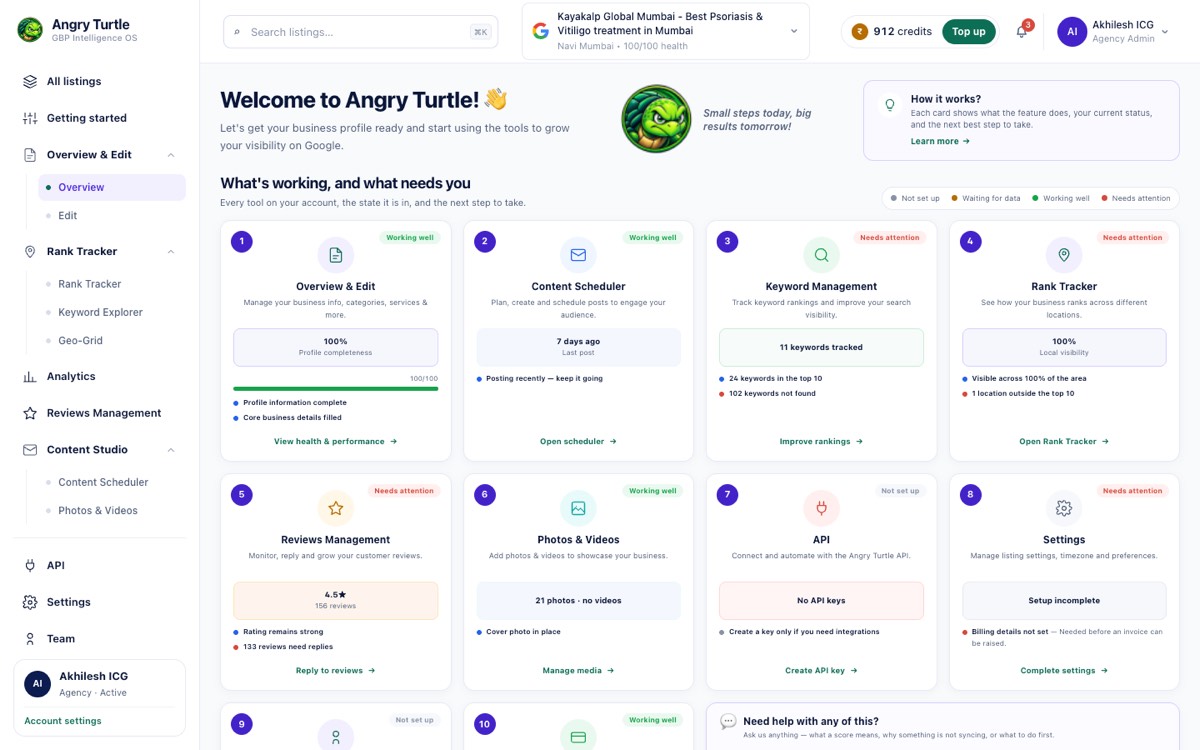
Rank OS gives every profile a 0–100 score built from five weighted dimensions — Relevance, Review Health, Freshness, Entity Authority and AIO Readiness — and the weights are tunable. Underneath it sits a ranked list of the fixes that move the number, each with the point lift it unlocks.
Ready to have this run for you?
Book a free audit — we'll show you where you stand in 48 hours.