 Angryturtle
What Is Relevance in Local SEO?
Relevance measures how well a business's GBP and broader digital presence match what a searcher is actually looking for. It's the first of Google's three declared local ranking pillars, sitting alongside prominence and proximity, and it answers a narrower question than the other two: is this business a plausible answer to this specific query at all?
Where prominence and proximity mostly determine ranking among businesses that already clear the bar, relevance determines who clears the bar in the first place. A gynaecologist correctly categorised on GBP is eligible to show up for "gynaecologist near me." A general physician who never added that category, however good their reviews, generally isn't — Google doesn't guess.
The signals that build relevance
The GBP primary category is the single most important relevance signal on the profile. A business listed as "Dermatologist" is highly relevant for "dermatologist near me." Listed under the generic "Doctor" category, it's eligible for far less. Getting this one field wrong is the most common — and most fixable — relevance problem Angryturtle finds when auditing a new client's GBP.
Secondary categories widen the net from there. A dermatology clinic that adds "Skin Care Clinic," "Laser Hair Removal Clinic," and "Cosmetic Surgeon" as secondary categories becomes eligible for a meaningfully broader set of relevant searches than one sitting on its primary category alone.
Services listed on the GBP go a level more granular still. A clinic that lists Acne Treatment, Chemical Peel, Botox, and Laser Hair Removal as discrete services becomes relevant for searches containing each of those specific terms, even where none of them appear in the category or the business description.
The business description adds secondary context — natural, informative copy that mentions what the business actually does and where. Google's policy draws a hard line here: keyword stuffing the description is a violation, while writing a genuinely descriptive paragraph that happens to include service terms is not.
The website linked from the GBP and the GBP's own posts round out the picture. A clinic whose website has a dedicated page per treatment, written in the terms patients actually search for, carries more relevance weight than one with a single catch-all "services" page. Posts that mention specific treatments do similar work at a smaller scale.
Relevance is a threshold, prominence is the differentiator
Relevance behaves differently from the other two pillars in one important way: it has diminishing returns. Once a business has adequate relevance signals — right category, right services, a description that isn't misleading — adding more relevance signals stops moving the needle much. From that point on, prominence is where the competitive gap actually gets decided: review count, review velocity, citation accuracy, GBP engagement.
This is where a lot of local SEO effort goes to waste. Businesses over-invest in prominence — chasing more reviews, more citations — while sitting in the wrong category or missing half their services from the GBP, which caps how much that prominence work can even help. The correct order is relevance first, then prominence, because no amount of review generation rescues a business that's invisible for its own core queries.
Proximity sits outside both of these — a searcher's distance from the business — and can't be optimised directly, which is why Rank OS scores relevance and review health as separate, independently weighted dimensions rather than folding everything into one number.
Category selection as the highest-leverage fix
For most Indian businesses, auditing and correcting GBP categories is the single fastest relevance win available, and often the cheapest. A clinic in the wrong primary category is effectively invisible for its most important searches — no volume of reviews, no citation cleanup, and no amount of posting will overcome a mis-categorised profile. Angryturtle's onboarding audit checks category selection before anything else for exactly this reason: fixing it first means every subsequent prominence investment actually compounds instead of being capped by a structural gap.
A concrete example
A multi-specialty hospital chain in Chennai had listed its Anna Nagar branch under "Hospital" only. It had strong reviews and solid citation coverage, yet it barely showed up for "cardiologist near me" or "orthopaedic surgeon Anna Nagar" — the searches actually driving its highest-value patients. Adding the correct secondary categories and building out a full services list changed which searches the branch was even eligible for; the review and citation strength it already had could then start doing its job.
Related terms: Prominence → · Proximity → · Rank OS → · Local ranking factors → · GBP categories → · Entity authority →
GBP Management Services → | How Google Ranks Local Businesses → | Managed Local SEO →
Related glossary terms
A score you can argue with, not a black box
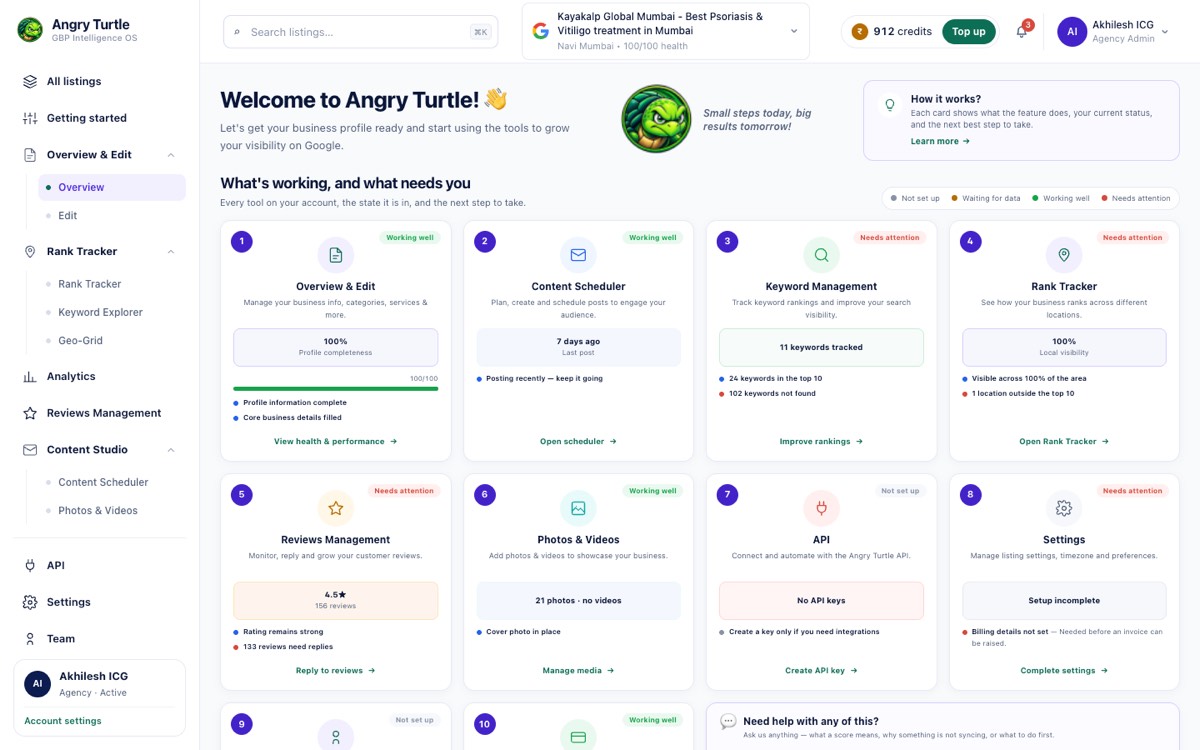
Rank OS gives every profile a 0–100 score built from five weighted dimensions — Relevance, Review Health, Freshness, Entity Authority and AIO Readiness — and the weights are tunable. Underneath it sits a ranked list of the fixes that move the number, each with the point lift it unlocks.
Ready to have this run for you?
Book a free audit — we'll show you where you stand in 48 hours.