 Angryturtle
How Does Google Decide Which Sites Appear in AI Overviews?
Google selects AI Overview sources by first finding pages that already rank well for the query and its related sub-questions, then choosing the ones with clear, trustworthy, directly relevant passages that answer the specific point being summarized. There's no separate "AI Overview index" you submit to. Eligibility flows from normal search visibility, content quality, and demonstrated expertise. Being cited is largely a by-product of being a genuinely useful, well-structured page on a reputable site, defined more formally at ai-overview.
The signals that appear to matter most
Pages cited in Overviews usually already sit on page one for the query or a close variant. Ranking is the entry ticket, not a separate hurdle. Beyond that, Google extracts a specific sentence or paragraph, so content that answers one question cleanly, in plain language, is easier to lift than a page that buries the answer in a long lead-up. Established sites, recognized brands, and pages with clear authorship tend to be favored too, especially for money-or-life topics like health and finance, a pattern eeat covers in general search terms. For time-sensitive queries, rules, prices, current-year questions, recently updated pages get preferred over stale ones.
The query fan-out effect
Google breaks one question into several. A search like "how to start a cloud kitchen in Bengaluru" might silently fan out into licensing, FSSAI registration, rent, and delivery-partner sub-queries, a mechanism explained at query-fan-out. Sources then get pulled from whichever pages best answer each fragment. A page that thoroughly covers sub-topics, not just the headline keyword, has more surfaces to be cited on, which is part of why thin pages built around a single keyword tend to lose out to pages that actually walk through the whole decision.
What this means in practice for Indian businesses
You cannot pay or petition your way into an Overview. The reliable lever is ranking first, then structuring content so answers sit in self-contained blocks, clear H2 questions, short direct answers, supporting detail underneath. Credibility signals help too, named authors, credentials, citations to authoritative Indian sources, and a consistent presence across directories that AI crawlers actually visit, like Practo, JustDial, or IndiaMART. And for local intent specifically, a strong, accurate Google Business Profile feeds the entities Google already trusts about a business.
Because selection is dynamic and query-specific, no agency can guarantee a citation, Angryturtle included. What a managed service can do is systematically improve the inputs Google rewards, then measure which queries start surfacing your pages, tracked through ask-maps-aio and insights-performance.
Where GBP and schema fit into this
A profile's entity-authority score and its structured data both feed the same trust signals Overviews draw on. Structured data doesn't move a listing from position five to position three in the local pack on its own, but it does clarify the entity Google is deciding whether to cite. That's a separate lever from ranking itself, and both matter for different reasons.
FAQ
Can I buy a spot in an AI Overview? No. There's no paid placement for AI Overviews. The only path in is being a page Google's system already trusts enough to rank and extract from.
Does one perfectly optimized page guarantee a citation? No. Selection happens per query, and a page that gets cited for one search may not for a related one if a competitor's page answers that specific fragment better. Coverage across a topic matters more than perfecting a single page.
How is this different from ranking in regular search? Ranking is necessary but not sufficient. A page can rank on page one and still not get pulled into the Overview if its passage isn't the cleanest, most directly relevant answer to the exact sub-question Google fanned out to. See ai-overviews-local-business-india for the fuller breakdown, and ai-overview-optimization for the service side of closing that gap.
More questions answered
A score you can argue with, not a black box
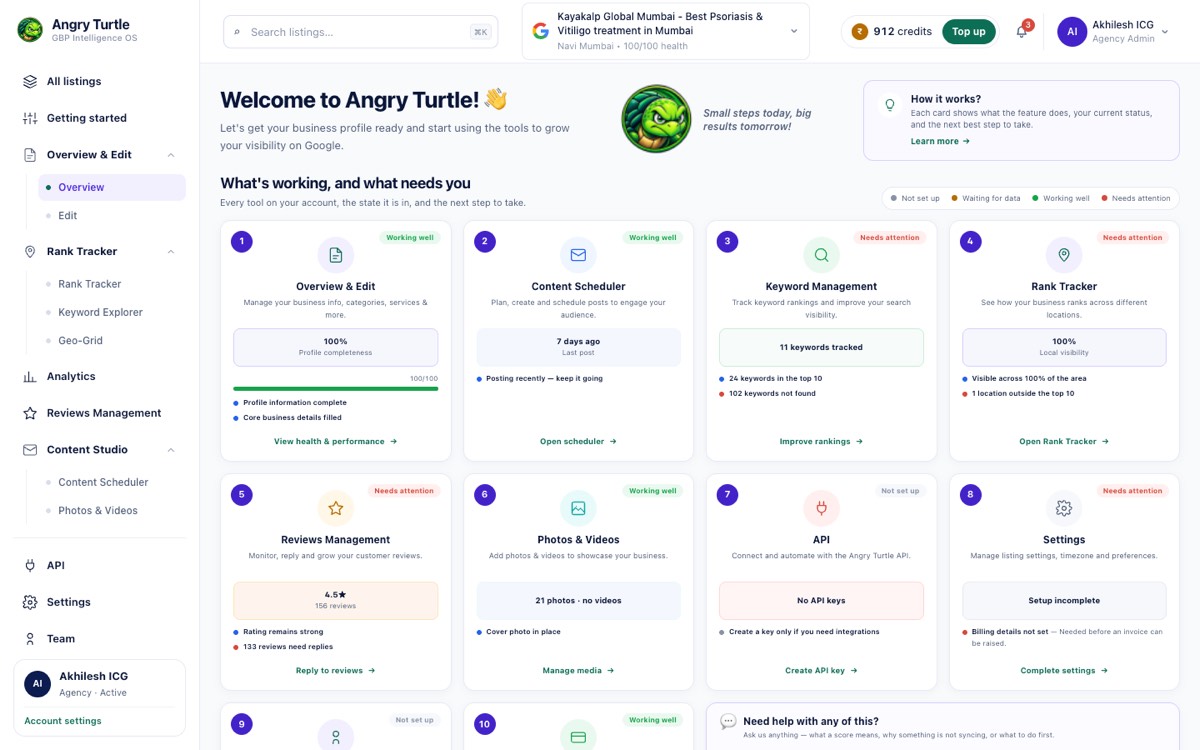
Rank OS gives every profile a 0–100 score built from five weighted dimensions — Relevance, Review Health, Freshness, Entity Authority and AIO Readiness — and the weights are tunable. Underneath it sits a ranked list of the fixes that move the number, each with the point lift it unlocks.
Ready to have this run for you?
Book a free audit — we'll show you where you stand in 48 hours.