 Angryturtle
What is entity authority in local SEO?
Entity authority is the degree to which Google's Knowledge Graph recognises a business as a distinct, well-defined, trustworthy entity, with verified attributes, consistent information across the web, and established relationships to other entities: locations, people, categories, topics. It's not a single metric you can check in a dashboard. It's closer to a confidence score Google's systems build up over time from every consistent, or inconsistent, signal they encounter about the business.
In local SEO, entity authority is the mechanism underneath how confidently Google can associate a business with a specific location, category, and set of services. A business with strong entity authority ranks more consistently for local queries simply because Google isn't guessing about what it is, where it is, or who it serves.
Entity authority vs domain authority
Domain authority is a link-based website metric. Entity authority is a business-level concept, it spans every digital touchpoint the business has, not just the link profile of its website. A clinic could have a mediocre website with few backlinks and still hold strong entity authority if its GBP, citations, and third-party mentions are consistent and complete. The two concepts overlap but they're measuring different things, and a site audit focused only on backlinks will miss entity authority gaps entirely.
The mechanism: how Google actually builds this confidence
Google's systems don't take any single source's word for what a business is called, where it's located, or what it does. They cross-reference. Every citation, every mention, every schema markup instance is a data point Google can check against every other data point about the same business. When ten independent sources all agree the business is named "Sharma Skin Clinic" at the same address with the same phone number, that agreement itself is the signal, not any one source individually. When three sources disagree on the address format, a house number written differently, a locality spelled two ways, Google's systems have to decide which version to trust, or whether to trust any of them fully.
This is why entity authority compounds slowly rather than updating the moment a single citation goes live. Confidence built from cross-referenced agreement takes time to accumulate precisely because it depends on multiple independent sources aligning, not on any one action taken by the business.
Entity building: what builds entity authority
Entity building is the practical work of accumulating the signals above, deliberately and consistently, rather than a single action a business takes once. Consistent NAP, name, address, phone, across every citation and directory is the most foundational entity-building signal, and the one most commonly broken by multi-location businesses. A complete GBP with every relevant category and attribute filled in, not left at Google's defaults, matters too, as does GBP and website cross-referencing each other so each confirms the other.
Mentions in credible, topically relevant publications, press coverage, industry directories, carry more weight than volume alone; ten citations with three different address formats do less for entity authority than five citations that match exactly. A consistent business name, address, and phone repeated in LocalBusiness schema on the website itself reinforces the same signal in a machine-readable format. Where the brand is established enough to warrant one, a Wikipedia or Wikidata entity adds a strong third-party reference point, and a claimed, accurate Knowledge Panel is often the most visible public evidence that the entity has been recognised at all.
Industry association and professional body listings sit in the same bucket, and they're worth naming specifically because most businesses never bother claiming them even where eligibility already exists. A hospital's NABH accreditation listing, a doctor's entry in the IMA directory, a chartered accountant's ICAI membership, a developer's CREDAI listing, a diagnostic lab's NABL accreditation — these are government or professional-body references most competitors leave unclaimed, and they carry more weight than an ordinary directory listing because the listing body itself has independent standing to verify.
What a Knowledge Panel does and doesn't indicate
A Knowledge Panel appearing for a business name is a visible sign that Google's systems have assembled enough confirmed data to construct a standalone entity summary, name, category, address, hours, sometimes a short description pulled from Wikipedia or Wikidata. That's genuinely useful evidence that basic entity recognition has occurred. What it doesn't indicate is quality, popularity relative to competitors, or rank in the map pack, none of these are guaranteed by having a panel, and plenty of well-ranking local businesses never get one at all, because panels are more commonly triggered by direct brand-name searches than by category searches, and a lot of local businesses are found through category searches, "dentist near me," rather than searches for their name specifically. A panel also isn't permanent or fully stable, fields can revert to an older value if Google's systems find conflicting signal elsewhere, which is itself a small, visible symptom of entity authority being contested rather than settled.
A claimed panel that's never revisited can end up doing more harm than no panel at all. An out-of-date panel is still an authoritative-looking source, and if it's showing an old address or a former phone number, it's actively spreading exactly the kind of inconsistency entity authority work is supposed to eliminate.
How authority accrues differently for a single location vs a chain
A single-location business accumulates entity authority around one address, one phone number, one consistent name, a relatively contained signal set that's easier to keep aligned because there's only one version of the truth to maintain. A chain with multiple branches is effectively building several related but distinct entities at once, one per branch, each needing its own consistent NAP, its own citation set, and its own local mentions, while also needing all of them to clearly connect back to the parent brand entity. This is why chains see uneven entity authority far more often than single-location businesses do: the flagship branch, usually the oldest, most-reviewed, most-cited location, often carries visibly stronger entity signal than a branch opened eighteen months ago with thinner citations, even though both operate under the identical brand name and design.
Entity authority for lifesciences and B2B brands
The mechanism doesn't change for a business without a storefront, but the signal set looks different. A pharmaceutical or medical device company building entity authority isn't accumulating restaurant-style citations; it's accumulating consistent NAP across corporate directories, media coverage naming the company correctly, detailed website content describing what it actually does, and membership listings with sector bodies like OPPI or FICCI. A company with those signals aligned is in a stronger position to get cited when an AI system answers a query about its products or patient-support programmes, for the same underlying reason a well-corroborated local clinic gets cited over one with thin, inconsistent signal. It's entity authority work rather than classic local SEO, but consistency, completeness, and external validation are the same three things being built either way.
Corroborating sources that carry particular weight in India
Government and quasi-official sources carry a kind of corroborating weight that ordinary directories don't. A GST registration record, a business's listing on a state government business portal, or its FSSAI licence number for a food business, aren't SEO tools and won't move a needle on their own, but where they're publicly visible and consistent with the name and address used elsewhere, they function as an independent, hard-to-fake confirmation of the entity's basic facts. Press coverage in a recognised regional or national outlet carries more corroborating weight than a paid directory listing, for the same reason, it's a source with its own reputation to protect, choosing to confirm the business exists and operates as described. None of this replaces the basics, NAP consistency, a complete GBP, and industry-specific directories, JustDial, Practo, Sulekha, 99acres, remain the higher-volume, more routine part of the work; these additional sources are corroboration on top of that foundation, not a substitute for it.
The honest boundary: what a business cannot influence directly
A business can control what it publishes and where, its GBP fields, its website schema, the directories it lists on. It cannot directly control whether Google's systems choose to trust a given source, how quickly a correction propagates through the Knowledge Graph, or whether a Knowledge Panel appears at all for a given search term. Content elsewhere that promises a guaranteed panel, a specific authority "score," or a fixed timeline for Google's confidence to update is promising something no public source confirms Google actually offers. What a business can do is control every input it's able to touch, consistency, completeness, corroboration, and accept that the confidence Google eventually assigns sits on the other side of a process it doesn't get to see directly.
What's evidenced versus what's widely repeated
It's genuinely documented that Google's Knowledge Graph represents entities and their relationships, and that Google has spoken publicly about entity understanding as part of how it processes search queries. It's also documented that structured data and consistent citations are among the recommended practices for helping search engines understand a business. What isn't documented anywhere public: a specific number of consistent citations required to "unlock" entity authority, a named threshold at which Google's confidence crosses some internal line, or a guaranteed timeline for when accumulated signal starts affecting rankings. Content that states those numbers with confidence is repeating an industry assumption, not citing a Google statement. This entry treats entity authority as a gradient that accumulates from consistent signal, not a gate with a known unlock condition.
Why entity authority matters more now than five years ago
As Google AI Overviews and third-party LLMs, ChatGPT, Perplexity, Gemini, increasingly answer local queries by pulling from structured entity data rather than ranking web pages, businesses with strong entity authority get cited more often in those AI-generated answers. This is the exact point where local SEO and AEO overlap: the same signals that used to just help a listing rank in the map pack now also determine whether an AI system trusts the business enough to name it in a conversational answer.
How to measure entity authority in practice
There's no single dashboard number for this, but there are practical proxies worth checking directly. Pull a list of every citation the business has across major directories, JustDial, IndiaMART, Practo for healthcare, Sulekha, 99acres for real estate, and Google itself, and compare the name, address, and phone format across all of them side by side. Any mismatch, a suite number included in one and dropped in another, a phone number with or without the country code, is a specific, fixable gap rather than a vague authority problem.
A second useful check is searching the business name directly in Google and seeing whether a Knowledge Panel appears, and if it does, whether every field in it is accurate and current. A missing or stale Knowledge Panel is a visible symptom of low entity authority, even though the panel itself isn't the whole story.
A bad reading here looks like assuming entity authority is fine because the GBP looks complete, while ignoring that three of the business's five biggest citation sources still list an old address from before a 2024 relocation.
Worked example
A hospital chain with 12 branches, consistent NAP across every citation, a claimed Knowledge Panel, and press mentions in three health publications carries measurably stronger entity authority than a competitor with the same branch count but inconsistent addresses across directories, and it shows up in how often each gets cited when patients ask AI tools for hospital recommendations by city.
Common mistakes
Businesses often chase entity authority through volume, more citations, more directory listings, without checking that the name and address format is identical across all of them. Another mistake is treating entity authority as a website-only concern and ignoring GBP attribute completeness, which is often the single fastest lever available. A third, specific to multi-branch businesses, is fixing NAP consistency for the flagship location and assuming the fix propagates to every branch, when each branch's citations have to be checked and corrected individually.
Fixing GBP consistency while leaving the website with no LocalBusiness schema at all is another common half-measure. GBP and on-site schema are meant to confirm each other, and a perfectly consistent Google profile sitting behind a website that says nothing machine-readable about the business leaves half the available entity signal unbuilt.
Relationship to entity SEO
Entity authority is the outcome; entity SEO is the discipline that produces it. Entity SEO covers the tactics, schema, sameAs links, disambiguation, while entity authority describes the trust level Google eventually assigns once those tactics have accumulated enough consistent signal. A business can do all the entity SEO tactics correctly and still take months to see entity authority build, because Google's confidence compounds gradually rather than updating the moment a citation goes live.
Frequently asked questions
Is entity authority the same as domain authority or page authority? No. Domain and page authority are link-based website metrics from third-party SEO tools. Entity authority is Google's own confidence in a business as a recognised, well-defined entity, and it spans citations, GBP, schema, and press mentions, not just website links.
Does a Wikipedia page guarantee strong entity authority? No, but it helps meaningfully where the brand is established enough to have earned one. Most local businesses build entity authority through NAP consistency, GBP completeness, and schema, without ever needing or qualifying for a Wikipedia entry.
What does "entity building" actually involve day to day? Mostly unglamorous consistency work: auditing citations for matching NAP format, filling GBP attributes, keeping schema in sync with the live profile, and correcting mismatches as soon as they're found rather than letting them accumulate across dozens of directories.
How long does it take to build entity authority? There's no published timeline, and this entry won't invent one. What's observable is that it accumulates gradually as consistent signal builds across sources, rather than jumping the moment one citation is corrected.
Related terms: Entity SEO → · Entity Home → · Entity Disambiguation → · AEO/AIO Readiness → · NAP Consistency → · Knowledge Graph → · Knowledge Panel → · Wikidata → · Lifesciences Local SEO → · Nap Inconsistency AI Entity Confidence Study →
How Angryturtle builds entity authority: citation discovery and NAP consistency checks across 20+ platforms are built into Citations & NAP →, and the same underlying entity data feeds AIO Readiness → scoring. Angryturtle manages 319 GBPs across 8 industries, and entity building work is a routine part of every one of those engagements. GBP Management Services →
Related glossary terms
A score you can argue with, not a black box
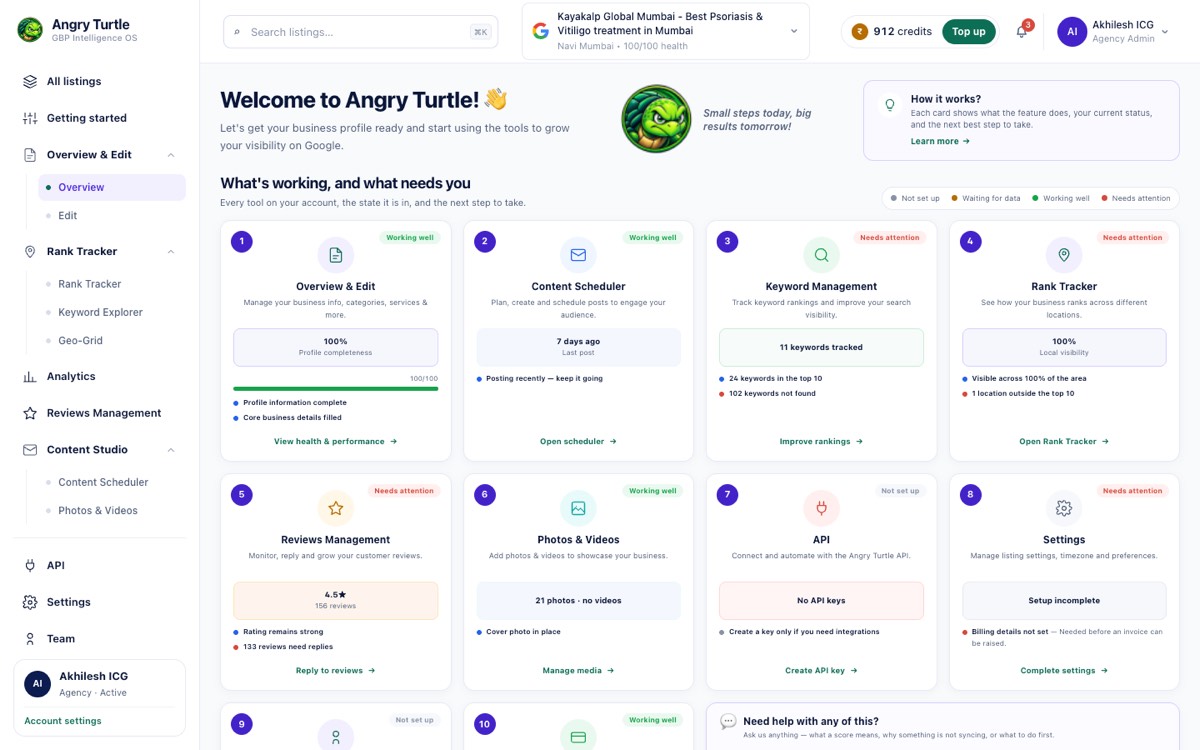
Rank OS gives every profile a 0–100 score built from five weighted dimensions — Relevance, Review Health, Freshness, Entity Authority and AIO Readiness — and the weights are tunable. Underneath it sits a ranked list of the fixes that move the number, each with the point lift it unlocks.
Ready to have this run for you?
Book a free audit — we'll show you where you stand in 48 hours.