 Angryturtle
What Is an Entity Home and Where Should It Be for Local Businesses?
An entity home is the primary online location where an entity is defined and described — the authoritative source for what the entity is, where it is, and what it does. For local businesses, the entity home is typically the business's own website (specifically the About page or homepage), reinforced by the GBP as the local entity anchor. The entity home should have the most complete, authoritative entity description on the web.
An entity home is the one primary source an AI system treats as definitively authoritative about a business, even though several other sources validate the same facts around it. Multiple platforms can confirm a business exists and describe it consistently, but AI systems still need one place to check when they need the fullest, most authoritative version of the truth, and that's what an entity home is for. The formal concept sits at entity-home.
Two entity homes for a local business, not one
For local queries specifically, a business's Google Business Profile functions as its local entity home. It's Google's own structured entity database, and a complete, accurate, verified GBP is the closest thing to a canonical local record a business controls. For the open web more broadly, the business's own About page should function as its web entity home, the single most complete, authoritative description of the entity that exists anywhere outside Google's own systems.
What an actual entity-home About page needs
A genuine entity home covers the full legal business name, the founding year and founders, a physical address matching GBP exactly, the primary services and specializations the business actually offers, credentials and accreditations relevant to the industry, the team by name and credential rather than a generic "our people" section, and any notable achievements or milestones worth stating plainly. Every one of these needs to actually be present as fact, not implied through marketing language, since an AI system checking the entity home is looking for specifics it can extract, not tone.
What entity building actually involves
Entity home and entity building are related but not identical. An entity home is the single anchor page. Entity building is the ongoing, broader work of making the business exist as a clear, well-defined entity across the web and inside AI systems' understanding of it, work that reaches well beyond that one page.
In practice, entity building covers a handful of concrete tasks: making sure the business's name, address, and phone number match exactly everywhere they appear online, since inconsistency is one of the fastest ways to fragment an entity into what looks like several different businesses; building out and verifying the profiles that feed sameAs, Practo, JustDial, Facebook, LinkedIn, Google Maps, and any category-specific directory relevant to the business; getting the About page itself into shape as the entity home described above; adding LocalBusiness or Organization schema that states those facts in machine-readable form; and, where the business is large enough, pursuing a Wikidata or Wikipedia presence, since AI systems weight those structured knowledge-base entries heavily. None of these tasks alone constitutes entity building, it's the combination, done consistently, that turns a business from a name AI systems have scattered, unconfirmed signals about into one they can confidently identify and cite.
Entity building is also not a one-time project. A business that changes its address, adds a location, or rebrands has to re-touch every one of those pieces, or the entity it built starts drifting out of sync with reality, which recreates the exact ambiguity the work was meant to remove in the first place.
Why AI systems check the entity home at all
When an AI system encounters uncertain or conflicting entity information from other citations, it may return to the entity home to resolve the ambiguity, which is exactly why a vague About page is a missed opportunity, not just weak marketing copy. The page should answer, clearly and specifically: who is this entity, what do they do, where are they, and why should they be trusted. Eeat covers the broader trust framework this sits inside.
The schema layer that makes this machine-readable
The About page should carry LocalBusiness or Organization schema with the most complete attribute set the business has, since this is the machine-readable version of everything stated in prose above it. Localbusiness-schema covers the specifics, that schema is also what feeds a system's Knowledge Graph read of the business, and sameas-property-schema-importance covers how this page should link out to every other verified profile the business holds.
The mistakes that undercut an entity home most often
A generic "we're a team of passionate professionals" About page with no specific facts is the most common failure, since it reads fine to a human skimming quickly but gives an AI system nothing concrete to extract. Missing a founding year, missing team credentials, and missing accreditations all compound the same problem, and a missing LocalBusiness schema on the page itself means even the facts that are present aren't machine-readable.
How this connects to entity authority overall
An entity home is layer one of the broader entity-authority build covered at build-entity-authority-local-business. It's the anchor everything else, directory listings, press mentions, structured content, gets checked against when there's ambiguity elsewhere.
FAQ
Is the About page always the web entity home, or could it be a different page? For most local businesses, the About page is the natural fit since it's the page designed to describe the entity comprehensively. A homepage trying to do both selling and describing tends to do the describing job worse.
Does a strong entity home guarantee AI citations? No. It resolves ambiguity when a system checks it, but citation selection still depends on ranking and the specific query, covered at how-google-selects-ai-overview-sources.
Can a multi-location business have one entity home for the whole brand? Generally yes for the brand-level facts, founding, ownership, accreditations, with each location's GBP serving as its own local entity home for location-specific details. Multi-location-local-seo-services covers how this splits in practice.
Is entity building the same task as writing the entity home page? No. Writing the entity home page is one piece of entity building. The rest of entity building, NAP consistency across directories, sameAs links, schema markup, knowledge-base presence where relevant, happens outside that single page even though the entity home is where it all gets summarized and referenced from.
More questions answered
A score you can argue with, not a black box
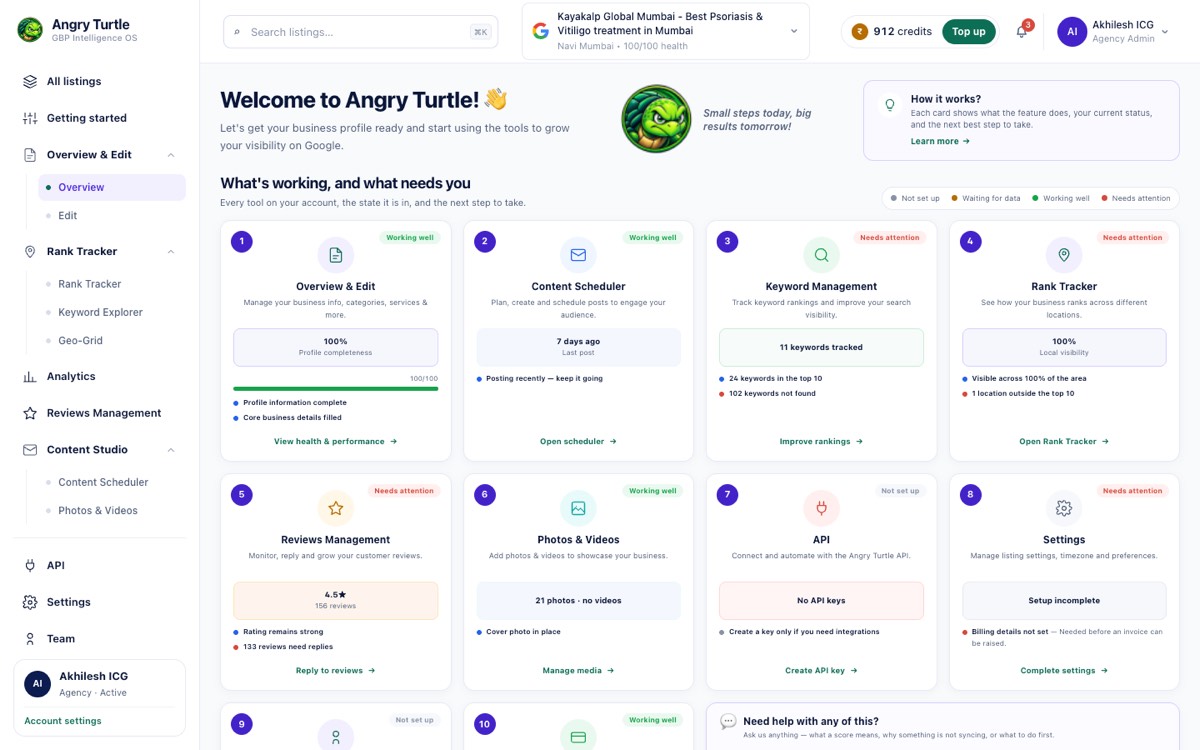
Rank OS gives every profile a 0–100 score built from five weighted dimensions — Relevance, Review Health, Freshness, Entity Authority and AIO Readiness — and the weights are tunable. Underneath it sits a ranked list of the fixes that move the number, each with the point lift it unlocks.
Ready to have this run for you?
Book a free audit — we'll show you where you stand in 48 hours.