 Angryturtle
Top 50 Business Listing Sites in India for Local SEO
The definitive list of Indian business listing sites for local SEO — from JustDial and Practo to niche verticals. With submission tips and NAP consistency advice.
·
The definitive guide to business listing sites in India (2026)
Business listing sites in India — the third-party directories that carry your business's name, address, and phone number, commonly shortened to NAP — are a primary local SEO ranking factor. Citations matter everywhere, but India's business listing sites look nothing like the US or UK: JustDial, Sulekha, and IndiaMART carry more local authority for Indian searches than most Western directories ever will, Practo dominates healthcare discovery, and 99acres and MagicBricks anchor real estate.
In short: the business listing sites worth your time in India are a different list than the one most global SEO guides hand you, and getting the tier order right matters more than covering every directory that exists.
Search demand for this topic uses several different phrasings for the same thing — business listing website India, business listing websites in India, local listing websites, india business listing sites in that word order — and all of them point at the same underlying list. Worth naming one distinction while we're on terminology: JustDial functions less like a directory and more like a local search engine in its own right. A large share of Indian searchers open JustDial directly instead of Google when they want a nearby business, which is exactly why claiming and correcting a JustDial listing carries more weight here than the equivalent directory does in most other markets.
This guide covers 50 of the most valuable business listing sites in India, organised by authority tier and vertical relevance, plus the submission discipline that actually makes citations count, which ones are worth your time first, and where the effort stops paying off.
Before anything else: every listing needs identical Name, Address, and Phone, matching your Google Business Profile exactly. Abbreviations, format variants, and old phone numbers dilute the citation authority you're trying to build — a citation with the wrong number doesn't just fail to help, it actively confuses any system trying to verify your entity. NAP consistency is the single technical concept underneath everything in this guide.
Tier 1: high authority, general
Google Business Profile is the foundation everything else reinforces — claim, verify, and fully optimise before touching any other directory.
JustDial is India's most-used general directory, with extremely high domain authority and significant consumer traffic, especially in Tier 2 cities. Claim it and keep it current — JustDial often surfaces outdated information auto-populated from old data sources.
IndiaMART carries very high domain authority as a B2B and general directory, particularly valuable for professional services, manufacturers, distributors, and B2B-facing businesses.
Sulekha is service-focused, with strong consumer traffic for home services, education, events, and professional services.
Bing Places for Business has lower traffic than Google in India but high domain authority, and its data feeds Bing Maps and various Microsoft products.
Apple Maps matters increasingly as iPhone adoption grows in urban India, since its data feeds Siri's local search results.
A Facebook Business Page is a high-DA citation that also surfaces in local search results for brand-name queries and feeds Facebook's own local search feature.
LinkedIn's Company Page carries particular value for B2B businesses, professional services, and corporate entities.
Google Maps, distinct from GBP itself, is confirmed through GBP verification but exists as a separate citation point in location data.
Foursquare has lower consumer-facing traffic in India but high domain authority, and its data feeds a range of third-party apps and data consumers — a citation here has downstream effects beyond its own visible traffic.
Tier 2: high-value vertical directories
For healthcare: Practo is the primary healthcare directory in India, essential for clinics, hospitals, diagnostic labs, dentists, and dermatologists, and it also drives direct appointment bookings. Lybrate covers doctor consultations and clinic listings as a valuable secondary citation. Bajaj Finserv Health is a growing health platform with appointment booking, relevant for clinics with tie-ups. Apollo 24|7 matters significantly for Apollo-affiliated hospitals and specialists and is gaining relevance for non-affiliated clinics too. 1mg (Tata 1mg) matters primarily for pharmacies and diagnostic labs, with high consumer traffic for health product and lab test searches.
For real estate: 99acres is the dominant property portal, essential for developers, brokers, and agents, and NAP consistency between 99acres and GBP is a key local authority signal in this vertical. MagicBricks is the second-largest portal with the same NAP-consistency logic applying. Housing.com carries major urban traffic. NoBroker is strong for rental listings and individual agent citations. PropTiger is developer-focused, valuable for new project launches specifically.
For hospitality and food: Zomato is the primary food discovery platform, essential for restaurants and cafés, with high domain authority and very high consumer traffic. Swiggy's restaurant listing works as both citation and revenue channel. MakeMyTrip is essential for hotels and resorts and also cites restaurants in travel-relevant locations. Goibibo is a major OTA with high-DA hotel listings. Booking.com carries global domain authority, particularly relevant for hotels targeting domestic and international travellers. Agoda has strong Southeast Asia and India presence. TripAdvisor carries very high domain authority and matters for hotels, restaurants, and tourist-area businesses as both review platform and citation.
Free, freemium, or paid — and what that actually changes
Every directory in this guide has a free listing tier. GBP, JustDial's basic listing, IndiaMART's free seller profile, Sulekha's basic business page, Practo's free clinic listing, and 99acres' free broker profile all let you claim a NAP entry and appear in that directory's own search results without paying anything. That free tier is what carries the citation value this guide is actually about.
Several of these platforms also sell a paid tier on top: JustDial sells enhanced visibility packages within its own search results, IndiaMART sells paid seller memberships with more product listings and lead-routing features, Practo sells paid placement and its booking-and-payments infrastructure, and 99acres sells premium listing slots for developers and agents. None of them publish what those packages cost in a way worth repeating here — check the vendor's own pricing page if you're evaluating one. What matters for this guide is narrower: paying for a premium tier on a directory can improve your visibility inside that directory's own results, and it sometimes adds a verified badge, but none of it is a documented, guaranteed lever for your Google local pack ranking. Treat any paid directory package as a platform-specific marketing spend you're evaluating on its own merits, separate from the citation value, which the free tier already delivers.
Tier 3: general authority directories
TradeIndia is a B2B directory with high domain authority, relevant for manufacturers, distributors, and B2B services. Yellowpages India is a classic directory with lower traffic than JustDial but still a valid citation source. AskLaila is regional and city-focused with good domain authority for Indian local search. Grotal is a general Indian directory useful for citation breadth. Hotfrog India is an international directory with India presence contributing to breadth. Cylex India, of German origin with India presence, carries high international domain authority. Brownbook is a global directory with India coverage and good domain authority. Tupalo is a location-based review and discovery site with Indian coverage. Yelp India has limited consumer traction here but very high global domain authority, still valuable for citation authority. Merchant Circle, US-origin but accepting Indian listings, carries high domain authority. n49.com and Wand.com are both business directories with India coverage that contribute to breadth. LocalStack is a local business data aggregator contributing to citation distribution.
Tier 4: industry and association directories
FICCI's member directory carries high domain authority for registered member businesses. CII's member directory is valuable for corporate entities. NASSCOM matters for technology companies and IT services specifically. ASSOCHAM offers a general industry membership directory. CREDAI's directory is a high-authority citation for RERA-registered developers. IMA is relevant for doctors and healthcare organisations. NABH is a very high-trust citation for accredited hospitals. The Bar Council directory is relevant for law firms and advocates. ICAI's member directory is essential for CA firms. Startup India, a government-run registry, carries high domain authority and relevance for registered startups.
If you can only do five, do these first
Most small and mid-sized businesses don't have the time to work through all 50 sites in one push, and they don't need to. If the choice is five listings or none, here's the order that returns the most citation value for the least effort.
Google Business Profile first, always — it isn't optional and isn't really a "listing" in the same sense as the rest, it's the anchor everything else points back to. JustDial second, because of its sheer reach across Indian search behaviour, particularly outside the metros. IndiaMART third if you're B2B-facing at all, otherwise Sulekha third if you're a consumer-facing service business. Fourth is your single most relevant vertical directory — Practo for healthcare, 99acres or MagicBricks for property, Zomato for food and hospitality — whichever one your actual customers are searching on. Fifth is Bing Places, mostly because it takes fifteen minutes and quietly extends your reach into Microsoft's ecosystem without any real ongoing effort.
That's a Saturday afternoon, not a quarter-long project, and it covers the directories doing most of the actual work. Everything past that — Tier 3 for breadth, Tier 4 for industry-specific trust signals — is worth doing eventually, but it's diminishing returns from here.
A worked example: an electrical contracting business in Nagpur
Take a two-person electrical contracting business in Nagpur, doing residential wiring and repair work, with one owner who also does the fieldwork and one office assistant handling calls. They have roughly four hours a week to spend on anything that isn't billable work, and no existing directory presence beyond a GBP that's been claimed but barely touched.
Given that constraint, the right sequence isn't "work through the tier list" — it's GBP first, fully filled out with services listed individually rather than bundled under "electrical services," because "wiring repair" and "electrical panel installation" are each their own searchable service line. JustDial second, because Nagpur's Tier 2 search behaviour leans heavily on JustDial for exactly this kind of home-services query, and it's where a homeowner actually searching "electrician near me" in Nagpur is most likely to land outside Google itself. Sulekha third, since it's the strongest vertical fit for home services specifically. That's three listings, roughly ninety minutes of setup time in total, done inside the first week.
IndiaMART doesn't make the cut here — it's a B2B and bulk-buyer platform, and a residential electrician has almost no reason to be there. Tier 4 industry bodies don't make the cut either; there's no electricians' trade association carrying meaningful local search weight for this business's actual customers. The honest recommendation for this specific business is three listings, not five, because the fourth and fifth slots on the general list don't map to how this business's customers actually search. That's the judgment call every business needs to make for itself — the tier list is a menu, not a checklist everyone has to clear in full.
Submission best practices
Export your canonical NAP exactly as it appears on your GBP before starting anything else, and treat that export as the single reference for every submission — no abbreviations, no reordering, no swapping in an old phone number because it's what's on file elsewhere.
Work Tier 1 first (GBP, JustDial, IndiaMART, Sulekha, Bing Places, Apple Maps), then move to the Tier 2 verticals relevant to your industry, then Tier 3 for breadth.
Before creating a new listing anywhere, search the directory for an existing listing under your business name. Claiming and correcting an existing entry is almost always preferable to creating a duplicate listing — duplicates split authority and confuse anything cross-referencing your entity later, including AI systems checking entity consistency.
Citations degrade over time. Phone numbers change, directories accept third-party edits, and listings drift. Run a citation audit roughly every six months to catch and correct that drift before it compounds. Citations and NAP tooling can carry this audit automatically once the list of directories to check grows past what's practical by hand.
Most submissions take longer than people expect on the first pass and far less on every one after. Expect fifteen to twenty-five minutes for a first Tier 1 listing — finding the right category, writing a description, uploading photos, waiting on an OTP or email verification. The second and third Tier 1 listing usually take half that, once the description and photo set exist and just need reformatting. Tier 2 vertical listings run longer the first time, particularly Practo and 99acres, because they ask for licence numbers, credentials, or RERA registration that a general directory doesn't. Budget an afternoon, not an hour, for a healthcare or real estate business setting up its full vertical presence for the first time.
What actually goes wrong when NAP drifts
The most common concrete failure looks like this: a business changes its landline to a mobile number two years ago, updates GBP and its website, and stops there. JustDial still shows the old landline, because JustDial pulled that number from a data aggregator years earlier and nobody went back to correct it directly. A customer calls the JustDial number, gets no answer or a wrong number, and either gives up or leaves a review complaining about it — a review that has nothing to do with service quality and everything to do with an uncorrected citation.
The second common failure is a founder's personal mobile number ending up on one directory while the business landline sits on another, with no single source of truth for which number is actually current. This tends to happen when a business is claimed by different people at different times — one team member claims JustDial, another claims IndiaMART six months later using whatever number they had on hand — and nobody owns the canonical record across all of it. Untangling this after the fact means going directory by directory rather than fixing one central source, because there usually isn't one central source once it's spread this far.
The third is Tier 3 breadth work done before Tier 1 and vertical Tier 2 are locked down — time spent claiming Yellowpages India or Cylex India while JustDial still shows a defunct address, which is effort spent on the wrong priority entirely.
Keeping NAP consistent once you're live everywhere
The work doesn't end at submission. A NAP entry that was correct on day one drifts for reasons that have nothing to do with anything you did wrong: a directory's own data-refresh cycle pulls in a stale record from an aggregator, a competitor or a confused customer submits a "correction" through a directory's public edit feature, or a directory simply migrates its database and mangles formatting in the process, turning "Shop 4, MG Road" into "Shop-4 M.G Road" somewhere along the way.
The practical fix is a recurring calendar entry, not a one-time project. Every six months, work back through the same list you used for initial submission, starting with Tier 1 since that's where drift does the most damage, and check each listing against your canonical NAP export rather than against memory. For a single-location business, this is maybe an hour every six months once the habit is established. For a business with five or more locations, or one spread across more than fifteen directories, checking by hand stops being a reasonable use of anyone's time, and that's the point where citation-tracking software or a managed audit — citation and NAP tooling covers what this looks like as an automated, standing check rather than a recurring manual task — starts paying for itself in the hours it saves alone, before counting anything else it catches.
The other habit worth building alongside the calendar check: whenever the business itself changes something — a new phone number, a moved location, a renamed brand — treat "update every directory" as part of that change, not an afterthought that happens whenever someone remembers. Most NAP drift traces back to exactly one of these events happening on the website and GBP while the other dozen listings just sit there, unchanged, until someone runs the audit.
Where directory listings stop being worth the effort
Not every business needs all four tiers, and pushing into Tier 4 industry directories in particular is only worth it for businesses that actually benefit from that specific trust signal — an accredited hospital citing its NABH listing, a RERA-registered developer citing CREDAI, a CA firm citing ICAI. A solo consultant or a small retail shop gets essentially nothing from chasing FICCI or ASSOCHAM membership directories; that's effort better spent finishing Tier 2 vertical coverage or, more usefully, generating and responding to reviews.
Tier 3 breadth directories carry real but small incremental value once Tier 1 and relevant Tier 2 are done properly — treat them as a background task to pick up over months, not something to front-load. And a directory with essentially no relevance to your business type — IndiaMART for a residential electrician, 99acres for a dental clinic — isn't worth claiming just because it's on a list somewhere. The tiers describe where authority tends to concentrate across Indian search generally; whether a specific tier or directory applies to your specific business is a separate question, and it's worth answering honestly before spending the afternoon.
Frequently asked questions
What are the best business listing sites in India? JustDial, IndiaMART, and Sulekha carry the most general-purpose authority, with Practo, 99acres, and Zomato leading their respective verticals. The full 50 above break down which of those actually apply to a given business.
What is a business listing website India businesses should prioritise first? Google Business Profile, regardless of sector, followed by JustDial and then either IndiaMART or Sulekha depending on whether the business is B2B or consumer-facing. The tier breakdown above covers the full set of india business listing sites by authority and vertical relevance, not just the first few.
How many citations does a business actually need? There's no fixed number. Coverage across Tier 1 plus the relevant Tier 2 verticals for your industry typically covers the meaningful authority; Tier 3 and 4 add breadth but with diminishing returns past a certain point.
Should every location have its own citation on every directory, or just the brand? Every physical location that serves customers directly should have its own listing where the directory supports multiple locations — a single brand-level citation understates a multi-location business's actual footprint. Multi-location local SEO covers the structural side of this at scale.
What's the fastest way to find NAP inconsistencies across dozens of directories? A manual search-by-search audit works for a handful of directories, but past 15-20 platforms it's worth using citation-tracking software or a managed service — manage 100+ GBP listings covers the tooling this requires at scale, and location data management covers the underlying discipline.
Does paying for a premium directory listing (JustDial's paid tier, for example) meaningfully help SEO? It can improve visibility within that specific directory's own search results and sometimes adds features like verified badges, but it's not a guaranteed local pack ranking lever on Google — treat it as a platform-specific investment, not a universal SEO one.
Is it worth using a citation-building service instead of doing this manually? For under ten citations, manual submission is usually fast enough to do yourself. Past that, particularly across multiple locations, the time cost of manual submission and the ongoing audit burden tend to justify a managed service — see Rank OS for how citation coverage rolls into a broader entity-authority score alongside NAP consistency, and local SEO agency India for the managed option.
Managing citations across 20+ platforms is our core service — Angryturtle audits and corrects the full stack as part of managed local SEO. See pricing or book a demo to see how this maps to your own directory footprint, or get in touch with specific questions.
Stop guessing where you rank locally.
Rank OS scores your Google Business Profile the way Google's local algorithm does — relevance, review health, freshness, entity authority and AIO readiness — and shows you exactly what to fix.
Book a live demo →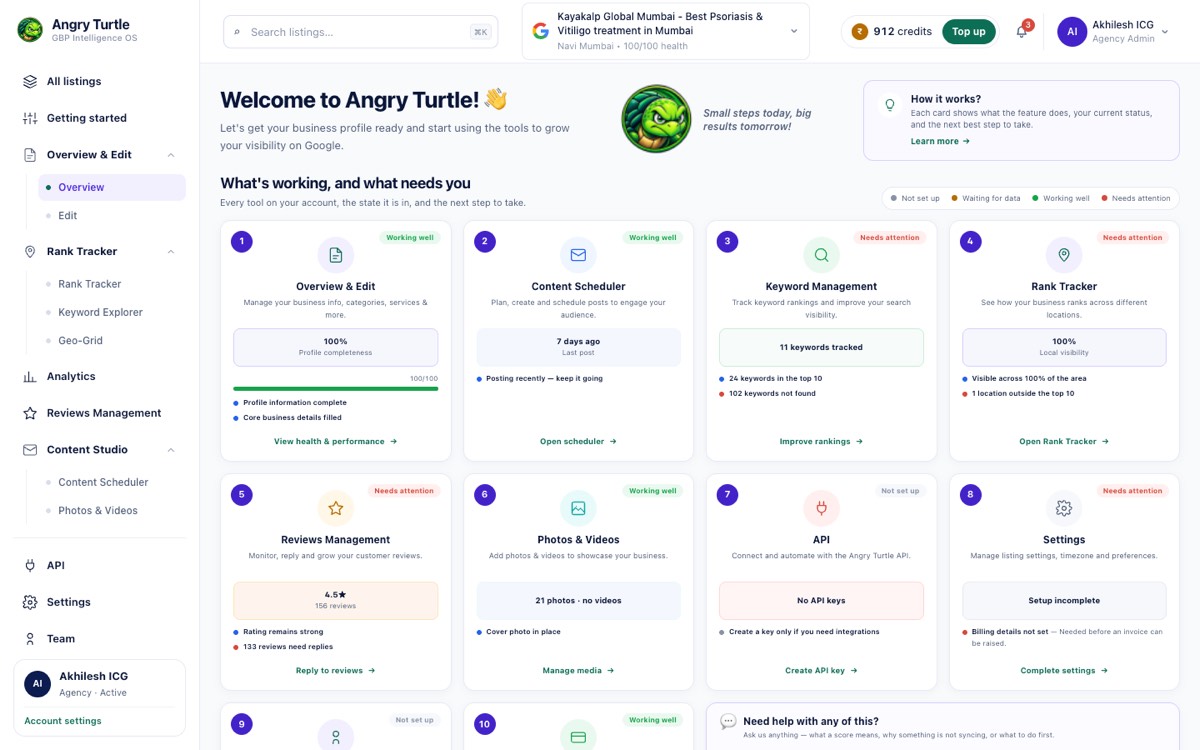

Related reading
Ready to have this run for you?
Book a free audit — we'll show you where you stand in 48 hours.