 Angryturtle
Generative Engine Optimisation (GEO) Explained
What generative engine optimisation is, how it differs from AEO and SEO, and what Indian local businesses can do now to position for AI-driven discovery.
·
Generative engine optimisation, usually shortened to GEO, is the discipline of making a business visible and citable inside AI-generated answers, not just inside a traditional list of search results.
When someone asks ChatGPT "which dental clinics in Gurgaon are most recommended," or asks Perplexity "best dermatologist near Koramangala," the model produces an answer synthesised from its training data and, for browsing-capable models, from live web sources it crawls in the moment. GEO is the practice of making sure your business shows up in whichever of those sources the model is actually drawing from.
GEO versus AEO versus traditional SEO
| Traditional SEO | AEO | GEO | |
|---|---|---|---|
| Target platform | Google Search, blue links | Google AI Overviews | ChatGPT, Perplexity, Gemini, Copilot |
| Output type | Ranked list of URLs | AI text plus source chips | AI-generated recommendation text |
| How businesses get cited | A URL in results | Named inside the AI summary | Named inside the AI response itself |
| Core signals | Links, content, technical SEO | GBP, reviews, entity structure | Web presence, reviews, structured data, press mentions |
| Maturity | Mature | Emerging | Early-stage |
All three disciplines lean on shared foundations — a business with strong traditional SEO, a complete GBP, and consistent citations already has the base layer all three need. GEO adds its own layer of content and structure requirements on top of that base, rather than replacing it. See AEO versus SEO and GEO versus AEO versus SEO for a fuller side-by-side.
How LLMs decide what to recommend for local queries
Large language models don't have direct access to your GBP data the way Google's own local pack algorithm does. They work from two sources instead.
Training data, for non-browsing models, is whatever was in web pages crawled before the model's training cutoff — directory listings, review platform content, news articles, and website content from businesses with a strong existing web presence. Live web browsing, for browsing-enabled models like Perplexity, ChatGPT with browsing turned on, and Gemini, means real-time crawling of whichever sources the model treats as authoritative for that specific query. For a "best dermatologist in Bengaluru" query, a browsing model might pull from the current local pack results, Practo's listing pages for those clinics, relevant blog coverage, and review platform data, all in the same pass.
The practical implication is straightforward: businesses that already rank well in traditional local search, and that show up prominently on platforms like Practo, Zomato, and JustDial, are simply more likely to be pulled into an LLM's browsing results for the same local queries. GEO doesn't replace that groundwork — it builds directly on top of it.
GEO-specific content tactics
Write in a way LLMs can confidently cite. Models prefer content that states facts plainly, with a specific attribution attached. "Our clinic was founded in 2015 and has treated over 8,000 patients" is more citable than "we've been serving the community for many years" — the vague version gives a model nothing concrete to repeat.
Match the conversational shape of real queries. LLM queries tend to sound like actual speech — "which dentist in Bandra is best for kids" — so content written in a natural question-and-answer format, something like "who is the best dentist for children in Bandra," aligns with how the query itself is phrased.
Build a genuinely rich About page. Founding year, credentials, team qualifications, notable achievements, and patient or client volume where you can disclose it — this is the entity-definition content models extract when they need to describe your business rather than just name it.
Earn mentions in third-party articles and listicles. When a piece titled "Top 10 dermatologists in Mumbai" or "Best IVF clinics in Delhi" includes your business, that article becomes a source models can draw on for the same recommendation queries going forward. These mentions compound — one listicle rarely moves the needle alone, but a growing body of them does.
Maintain a well-built Practo, Zomato, or JustDial presence, depending on your category. Models that browse the live web treat these as rich, authoritative local data sources, so a detailed, credential-complete profile on the right platform is doing real GEO work even though it lives outside your own website.
Where GBP, reviews, and structured data fit into GEO
A complete, well-categorised GBP still matters here, since it's frequently one of the sources a browsing model pulls from directly or indirectly through the local pack results it crawls. Review volume and recency, covered in get more Google reviews and GBP ranking factors, feed the same underlying trust and prominence signals GEO draws on, even though the end destination is an AI answer instead of a search results page. And structured data on your own website — LocalBusiness schema, FAQ schema — gives both traditional crawlers and AI crawlers a clean, unambiguous version of your facts to extract, rather than forcing a model to infer them from unstructured prose.
The GEO timeline for India
GEO is genuinely early-stage in the Indian market as of 2026. ChatGPT and Perplexity usage for local discovery specifically is growing but hasn't reached mainstream adoption the way Google Search has. Gemini is more immediately relevant given Google's existing market position and its integration across Google's own products.
There's a real window here. Businesses building GEO-compatible presence now — complete entity information, structured content, a genuine footprint across the directories models actually crawl — are establishing a foundation before GEO becomes table stakes the way traditional SEO already is. Waiting carries a specific, concrete cost: training data cutoffs mean a business absent from web content before a model's cutoff date may simply not appear in that model's non-browsing recommendations, even well after the model ships and users start relying on it.
Common mistakes
The most common mistake is treating GEO as a separate initiative disconnected from existing local SEO work, when in practice the two overlap heavily and compete for the same limited attention and budget. Businesses that try to run GEO as an entirely new project, rather than an extension of what they're already doing for answer engine optimisation and traditional local SEO, tend to duplicate effort rather than compound it.
The second is chasing GEO tactics while neglecting the GBP and review foundation those tactics actually depend on — a beautifully written About page means little if the business isn't showing up in the local sources a browsing model checks first.
The third is expecting fast, measurable results. Given how early-stage LLM local recommendation behaviour still is, and how little standardised tracking exists for it, GEO progress is genuinely harder to attribute than a traditional keyword rank movement — patience and consistent groundwork matter more than a quick campaign here.
Frequently asked questions
Is GEO the same thing as AEO? Related but not identical. AEO generally refers to optimising for Google's own AI Overviews specifically, while GEO covers the broader set of generative AI platforms — ChatGPT, Perplexity, Gemini, Copilot — that don't sit inside Google's search results at all. See GEO versus AEO versus SEO for the full distinction.
Can I measure GEO performance directly today? Not with the same precision as traditional rank tracking. Share of AI voice tracking is the closest available approach — checking how often and how favourably your business is mentioned across a set of representative AI queries over time.
Should a small, single-location business bother with GEO at all right now? It's worth the low-effort parts — a complete GBP, a solid About page, genuine directory presence — since those help traditional SEO regardless of how GEO develops. The higher-effort tactics, like actively pursuing listicle mentions, are more clearly worth it once GEO adoption grows further in your specific category and city.
Angryturtle builds GEO-ready entity infrastructure as a standard part of managed local SEO.
Stop guessing where you rank locally.
Rank OS scores your Google Business Profile the way Google's local algorithm does — relevance, review health, freshness, entity authority and AIO readiness — and shows you exactly what to fix.
Book a live demo →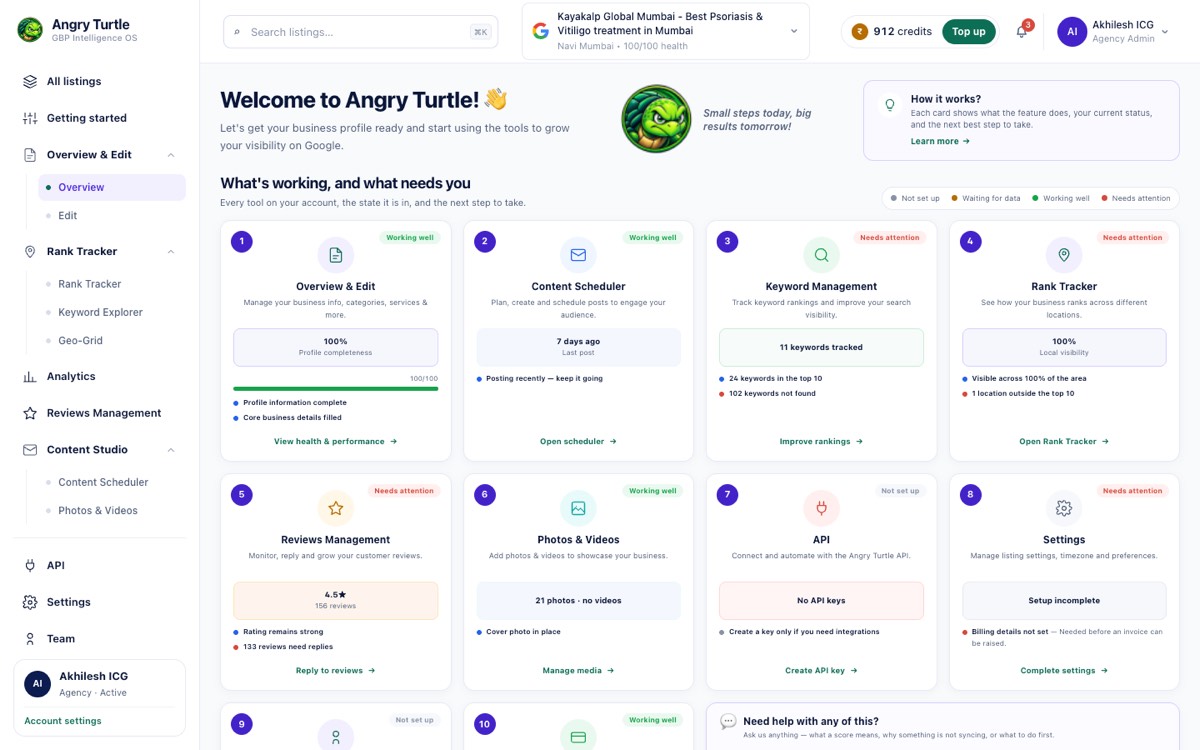

Related reading
Ready to have this run for you?
Book a free audit — we'll show you where you stand in 48 hours.