 Angryturtle
Best GBP Management Practices (2026)
The definitive GBP management playbook for 2026. Covers category selection, photo management, posting cadence, review management, Q&A, and monthly maintenance.
·
Managing a Google Business Profile well isn't complicated. It's consistent. The businesses sitting in positions 1 to 3 of the local pack are almost always there because they do the basics better, and more often, than the businesses stuck behind them — not because they've found some hidden trick.
This playbook runs through every GBP management practice worth doing, roughly ordered from highest to lowest impact, and links out to a deeper page for each one.
Get the category right first
The primary category is the single most consequential field in your profile. It decides which searches you're even eligible to appear for, full stop. A clinic sitting in the wrong category is effectively invisible for the queries that matter most to it, no matter how many reviews it has.
Pick the most specific category that's actually true of your business, not the broadest one that technically applies. "Dermatologist" beats "Doctor" for dermatology searches. "Fine Dining Restaurant" beats "Restaurant" for fine-dining searches. Fill in all nine secondary category slots with anything genuinely applicable, and revisit the full list quarterly — Google adds categories without much announcement. Our GBP categories guide walks through the exact recommendations by industry.
Complete every profile field
Completeness itself functions as a signal. Every blank field is a missed one.
The description (750 characters), services and products, attributes, special hours, a booking link, and a seeded Q&A section all need filling in — not with keyword stuffing, just with accurate, specific information. GBP products and services covers how to structure that section so it does real relevance work instead of sitting empty, which is where most Indian profiles leave it.
Maintain a consistent posting cadence
GBP posts work as both a recency signal and a keyword surface, and the businesses that post occasionally get roughly nothing out of it. Two posts a month is the floor for the signal to register at all; four to six is a sustainable weekly rhythm most businesses can actually sustain without a dedicated content team.
Offer posts need a specific discount, a validity date, and redemption terms — "call for our Diwali offer" gets ignored. Event posts need a real date. Product posts work well for new launches, seasonal menu items, or new course batches. Every post should carry a call-to-action button, and none of them should repeat last month's content word for word. GBP posts frequency has the full monthly template and a 12-month Indian festival calendar; 17 GBP post ideas has ready copy by post type.
Manage reviews actively, both directions
Reviews sit on both sides of the ledger — they're a ranking factor and a conversion signal at once, so generation and response both need ongoing attention.
On generation: ask after every positive interaction, and lean on WhatsApp, which outperforms every other request channel for Indian customers by a wide margin. Use a direct link to your review page, not a request to "search us on Google." QR cards at the point of sale work well as passive, always-on generation.
On response: answer every review, positive and negative, within 48 hours if at all possible. Positive responses should read as personal and specific, not templated. Negative responses should acknowledge the complaint, avoid public disputes, and offer a path to resolution — never argue with a reviewer in the comment thread. Regulated categories like healthcare and BFSI need a compliance check on every response before it goes live. Get more Google reviews has 21 tactics that work for Indian customer behaviour specifically.
Keep photos current and comprehensive
After reviews, photos are the most visible trust signal in the GBP panel — customers scan them before reading a word of your description.
Start with at least 10 photos and build toward 30+ for competitive categories. Cover the exterior with clear signage, the interior, your team, products or dishes, and some behind-the-scenes shots. Upload two or three new photos every month rather than doing a single annual dump, and check the "By customer" tab periodically for user-uploaded photos that might be low quality or unflattering. GBP photos best practices breaks this down by industry, including the exact photo priority order for clinics, restaurants, and hotels.
Monitor and moderate Q&A
The Q&A section is public, and it's only moderated if you're actually watching it. Seed six to eight of the questions customers ask most before their first visit, using a personal account to post the questions and your business account to answer them fully. Turn on notifications so you catch new questions within 48 hours, and report any incorrect third-party answers before they mislead someone. One thing worth flagging here: GBP Q&A is being deprecated as a feature in some markets, so treat it as legacy upkeep rather than a growth lever — worth maintaining, not worth building a strategy around. GBP Q&A management has the seed questions by industry.
Watch for unauthorised profile edits
Google accepts suggested edits from the public and sometimes applies third-party data automatically. That can silently overwrite correct information — a changed phone number, a category swap you never asked for. Check the profile weekly, turn on GBP's own change notifications, and revert anything wrong the moment you spot it. Regulated businesses should pay particular attention to category and description changes, since those carry compliance risk if they drift.
Track performance in GBP Insights
GBP Insights, now labelled Performance in the newer interface, shows calls, direction requests, website clicks, photo views, and search impressions. A sudden drop in calls or directions is often the first visible sign of a suspension, an unauthorised edit, or a rank drop — check it before the problem shows up anywhere else. Rising discovery-search volume, as opposed to direct searches for your business name, is the clearest sign your category and relevance work is paying off. GBP performance insights walks through every metric and what to actually do when it moves.
Run a monthly compliance check
For regulated industries especially, content drifts slowly toward policy violations if nobody's watching: a business name that's accumulated keywords over time, a description with clinical claims that crept in, posts with promotional language that pushes past what's allowed. A monthly look at the business name, description, posts, and Q&A catches this before it becomes a suspension.
Treat suspension as an emergency
A suspended profile disappears from Google Maps entirely — not demoted, gone. Every day of suspension is lost business, particularly for categories where customers rarely scroll past the local pack.
If a profile goes down, don't touch it until you've identified the root cause, and don't submit an appeal until the underlying violation is actually corrected. An appeal filed before remediation is close to guaranteed to fail. GBP suspension reasons covers the ten most common causes in India and the specific fix for each.
What separates the top of the local pack from the middle
No single item on this list moves rank dramatically on its own. What separates position 2 from position 6 is usually that the top business does all ten of these consistently, month after month, while its competitor does two or three of them occasionally. Inconsistency, not ignorance, is the most common GBP management failure we see.
Frequently asked questions
How much time does proper GBP management take per month? For a single-location business doing it properly — posts, review responses, photo uploads, Q&A checks, a performance review — expect several hours a month, spread across the month rather than done in one sitting. Multi-location businesses need this multiplied per location, which is usually where the case for managed GBP services becomes clear.
What's the single highest-priority fix if I've been neglecting my GBP? Check the category first, since everything else you do is wasted if the category is wrong. Then complete every blank field before touching posting cadence — a complete, correctly categorised, inactive profile still outperforms an incomplete, actively-posted one.
Is it worth managing multiple locations the same way? The core practices are identical, but multi-location management adds NAP consistency checks across every listing and a way to spot which location is underperforming relative to its local competitors — see managed local SEO for how that's typically structured.
Stop guessing where you rank locally.
Rank OS scores your Google Business Profile the way Google's local algorithm does — relevance, review health, freshness, entity authority and AIO readiness — and shows you exactly what to fix.
Book a live demo →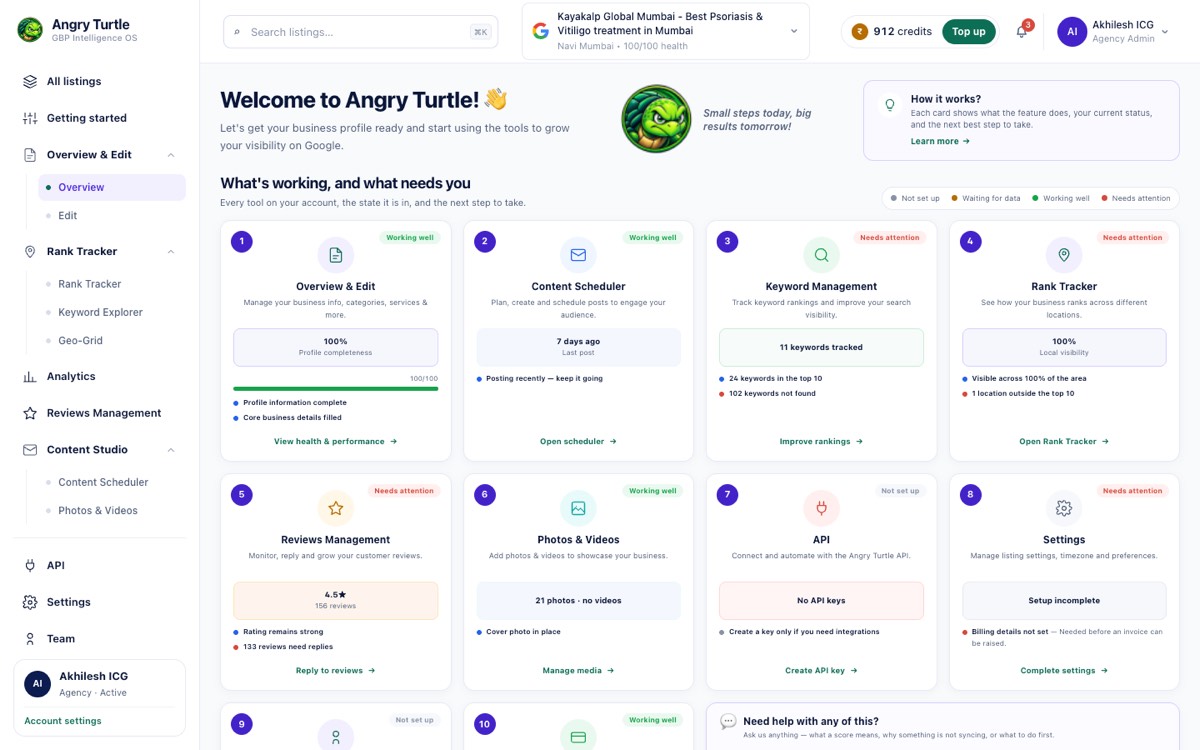

Related reading
Ready to have this run for you?
Book a free audit — we'll show you where you stand in 48 hours.