 Angryturtle
Hospital SEO in India: Multi-Department, Multi-Location Local Search
·
A 200-bed hospital in Pune isn't one local SEO problem. It's cardiology, orthopaedics, maternity, an emergency department, a diagnostic wing, and often a dozen visiting consultants, each of which a patient searches for separately and none of which Google's Business Profile system was really built to represent as one listing. This is what makes hospital SEO in India structurally different from clinic SEO — it's not about optimising a single profile better, it's about deciding how many profiles to have and what each one is responsible for.
Most hospitals get this wrong in one of two directions. Some try to cram every department into a single GBP listing with nine secondary categories doing the work of nine different specialties, which dilutes relevance for all of them. Others spin up a separate listing per department without any coordination, and end up with five profiles competing against each other in the same local pack, or worse, flagged as duplicates.
Deciding what deserves its own listing
Google's guidelines are reasonably clear here even though hospitals routinely ignore them: a single physical location generally gets one Business Profile. A hospital doesn't get a separate GBP for cardiology and a separate one for orthopaedics just because patients search for them differently — that's a duplicate listing risk, and cleaning it up later is harder than not creating it. Where a genuinely separate listing is justified is when a department operates at a distinct address or has its own dedicated entrance, staff, and booking system that functions independently of the main hospital — a standalone diagnostic centre on the same campus, or a satellite outpatient clinic in a different part of the city, covered in more depth in finding and killing duplicate listings at scale.
For the single-listing case — one hospital, multiple departments, one address — the category strategy is to pick the dominant identity as primary (usually "Hospital" for anything above roughly 50 beds, per the category table in choosing the right GBP category) and use secondary categories and, more importantly, the services list and GBP Q&A to spell out every department by name. A hospital that only lists "Hospital" as its category is invisible to a "maternity hospital near me" search that a competitor with "Hospital" plus "Maternity Hospital" as a secondary category will win.
Where department-level search actually gets served
Since one GBP listing can't carry nine distinct search intents equally well, the department-level differentiation has to happen on the hospital's own website, through dedicated department landing pages that each target their own search terms — "cardiology department Pune," "maternity ward Pune" — and interlink back to the main hospital location page. This is the same logic covered generally in local content and landing pages, applied to a hospital's internal structure: the GBP listing sends the map-pack click, the website page catches the specific intent once the patient lands, and internal links between department pages keep a visitor who came in for orthopaedics from bouncing if what they actually need is physiotherapy.
Multi-location hospital groups
Chains with branches across cities — a hospital group with a Bengaluru flagship and satellite branches in Mysuru and Mangaluru — face the harder version of this problem: managing dozens of listings that need consistent branding but distinct, correct local detail for each city. NAP consistency has to hold across every branch without collapsing into a single templated profile that ignores each location's actual services, staffing, and hours; the mechanics are in multi-location local SEO strategies and, for the governance side of running this at scale, enterprise multi-location governance. Branches also need their own review pipelines — a flagship hospital with 2,000 reviews and a two-year-old satellite branch with 40 aren't comparable, and treating them with the same review-generation cadence usually means the satellite branch stays under-reviewed indefinitely.
Bulk management is where most multi-location hospital groups actually fail, not strategy. Nine correct department listings updated once and never touched again drift out of date faster than nine listings each getting a monthly review; bulk operations via the GBP API exist specifically because manual per-listing updates don't scale past a handful of locations.
Suspension risk is higher for hospitals, not lower
A common assumption is that a large, established hospital is somehow safer from a GBP suspension than a small clinic. It isn't — if anything, the more departments and secondary categories a listing carries, the more surface area there is for a mismatch between what's claimed and what's verifiable, and healthcare listings already get stricter review than most categories. GBP suspension reasons and, for hospitals specifically working through an active suspension, writing a GBP reinstatement appeal cover what that review process actually checks and what evidence helps an appeal.
Reviews across departments
A patient's maternity ward experience and a patient's emergency department experience are not the same review, and treating hospital reviews as one undifferentiated stream misses a lot of useful signal — see reviews and AI search visibility for how review content itself, not just star rating, feeds into whether a listing gets treated as a trustworthy source. Encouraging department-specific detail in review requests ("how was your experience with the cardiology team?") produces reviews that actually mention the department, which helps both human searchers scanning reviews for a specific specialty and any AI system trying to answer a department-specific query about the hospital.
AI search and hospital discovery
Patients increasingly ask AI assistants department-specific questions rather than generic ones — "which Pune hospital has a NICU" rather than "hospital near me" — and answering that well depends on the same structured, department-explicit information covered above: accurate categories, a services list that names each department, and schema that reflects the hospital's actual specialties, detailed in schema markup for AI search and AI overviews for local business in India. A hospital that's done the category and department work for ordinary search is most of the way to being AI-citable too.
What a platform actually adds at this scale
Running this manually across even a five-branch hospital group means tracking category accuracy, review velocity, and NAP consistency separately for every listing, on a schedule nobody has time for. Angryturtle's Rank OS scores each location independently against the same five weighted dimensions — relevance, review health, freshness, entity authority, AIO readiness — so a group can see which branch is actually falling behind rather than assuming they're all fine because the flagship is. The agency and enterprise operating system handles the portfolio view across locations, and managed GBP services can execute the category audits, citation cleanup, and ongoing updates directly rather than leaving it to whichever department has bandwidth that month. The hospitality-adjacent healthcare industry page covers how the cluster taxonomy is built specifically for medical practices.
Nothing here is medical advice, and no tool or agency can guarantee a Google ranking outcome for a regulated healthcare listing — Google's review and ranking systems are outside anyone's direct control. What's controllable is getting the listing structure, categories, and review process right and keeping them that way.
Frequently asked questions
Should a hospital's ICU or emergency department have its own GBP listing? Generally no, unless it operates at a genuinely separate address with its own entrance and staff. Department-level search intent should be served through website landing pages and the services list on the main hospital listing, not a second GBP profile at the same address.
How many secondary categories should a large multi-department hospital use? Up to the nine-category limit, using every one that's genuinely true — but the category list alone can't carry nine distinct specialties well. Lean on the services list and GBP Q&A to name each department explicitly rather than relying on secondary categories to do all the work.
Does a hospital group need one review strategy or one per branch? One per branch. A flagship location with years of review history and a new satellite branch are at different stages, and a single group-wide review cadence usually leaves newer or smaller branches under-reviewed.
What's the biggest local SEO mistake hospital groups make? Creating duplicate listings for departments or satellite services at the same address, which fragments review signal and search relevance across profiles that should have been one. Cleaning this up after the fact takes longer than getting the structure right from the start.
Can AI search tools answer department-specific hospital questions accurately? Only as well as the underlying data supports. A hospital with accurate categories, a detailed services list, and correct schema gives AI systems something citable to work from; a listing that only says "Hospital" with no further detail leaves an AI system with nothing specific to answer a department-level query with.
Stop guessing where you rank locally.
Rank OS scores your Google Business Profile the way Google's local algorithm does — relevance, review health, freshness, entity authority and AIO readiness — and shows you exactly what to fix.
Book a live demo →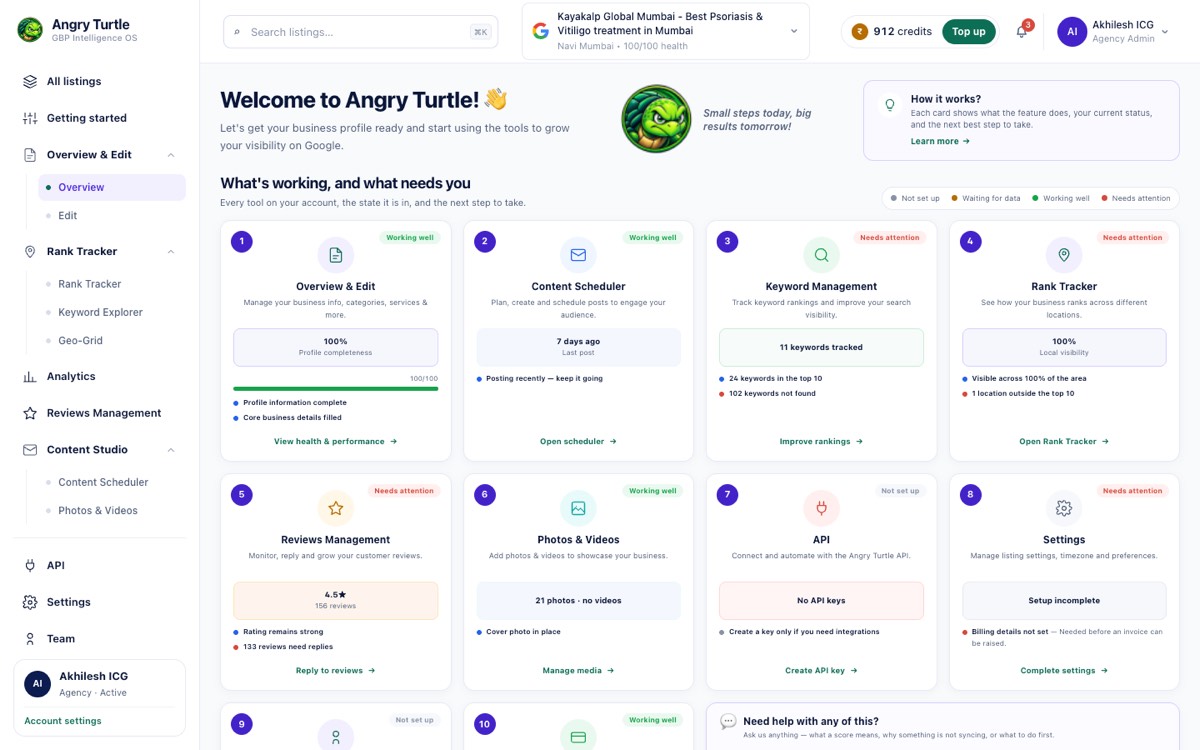

Ready to have this run for you?
Book a free audit — we'll show you where you stand in 48 hours.