 Angryturtle
Writing a GBP Reinstatement Appeal That Gets Read
·
A suspended Google Business Profile stops showing on Maps and in local search results the same day it's flagged, and the appeal that follows is often the difference between a business back online in a week and one stuck in limbo for months. Most appeals fail not because the business did anything wrong, but because the appeal itself was vague, defensive, or missing the specific evidence Google's review team actually needs to reverse the decision. This is what a suspension appeal needs to include to actually get read and taken seriously — and what reliably gets one rejected.
Google alone decides the outcome of any appeal. Nothing in this guide, or any service built around it, can guarantee reinstatement — what follows is about giving an appeal the best realistic chance.
Understand which kind of suspension you're dealing with first
Google distinguishes between a soft suspension, where the listing stays live but loses certain features or visibility, and a hard suspension, where the entire profile disappears from Maps and Search. The appeal process and the evidence that helps differ depending on which one applies, and GBP suspension reasons breaks down the common triggers for each — category misrepresentation, guideline violations around reviews or content, verification problems, or a spam or duplicate-listing flag. Knowing the actual trigger, rather than guessing, changes what the appeal should say. An appeal that argues against a violation the listing was never actually flagged for wastes the one shot at a clear, specific response.
Category-related flags are worth checking first, since they're the most common trigger and the easiest to misdiagnose — choosing the right GBP category covers what an accurate category actually requires, and a business that hasn't already corrected a genuine mismatch is appealing a decision that's still technically correct.
What a strong appeal actually contains
The single biggest difference between an appeal that gets read carefully and one that gets a form rejection is specificity. A strong appeal names the exact policy the business believes it complies with, states plainly what may have triggered the flag, and provides documentary evidence that directly answers the suspicion — not a general defence of the business's reputation.
For a category-related suspension, that means documentation showing the business genuinely operates in the category it claims: a registration certificate, a professional licence for a regulated field like healthcare, photos of a real physical premises matching the address on file, or utility bills confirming the business operates from that location. For a duplicate-listing flag, it means clearly identifying which listing is the correct one and providing evidence — ownership documents, a business registration number matching both listings — that explains why a second listing existed and confirms it should be merged or removed rather than treated as evidence of deception. Finding and killing duplicate listings at scale walks through how to identify and resolve the underlying duplicate before the appeal is even filed.
For a review-manipulation flag, evidence needs to show the business didn't solicit fake reviews or incentivise reviews in violation of policy — this is harder to prove directly, and honesty about what actually happened, including any legitimate review-request process the business runs, tends to read better to a human reviewer than a blanket denial with no detail behind it. The kind of review activity that actually helps a listing, versus what crosses into manipulation, is covered in reviews and AI search visibility.
For a service-area business flagged over an address or coverage discrepancy, the appeal needs to show the declared service area matches actual operations — see setting up GBP service areas correctly for what a compliant setup looks like in the first place.
What gets an appeal rejected
A generic appeal that says "please reinstate my listing, I run a legitimate business" with no supporting evidence gets rejected almost automatically, because it gives Google's review team nothing new to evaluate against the original flag. Submitting multiple appeals in quick succession without addressing why the first was denied tends to slow the process down rather than speed it up — each new submission usually restarts the review queue rather than escalating the case.
Appeals that argue Google made a mistake without providing anything to substantiate that claim rarely succeed, even when the business genuinely believes the flag was wrong. The appeal needs to prove the business's side, not just assert it. And appeals filed before the business has actually fixed the underlying issue — a wrong category still uncorrected, a duplicate listing still live — are asking Google to reverse a decision while the thing that triggered it is still true.
The evidence checklist
Business registration documents matching the name and address on the GBP listing. A professional licence or regulatory registration, where the industry requires one — this matters more for healthcare and other regulated categories, where Google's review process is stricter to begin with, a point covered in more depth for hospitals and clinics specifically in hospital SEO in India. Recent utility bills or a lease agreement confirming the business operates at the stated address. Photos of the physical premises, exterior and interior, showing signage that matches the listed business name. For service-area businesses, evidence connecting the business to its declared coverage area. A clear, dated timeline of what happened if the suspension followed a specific event — a move, a name change, a category correction — rather than an unexplained flag, and if the business operates multiple locations, evidence that the flagged listing is being handled consistently with the rest of the portfolio, covered generally in multi-location local SEO strategies.
Timing and what to expect
Google doesn't publish a fixed appeal turnaround time, and it varies by case complexity and the current review backlog. Some appeals resolve within days; others take weeks, particularly for categories under stricter review like healthcare or financial services. Filing a clean, complete appeal the first time is worth more than filing quickly with gaps, because a rejected appeal often means a longer wait for the next review cycle, not an instant retry.
While a listing is suspended, the business doesn't disappear from every channel — reviews already collected remain part of the business's record once reinstated, and citation and NAP work on the site and across directories, covered in NAP consistency at scale, can continue in the background so the listing is in better shape the moment it's back live.
After reinstatement
A reinstated listing is often reviewed more closely for a period afterward, so it's worth over-correcting on accuracy immediately after getting a profile back — the exact category, verified address, and complete services list, following the same fundamentals in GBP management best practices and the GBP optimisation checklist. A second suspension on the same account tends to be harder to appeal successfully than the first, which is part of why ongoing profile monitoring through something like Rank OS matters more after a reinstatement than before one.
Where this gets harder than a DIY appeal can handle
A single clear-cut case — a wrong category corrected, straightforward documentation to prove it — is often manageable as a direct self-filed appeal. Cases involving a duplicate-listing history, a business that's changed address or ownership, or a healthcare or financial listing under stricter review benefit from someone who's actually built appeals before and knows what documentation Google's review team responds to. Our GBP reinstatement service handles exactly this — building the evidence package, drafting the appeal language, and managing the resubmission process if a first appeal needs follow-up — though the decision itself always rests with Google, not with any service acting on a business's behalf. Broader managed GBP services can also take over ongoing profile upkeep afterward so the same trigger doesn't recur.
Frequently asked questions
How long does a GBP suspension appeal usually take? There's no fixed timeline. Simple, well-documented cases sometimes resolve within days; complex ones, or listings in more heavily scrutinised categories, can take several weeks. A complete first submission is generally faster overall than a quick but incomplete one that gets rejected and resubmitted.
Can I file multiple appeals if the first one is denied? Yes, but each resubmission should address specifically why the previous appeal was denied and add new evidence, rather than repeating the same appeal. Submitting several nearly identical appeals in a short window usually slows the process rather than helping it.
What documents matter most for a healthcare listing suspension? Professional licensing or registration documents specific to the medical practice, alongside standard business registration and premises evidence. Healthcare categories go through stricter review, so documentation needs to directly support the specific category claimed.
Does having a lot of good reviews help a suspension appeal? It can support the case that the business is legitimate and operating well, but it doesn't substitute for evidence directly addressing whatever triggered the suspension. A high review count with no documentation to answer the actual flag rarely changes the outcome on its own.
Is there any way to guarantee a suspended listing gets reinstated? No. Google makes the final decision on every appeal, and no business, agency, or platform can guarantee an outcome. What can be controlled is the quality, specificity, and completeness of the evidence submitted.
Stop guessing where you rank locally.
Rank OS scores your Google Business Profile the way Google's local algorithm does — relevance, review health, freshness, entity authority and AIO readiness — and shows you exactly what to fix.
Book a live demo →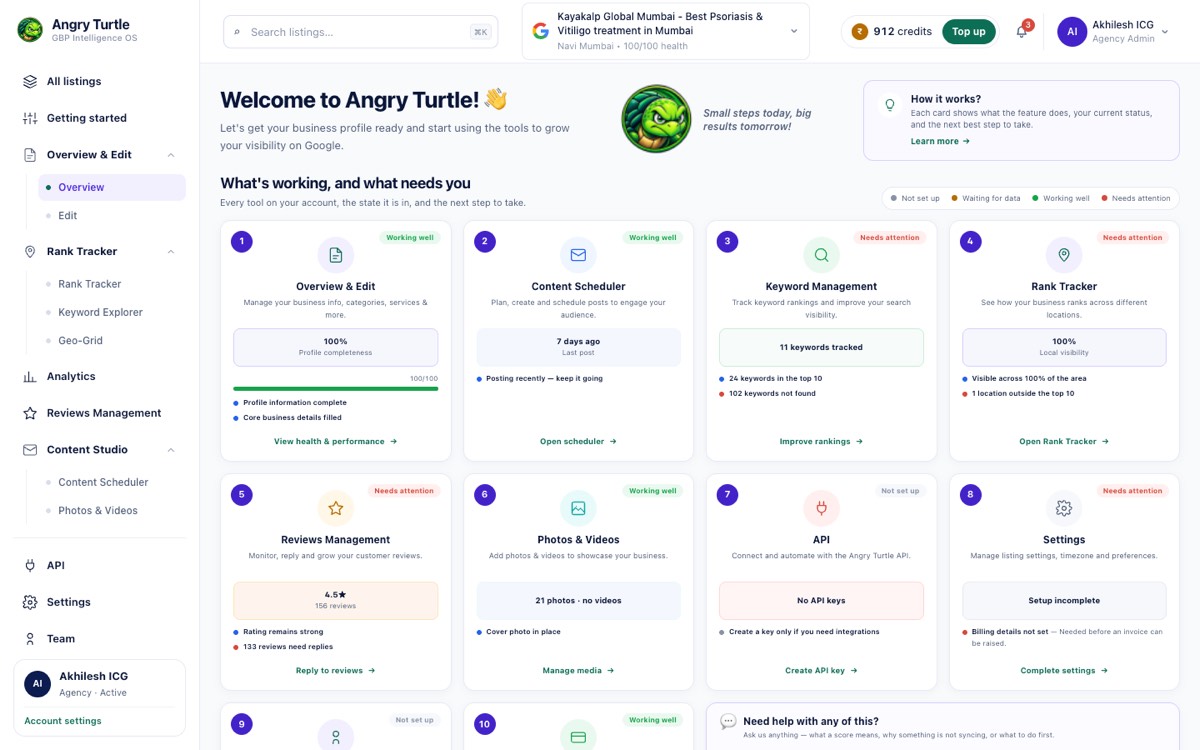

Related reading
Ready to have this run for you?
Book a free audit — we'll show you where you stand in 48 hours.