 Angryturtle
GBP Messaging: Should You Turn It On?
Is GBP messaging right for your Indian business? Decision guide covering response requirements, WhatsApp comparison, setup tips, and when messaging helps vs. hurts.
·
GBP messaging: the feature that helps some businesses and hurts others
Google Business Profile Messaging lets customers send a direct message to a business straight from the GBP panel in Google Search and Maps. Turn it on, and a "Chat" or "Message" button sits next to "Call" and "Directions" — one more way in, before a phone call or a website visit.
It sounds like a feature every business should switch on. It isn't. Enable it without the operational capacity to answer, and it becomes a visible mark against you rather than a conversion channel.
The core requirement: you must respond within 24 hours
Google tracks response rates for GBP messaging and expects a reply within 24 hours of every message received. Fall below the threshold and Google can disable messaging on your profile automatically — no warning email, no grace period announcement, it just goes.
What that means day to day: someone on your team checks GBP messages daily, ideally more than once, and replies. Not aspirationally. Actually. There's no carve-out for a Sunday, a public holiday, or the week your front desk is short-staffed.
If your team can hold that line, messaging is worth turning on. If it can't, one of two things happens. Google disables the feature itself, which is a visible signal of poor responsiveness sitting on your profile. Or the feature stays live with a pile of unanswered messages, which does more damage to a first impression than never having offered messaging at all.
When to enable GBP messaging
Appointment-based businesses with quick yes/no questions get the most out of this. "Do you have a slot Saturday?" "What's the fee for a first consult?" Questions a receptionist answers in thirty seconds. Clinics, coaching institutes, salons, and professional services with someone at the front desk convert these fast queries into bookings that would otherwise have gone to a competitor who answered the phone first.
Businesses fielding the same three or four pre-purchase questions repeatedly also benefit — messaging lets you answer directly and move the customer toward a decision faster than making them call and wait on hold.
And if you've already tried it — turned messaging on, saw bookings and enquiries actually arrive through it — keep it running and resource the reply function properly rather than letting it drift.
When not to enable GBP messaging
No one owns the inbox. If checking GBP messages is a task that "falls to whoever has time," it won't get checked consistently, and inconsistency is exactly what triggers Google's automatic disable. Enable messaging only once a specific person owns it.
High message volume paired with complex questions is another bad fit. Detailed medical queries, layered legal questions, multi-variable loan quotations — these create an expectation of a fast, complete answer that a messaging thread can't actually deliver. You end up either rushing a wrong answer or leaving the customer hanging, both worse than no message button at all.
Solo practitioners should generally skip it. A single doctor, lawyer, or consultant running between patients or clients doesn't have a spare five minutes every few hours to check GBP and reply inside the 24-hour window.
And if WhatsApp is already your primary enquiry channel — customers found your number from the GBP description, the website, or a friend, and use it as their default — GBP messaging just adds a third inbox without adding volume. Consolidate on WhatsApp instead.
GBP messaging vs. WhatsApp: the India-specific reality
In India, WhatsApp is overwhelmingly the preferred channel for messaging a business directly. Customers already know how to use it; many are far less familiar with the GBP chat button, which sits inside an interface they don't otherwise interact with.
For most Indian businesses the actual conversion path looks like this: customer finds the business on Google, then either calls directly or navigates to WhatsApp — via the website, or a number shown on the GBP itself. GBP messaging doesn't replace that path, it just sits alongside it as an extra, thinly used channel.
Unless you genuinely have the staffing to monitor GBP messages consistently, putting "Message us on WhatsApp: [link]" in your profile description does more for conversion than switching on GBP chat. A dental clinic in Andheri that gets four WhatsApp enquiries a day from its GBP description doesn't need a second inbox to also miss.
Setting up GBP messaging, if you decide to enable it
Open the GBP dashboard, go to Messages, and turn it on. Set up an automated welcome message — it fires the moment a customer starts a chat, and it should set expectations rather than promise instant replies. Something like: "Thank you for your message! We typically respond within 2 hours during business hours (9am–7pm Mon–Sat). For urgent enquiries, call us at [number]." That single line does most of the work of managing expectations without committing you to an instant response you can't guarantee.
Download the Google Maps for Business app so notifications actually reach a phone, not just a dashboard nobody opens. And set a daily reminder — a literal phone alarm — until checking messages becomes habit rather than a task someone has to remember.
What write-back to Google actually means here
Angryturtle's platform edits, posts, and replies directly to a business's live Google profile — GBP write-back is confirmed working, not a manual-only workaround. For messaging specifically, that means the welcome message, response templates, and the daily reply cadence can be set up and maintained through the platform rather than someone logging into the GBP dashboard by hand every day. It doesn't remove the need for a human to actually answer substantive questions — messaging still needs a person who knows the business — but it removes the friction of hunting for the message tab inside Google's own interface.
Common mistakes with GBP messaging
Turning it on because a competitor has it, without checking who on the team will own replies. Leaving the default welcome message blank, so the first thing a customer sees is silence. Treating messaging as a second inbox that gets checked "when there's time" rather than on a fixed schedule. And running templated, identical-sounding replies to every enquiry — customers notice, and it undercuts the personal touch that made messaging worth having in the first place.
Do GBP messages show up on the website too? No. Messaging through GBP is a separate channel from any chat widget on your website — the two aren't linked unless you build that integration yourself.
Can I turn messaging off after enabling it? Yes, at any point through the GBP dashboard under Messages. There's no penalty for switching it off if you find the response burden isn't sustainable.
Does a slow response rate affect local ranking? Google hasn't confirmed messaging responsiveness as a direct ranking factor, but a disabled messaging feature and a pattern of unanswered questions both send a weak trust signal that plausibly affects how the profile performs overall.
What's a realistic response time to promise? Set the expectation your team can actually meet — for most small teams, 2 to 4 hours during business hours is honest and achievable, which beats promising "instant" and missing it.
Related reading: for the underlying setup that messaging sits on top of, see how to set up a Google Business Profile in India; for the review-generation side of the same conversion funnel, see how to get more Google reviews. If your team is weighing messaging as part of a bigger profile-completeness push, the GBP optimisation checklist and the GBP posts frequency guide cover the adjacent pieces. Enterprise or multi-location teams evaluating messaging across many branches at once should look at the Google Business Profile API for what's automatable versus what still needs a person. For AI-era context on why responsiveness increasingly matters beyond just ranking, see Google Business Profile AI features and the glossary entry on GBP messaging.
Angryturtle advises on GBP messaging as part of managed GBP services →
Stop guessing where you rank locally.
Rank OS scores your Google Business Profile the way Google's local algorithm does — relevance, review health, freshness, entity authority and AIO readiness — and shows you exactly what to fix.
Book a live demo →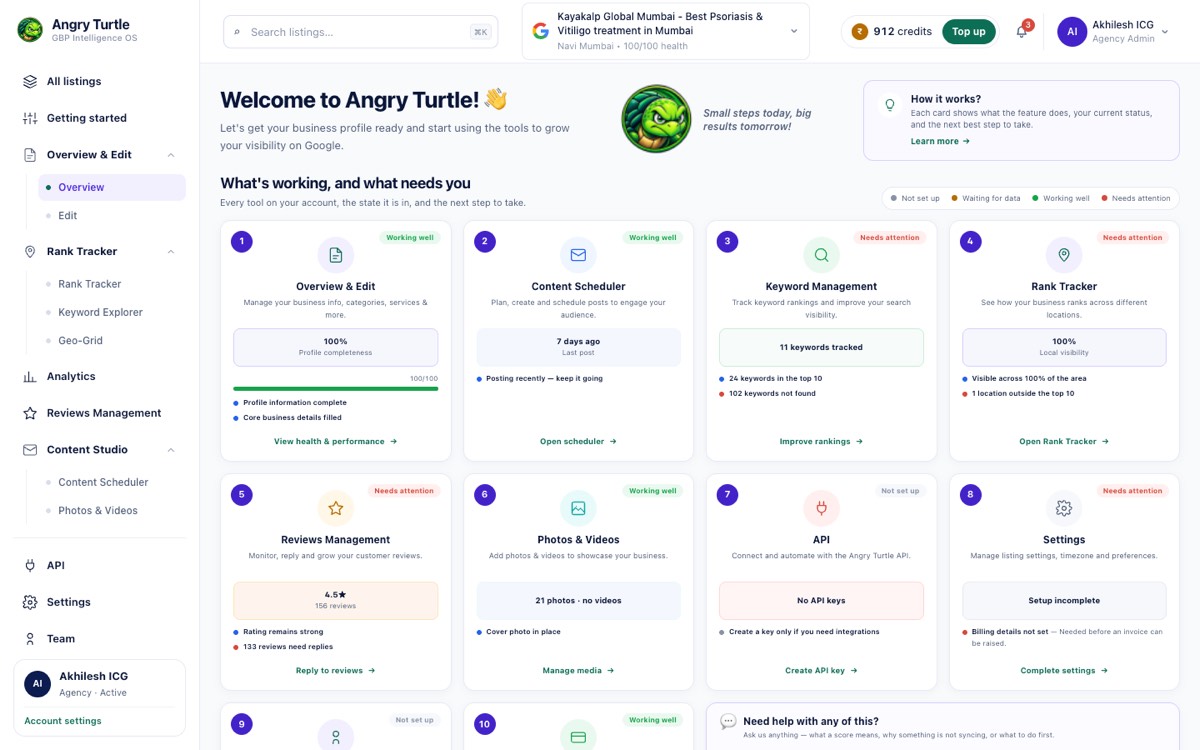

Related reading
Ready to have this run for you?
Book a free audit — we'll show you where you stand in 48 hours.