 Angryturtle
Local SEO in Agra
Splitting tourist-facing and resident-facing strategy in a city with two markets.
·
Ask ten people what business a Google search for "best hotel in Agra" is trying to satisfy and nine will say tourism. That's correct, and it's also the wrong lens for maybe half of what actually needs local SEO in this city. Agra runs two markets that barely overlap: the Taj-adjacent tourist economy, and the ordinary resident city underneath it, and a local SEO plan that doesn't separate the two ends up optimising a dentist's GBP like a heritage hotel's, or the reverse.
The tourism-resident split, not the addressing quirk, decides strategy here
Businesses in Taj Ganj and along Fatehabad Road live and die by tourist search volume that spikes hard in winter and thins out through the monsoon months. A hotel or a marble-handicraft showroom that leaves its GBP hours, photos, and posts untouched between seasons is quietly losing the highest-intent traffic of the year during the exact weeks it matters most. Meanwhile a pharmacy in Kamla Nagar or a dental clinic in Civil Lines competes on the same fundamentals as any resident-facing business anywhere in India: category accuracy, review volume, consistent NAP data. Almost none of the tourism-specific tactics below apply to it, and it shouldn't spend budget on them.
Sadar Bazaar, Civil Lines, and the resident-facing half of the city
Sadar Bazaar carries a lot of Agra's everyday retail and service demand, alongside a fair amount of tourist foot traffic that spills over from nearby hotels. Civil Lines is more purely residential and professional, clinics, coaching centres, legal offices. Kamla Nagar sits further from the monument corridor and behaves like an ordinary mid-size-city residential neighbourhood, with search demand that looks nothing like Taj Ganj's. A GBP description, category, and posting cadence built for one of these areas rarely transfers cleanly to another, the same neighbourhood-specific logic covered generally for other Indian cities in why tier-2 markets aren't smaller metros.
Braj, Hindi, and international English all hit the same search box
Resident queries in Agra carry Hindi and Braj-influenced phrasing that a formal English-only GBP description quietly misses, the mechanism covered generally under vernacular search. Tourist-facing queries run almost entirely in English, often transliterated or phonetic ("Taj Mahal sunrise view hotel," "leather shop near Taj"), and increasingly arrive typed by a visitor who's never been to India before and doesn't know local landmark names. A hotel or handicraft business writing its profile only for the international visitor and never for the resident staff, delivery, or supplier search that also touches its listing gives up ground it doesn't need to.
Marble handicraft and leather retail carry an authenticity-first review pattern
A tourist buying a marble inlay piece or a leather item in Agra is usually making a single, high-consideration purchase during one visit, and won't be back to leave a correction if the piece turns out to be mass-produced rather than handmade as advertised. Reviews in this category cluster around authenticity and provenance far more than around service speed, which means review prompts should ask about exactly that rather than defaulting to generic satisfaction questions. How review text itself functions as searchable, citable content covers the underlying mechanism; for Agra's handicraft sellers specifically, a review mentioning "watched the artisan work" or "saw the workshop" does more for the next buyer's confidence than five stars alone ever could.
A worked scenario: the hotel whose winter listing looked like its monsoon listing
Take Yamuna View Residency, a fictional mid-size hotel a few minutes from Fatehabad Road. Through the slow monsoon months its GBP carried monsoon-season hours, a handful of off-season photos, and no active posts, which was fine because demand was genuinely low. The trouble started when peak winter season arrived and nobody updated anything. Checked-availability queries kept surfacing outdated occupancy-adjacent details, and photos still showed empty, rain-streaked courtyards during the exact weeks travellers were deciding where to book their Taj sunrise trip. Competitors with fresher winter photos and updated posts pulled ahead in the local pack for that stretch, not because they ranked better on any lasting signal, but because their listings visibly matched the season a searcher was actually booking in. The fix was mechanical: a seasonal GBP calendar, reviewed and refreshed at the start of each tourist season rather than left to whoever remembered.
Healthcare, education, and the parts of Agra that don't care about the Taj
Agra's clinics and diagnostic centres, concentrated in Civil Lines and around the newer residential belts, follow ordinary Indian healthcare local SEO fundamentals: category precision, healthcare-relevant citation coverage, and a review-response approach suited to medical categories rather than retail ones. Dentist and clinic local SEO has the category-specific detail. Coaching institutes and schools serving Agra's resident families need the trust-building approach covered in local SEO for schools in India, which has nothing to do with tourist search at all and shouldn't be forced into the same content plan.
Directories a tourism business needs that a resident business doesn't
A hotel or tour operator's discovery funnel runs through booking platforms and travel aggregators as much as through Google, a layer the general Indian directory landscape guide and the top-directories breakdown cover at the country level. A resident-facing pharmacy or clinic in Agra can mostly ignore that whole layer and focus its citation effort on the standard Indian directory set instead. Local SEO for hotels and travel agency local SEO go deeper on the tourism side specifically.
Where AI-generated answers are already changing tourist discovery
A growing share of Taj-adjacent search now resolves as a conversational answer rather than a list of links, "best hotel near Taj Mahal for sunrise view," "where to buy genuine marble inlay in Agra." AI overviews and local businesses in India covers the mechanism generally; specific, checkable facts on a profile, a documented view of the monument, an on-site workshop a buyer can actually visit, tend to surface more reliably in that kind of answer than vague claims do.
What local SEO cannot do for either half of Agra
It can't manufacture tourist season out of nothing, and no amount of GBP polish moves a hotel's occupancy in July the way a working shoulder-season pricing strategy might. It also can't make a mass-produced souvenir pass as handmade in reviews that ask the right authenticity questions, nor should anyone want it to. And for the resident half of the city, it can't substitute for basic clinical or service quality; a dentist with thin reviews and an inconsistent profile in Civil Lines has a fundamentals problem no amount of tourism-adjacent tactics from the Taj Ganj side of this guide will fix, because that's simply the wrong playbook for that business.
Local SEO in nearby cities
Addressing conventions, language mix and competitive density change from one city to the next, and a playbook tuned for Agra will not transfer cleanly. We cover Delhi, Gurgaon, Noida, Faridabad and Ghaziabad separately for that reason. If you run locations in more than one of them, multi-location local SEO services covers how the work is coordinated across a network, and managed local SEO covers what running it for you actually involves.
FAQ
Does an Agra business need a different local SEO strategy depending on its location? Yes, more so than in most Indian cities. Taj Ganj and Fatehabad Road businesses run on tourism-driven, seasonal demand; Sadar Bazaar, Civil Lines, and Kamla Nagar businesses mostly follow ordinary resident-city fundamentals.
How much does tourist seasonality actually affect GBP strategy in Agra? Substantially for tourism-facing categories. Hours, photos, and posts need a seasonal refresh cycle timed to Agra's winter peak and monsoon lull, not a one-time setup left untouched year-round.
Should marble handicraft and leather retailers prompt for different reviews than other businesses? Yes. Authenticity and provenance drive purchase decisions in these categories far more than service speed does, so review requests should ask about the making process and materials specifically.
Do Hindi and Braj-language queries matter for Agra's tourism businesses? Less than for resident-facing categories. Tourist search runs mostly in English, sometimes transliterated, while resident queries carry real Hindi and Braj-influenced volume that a formal English-only profile misses.
What's the most common local SEO mistake in Agra? Applying tourism tactics to resident-facing businesses, or the reverse, applying seasonal tourism thinking to a business, like a clinic or coaching centre, whose customer base doesn't move with the tourist calendar at all.
Stop guessing where you rank locally.
Rank OS scores your Google Business Profile the way Google's local algorithm does — relevance, review health, freshness, entity authority and AIO readiness — and shows you exactly what to fix.
Book a live demo →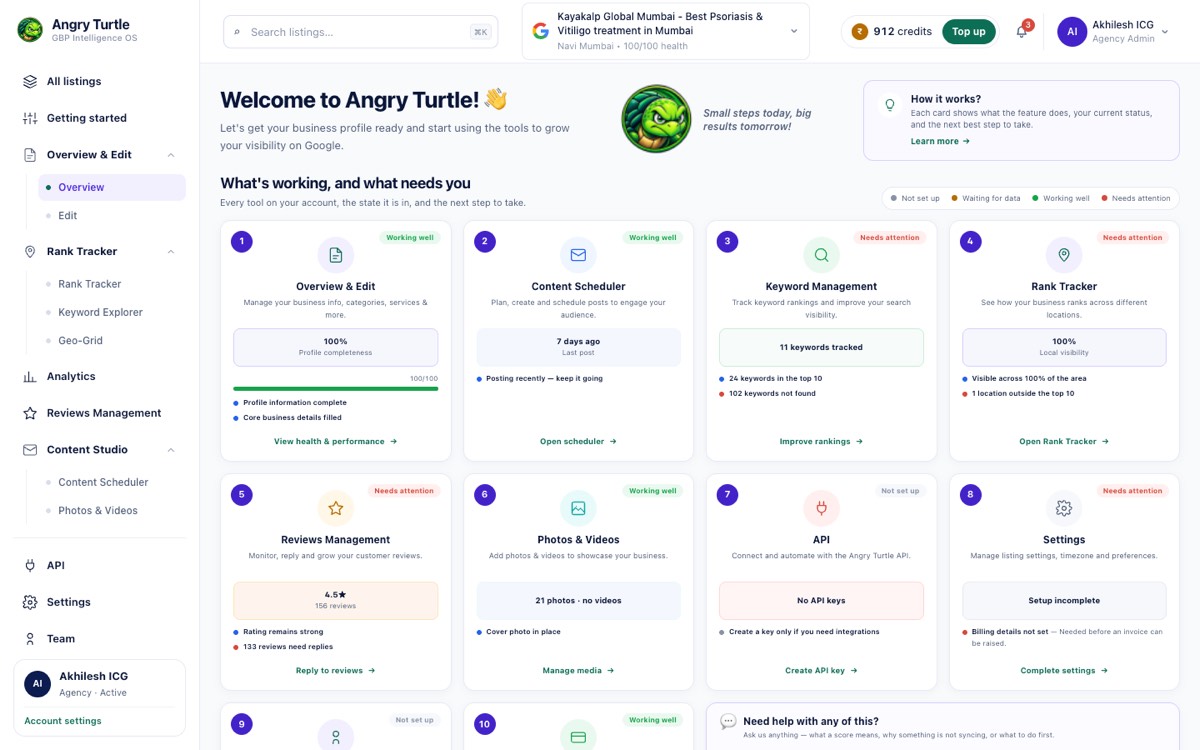

Related reading
Ready to have this run for you?
Book a free audit — we'll show you where you stand in 48 hours.