 Angryturtle
Best Local SEO for Dentists & Clinics in India
How dentists and clinics in India rank higher on Google Maps. GBP management, Practo citations, review generation, category selection, and appointment link setup.
·
Local SEO for dentists and clinics in India: what moves rankings
Most Indian metros run 5 to 15 well-funded operators deep in the local pack for "dentist near me" or "dental clinic [area]" — this is one of the more contested local categories in the country. Here's what actually separates the top 3 from everyone else fighting for the remaining slots, and where dental SEO in India specifically differs from the generic local SEO playbook.
How patients actually search for a dentist
A patient with a toothache at 11pm searches differently from a parent booking a routine cleaning three weeks out, and a dental clinic's local presence has to answer both. The urgent searcher types "dentist open now near me" or "emergency dentist [area]" and picks from whoever shows as open with a phone number that actually gets answered — proximity and immediate contactability decide this search, not reputation research. The planned searcher does something closer to comparison shopping: checking Practo alongside Google, reading several reviews, sometimes checking two or three clinics before booking. That's the searcher a strong description, complete service list, and review depth are built for.
Search behaviour also runs through named procedures more than people initially assume. "Root canal cost Bangalore" and "invisalign India" both carry real, specific search volume distinct from generic "dentist near me" queries — a clinic that only lists "General Dentistry" as a service is invisible to a patient searching by procedure name, even if it performs every one of those procedures daily.
Getting the category right for the specific practice
A general dental clinic should sit under "Dentist" as primary, with "Dental Clinic," "Cosmetic Dentist," "Orthodontist," and "Dental Implants Provider" as secondaries where each is genuinely offered. A specialist practice needs the opposite emphasis: an orthodontic focus takes "Orthodontist" as primary with "Dentist" and "Dental Clinic" secondary; an implant-focused practice takes "Dental Implants Provider" or "Dentist" as primary with implant-specific secondary terms; a pediatric practice takes "Pediatric Dentist" as primary with "Dentist" and "Dental Clinic" secondary. A multi-speciality clinic should lead with whichever specialty carries the highest local search volume — often general practice — and list every other specialty as secondary.
The wrong primary category is, in practice, the single most common reason a dental or clinic GBP underperforms despite everything else being in order.
Why Practo carries real weight here
For dental and clinic local SEO specifically, Practo isn't an optional extra — patients searching there convert at higher intent than a generic Google search, because they've already narrowed down to booking rather than browsing. A strong Practo profile needs verified doctor profiles with credentials and a photo, every service listed with a description, appointment booking enabled for both in-clinic and online consultation where offered, consultation fees clearly listed, accepted insurance and empanelment noted, and clinic photos covering reception, the operatory, and the exterior.
The NAP on Practo has to match the GBP exactly — Google crawls Practo as a citation source, and a mismatch there works against both profiles rather than just one. This is the same NAP consistency discipline that applies across every other directory a clinic touches.
The booking link most clinics leave empty
The appointment booking link inside GBP is a high-conversion feature that a surprising number of clinics never set up. It can point to the clinic's Practo booking page, or to an in-website booking system, alongside setting the "appointment required" attribute where relevant. A patient who sees a "Book appointment" button directly in the GBP panel books immediately, before ever visiting the clinic's website — it's the lowest-friction path from a local search to a confirmed appointment that exists in the entire funnel.
Review dynamics in healthcare are not the same as other categories
Reviews carry more weight in healthcare decisions than in most local categories, because the decision itself carries higher personal stakes than picking a restaurant or a hardware store. But the dynamics of getting and managing those reviews differ from a typical retail or hospitality business in a few specific ways.
Patients are more reluctant to leave a public review naming a health condition, which means dental practices tend to see lower review-request conversion than comparable non-healthcare local businesses, even with a well-timed ask. What patients do write about skews heavily toward the experience around the treatment rather than clinical detail — pain management, how long they waited, whether the cost matched what they were quoted, how the staff treated them — rather than anything resembling a clinical outcome claim, and that's exactly the content a clinic should be reinforcing in its own review responses rather than trying to redirect toward clinical language.
Negative reviews in healthcare also carry a different resolution burden. A one-star review complaining about a billing surprise needs a response that's specific and calm without relitigating the dispute publicly or including any patient-identifying medical detail in the reply — a response has to resolve the tone of the complaint in public while taking any substantive back-and-forth to a private channel, which is a tighter balance than most other categories need to strike.
Timing the review request around dental anxiety
Dental patients tend to arrive anxious and leave relieved — that emotional swing, in the two to four hours right after an appointment, is the ideal moment for a review request, while the relief is still fresh and specific.
A workable workflow: the receptionist sends a WhatsApp message with the review link about two hours after the appointment wraps up, personalised rather than generic — "Hi [Name], hope you're feeling well after today's appointment. If you have a moment, a quick Google review would really help other patients find us. [direct link]." If nothing comes back after five days, one gentle follow-up and no more. QR cards at reception cover the passive, always-on side of generation for anyone who slips past the WhatsApp trigger.
What patients actually write about most in dental reviews — pain management, wait time, cost transparency, staff friendliness, and clinic cleanliness — are the operational signals worth emphasising in both review responses and ongoing GBP content, since they're what future patients are actually screening for.
One clinic profile, or one profile per doctor
Clinics with multiple doctors face a real structural choice. Option A keeps a single clinic-only GBP, with every doctor mentioned across services and the description — simpler to manage, and the right call when the clinic brand carries more weight than any individual doctor's name. Option B pairs the clinic GBP with individual practitioner profiles for doctors who've built their own patient following, each set up as its own Health & Medical or specialty-specific profile — this needs careful NAP differentiation to avoid the two profiles cannibalizing each other's rank.
The right choice depends on how patients in the specific market actually search. Checking Google Search Console for the clinic's website settles it quickly: are the top brand-adjacent queries clinic-name-based, or doctor-name-based? That answer, not a general preference, should decide the structure.
Staying inside NMC guidelines on the profile itself
Clinic GBP content has to stay within National Medical Commission guidelines at every point — no clinical outcome claims like "we cured 500 patients of diabetes," no comparative claims like "India's best dermatologist," no before-and-after patient imagery without documented consent, and no medical advice folded into a review response. Angryturtle's healthcare-specific content templates are built to sit inside these guardrails by default, rather than relying on someone catching a violation after it's already published.
The same caution extends to how reviews are handled and how offers are worded. A festive-season teeth-whitening promotion can describe the service and the timeframe of the offer, but it shouldn't imply a guaranteed cosmetic outcome or use a patient testimonial that reads as an outcome claim rather than an experience description. When in doubt on a specific piece of copy, the safer version is always the one that describes the service rather than promises a result — that's true across almost every regulated-advertising question a clinic will run into, not just the obvious ones.
Seasonal patterns worth building a calendar around
January brings a natural window for a New Year oral health check-up offer, riding the same resolution impulse that drives gym memberships. April and May, coinciding with the school exam break, is the strongest period for children's dental check-ups. October, just ahead of Diwali, supports teeth-whitening offers tied to festive-season appearance demand. December rounds the year out with year-end check-up campaigns for anyone using remaining insurance benefits before they reset.
A worked example: a two-chair clinic in Lucknow
Take a two-chair general dental clinic in Lucknow's Gomti Nagar, run by a husband-and-wife dentist team with one receptionist, competing against roughly eight other general dental practices within a two-kilometre radius. Their constraint is time, not money — between them they can give the clinic's online presence maybe three hours a week, on top of a full patient schedule.
Given that, the highest-leverage fix isn't a new website or a paid campaign, it's tightening what's already there. Their GBP category was set to "Medical Clinic" from years ago rather than "Dentist" — the single most common category error in this category, and one that alone can explain underperformance against a competitor with a weaker profile but the correct category. Their Practo listing hadn't been touched in over a year and was missing half their actual service list. And their review request process was informal — asking happy patients verbally rather than sending a link — which meant a real but under-captured base of goodwill wasn't converting into visible reviews.
The recommended sequence for three hours a week: fix the GBP category and rebuild the service list properly in week one, rebuild the Practo profile to match in week two, and set up the WhatsApp review-request workflow from week three onward as a standing process rather than a one-time fix. None of that requires new patients or new spend — it converts existing patient volume and goodwill into a stronger profile, which is usually the actual gap for a clinic in this position rather than a lack of demand.
A concrete failure mode: the mismatched Practo listing
Here's a specific way this goes wrong in practice, seen across enough clinics to be a pattern rather than a one-off. A clinic updates its GBP address after moving two streets over within the same neighbourhood — new signage, new Google listing, everything correct on Google's side. The Practo profile, though, was set up by a staff member who's since left, and nobody has the login details memorised or documented anywhere. Six months later the Practo listing still shows the old address, and a patient who found the clinic through Practo's own search shows up at the wrong building.
That's not a hypothetical inconvenience. Google crawls Practo as a citation source, so the address mismatch is quietly working against the GBP's own ranking at the same time it's actively sending a patient to the wrong address. The fix isn't complicated once someone notices it — recover the Practo login, correct the address, done in twenty minutes — but the pattern behind it is worth naming: whoever owns platform logins on day one has usually left the clinic by the time something needs updating two years later, and there's rarely a documented handover. A shared, written record of every directory login, kept somewhere more durable than one staff member's memory, is the actual fix, not a one-time correction.
Where this connects to the Kolkata healthcare search cluster
Search demand for dental and clinic local SEO shows a distinct concentration around Kolkata specifically, alongside the broader healthcare-services search pattern in the city. For a Kolkata dental or multi-speciality practice, the fundamentals above — correct category selection, a fully built-out Practo profile, disciplined review timing — often move rank faster than in more saturated metros like Bengaluru or Mumbai, simply because fewer local competitors have executed on all of them consistently yet.
Common mistakes in dental and clinic local SEO
Choosing "Medical Clinic" as the primary category out of habit instead of the more specific and correct "Dentist" or "Orthodontist." Leaving the Practo booking link disconnected from the GBP appointment button, forcing patients through an extra step. Sending review requests the next morning instead of within the two-to-four-hour window right after the appointment, when the emotional response has already faded. And running individual doctor GBPs without checking Search Console first, creating a cannibalization problem that didn't need to exist.
Where a self-serve approach stops being enough
A single-clinic practice with someone willing to spend a few hours a week can genuinely handle category correction, a Practo rebuild, and a WhatsApp review workflow using self-serve tools alone — none of that inherently requires a managed retainer. The point where managed support starts earning its cost is usually multi-location clinics needing consistent execution across every branch, practices in a genuinely saturated metro where competitors are actively and continuously optimising, or any clinic that's had a suspension scare and needs faster, more experienced escalation than a solo owner can manage while also seeing patients all day. Compliance review is the other honest trigger — a clinic running frequent promotional content benefits from a second set of eyes checking NMC-guideline risk before something goes live, rather than finding out after a complaint.
Should a multi-speciality clinic have one GBP or several? Generally one, with every specialty listed as a category — separate profiles per specialty at the same address usually create duplicate-listing risk rather than solving a real problem.
Does Practo directly affect Google ranking, or just Practo's own visibility? Both — Practo functions as a citation source Google crawls, so an accurate, complete Practo profile supports GBP ranking as well as Practo-native discovery.
How many reviews does a competitive dental clinic typically need to break into the top 3? There's no fixed number since it depends entirely on the local competitive set. The reliable check is looking at the review counts of the clinics actually holding top-3 spots in your specific metro right now and treating that as your working target — in contested metros that bar tends to be set high, and it keeps moving as competitors keep adding reviews, so a steady ongoing flow matters as much as the starting count.
Can a clinic mention a specific procedure's success rate in GBP content? Only with real caution — NMC guidelines restrict outcome-implying claims, so any statistic used needs to be carefully worded and, ideally, reviewed against current guidelines before publishing.
Is dental SEO India different from dental SEO anywhere else? What people searching for dental SEO India are usually asking is whether the playbook travels. The fundamentals of GBP optimization are similar everywhere, but the specific mix — Practo's role, WhatsApp as the primary review-request channel, NMC guidelines rather than another country's medical advertising rules, and the seasonal patterns tied to Indian school and festival calendars — is specific enough that dental SEO in India misses real opportunity when it's treated as a generic international playbook with the country name swapped in.
Who should keep track of directory login details for a small clinic? Whoever manages the front desk day to day, written down somewhere the clinic owner can also access directly, updated whenever staff turnover means a handover — not left as one person's private knowledge.
Related reading: healthcare reputation management covers the compliance-heavy review response side in full detail. How to get more Google reviews covers generation mechanics generally. For the industry hub, see healthcare industry page, the sector-wide healthcare local SEO playbook, and the Kolkata local SEO hub. For the structured-data side of a clinic's own website, see local business schema and the schema markup pillar. For entity and citation fundamentals that apply to any clinic regardless of city, see NAP consistency, entity authority and Angryturtle's directory guide.
On the tooling side, Rank OS scores a clinic profile across the five weighted dimensions, geo-grid tracking shows whether you rank across a city or only outside your own door, review management drafts compliant responses for a human to approve, and citation management keeps Practo, JustDial and your Google profile telling the same story. If a profile has already been suspended, the reinstatement service covers the documentation-led appeal. For how these same signals feed AI answers rather than the local pack, see the GBP optimisation pillar.
Angryturtle manages GBP for dental and multi-speciality clinics across India → See pricing for managed and self-serve tiers, or book a demo to see Rank OS and Ask Maps against a real dental profile.
Stop guessing where you rank locally.
Rank OS scores your Google Business Profile the way Google's local algorithm does — relevance, review health, freshness, entity authority and AIO readiness — and shows you exactly what to fix.
Book a live demo →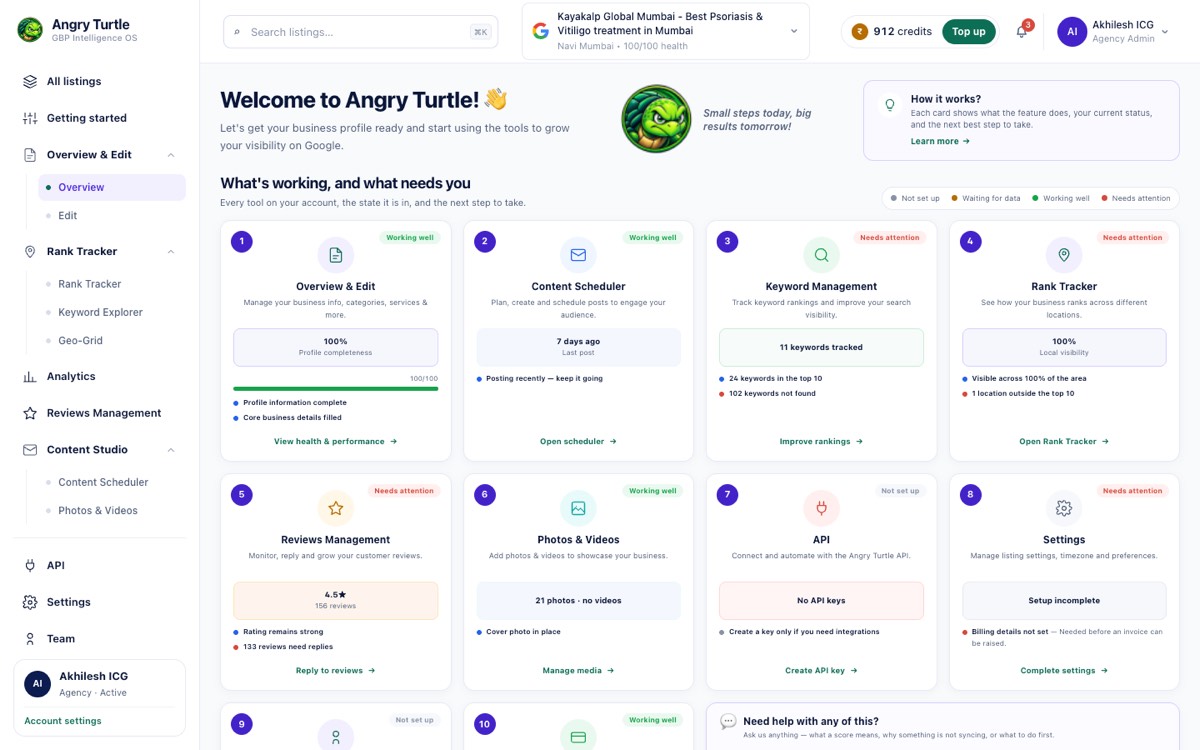

Related reading
Ready to have this run for you?
Book a free audit — we'll show you where you stand in 48 hours.