 Angryturtle
Attribution for Local: Calls, Directions and Walk-Ins
·
A patient calls a Chennai clinic after seeing it on Google Maps, books an appointment over the phone, and never once visits the website. A shopper checks a Pune store's hours on its profile, drives over, and buys nothing online. Both are conversions. Neither shows up in a conversion report built for e-commerce. Local attribution is hard precisely because so much of the value happens off the click path that most analytics tools were built to track.
This piece is about the three channels that actually carry local intent to a decision — calls, direction requests, and walk-ins — and how to attribute value to each without pretending you have more precision than you do.
- Why local attribution breaks standard models
- Calls: the easiest of the three to actually measure
- Direction requests: a real signal with a soft edge
- Walk-ins: the hardest one, and the one to stop ignoring
- Putting the three together without inventing a number
- What this looks like across a multi-location book
- Frequently asked questions
Why local attribution breaks standard models
Most attribution frameworks assume a session, a click, and eventually a page where a conversion event fires. Local search regularly skips all three. Someone searches "AC repair near me," sees your Google Business Profile, reads three reviews, and calls. No landing page. No pixel. No UTM. The entire decision happened inside Google's own interface, and GA4 or Meta Pixel never got a chance to see it.
This is also where a lot of the disagreement between GBP Insights and GA4 comes from — Insights is closer to the moment of intent, GA4 is closer to the moment of website engagement, and local attribution has to sit between the two rather than picking one as ground truth. A broader read on local SEO measurement covers where this fits against organic and paid attribution too.
Calls: the easiest of the three to actually measure
Calls are the best-instrumented of the three local actions, mostly because call tracking numbers are a mature, cheap technology. A dedicated tracking number on your GBP phone field, routed through a service that logs duration and (optionally) records the call, turns a call into a data point almost as clean as a form submission: timestamp, duration, and — if you review recordings or transcripts — whether it converted into an appointment or sale.
The trap is treating raw call count as the KPI. A 12-second hang-up and a 6-minute booking call both count as "1 call" in GBP Insights. If you're running a managed profile at any real volume, tagging calls by outcome (booked, no-show follow-up, wrong number, spam) turns a vanity number into something a business owner can act on. This is the same discipline covered under local SEO KPIs — raw counts without qualification hide more than they reveal.
Direction requests: a real signal with a soft edge
A direction request is Google logging that someone tapped "Directions" from your profile. It's a strong intent signal — nobody asks for directions to a business they're not planning to visit — but it has a soft edge on both ends. Some direction requests are people checking distance before deciding, not committing to go. Some walk-ins never request directions because they already know the route.
Treat direction requests as a leading indicator of footfall, not a count of footfall itself. If direction requests for a Gurgaon showroom jump 30% after a category or photo update and nothing else changed, that's a real signal the change worked — read it as "more people are planning to visit," not "we got this many more customers." The distinction matters when a client asks for hard ROI; overstating what a direction request proves is how measurement credibility gets lost the first time someone checks the actual footfall against it.
Walk-ins: the hardest one, and the one to stop ignoring
Walk-in attribution is the weakest link in almost every local measurement setup, and most businesses respond by simply not measuring it — which understates the channel's real contribution more than any other gap on this list. A few low-tech methods actually work:
A simple front-desk or till-side question — "how did you hear about us" — logged consistently, even roughly, over a month gives a directional read that's better than nothing. Asking new patients or customers is standard practice in local competitor analysis work for exactly this reason: it's the only channel where a human, not a pixel, is the sensor.
A QR code on in-store signage linking to a short feedback form, tied to a GBP-specific landing page, at least tells you which walk-ins are engaged enough to scan something once they're already inside. It won't capture the customer who walked in and bought in silence, but it adds one more data point to a channel that otherwise has none. The review collection kit approach — a QR code pointed at a review link instead — works the same way and doubles as review generation.
Review timing is a rough proxy too — a spike in reviews mentioning "found you on Google" or "saw your listing" in the days after a GBP change is a signal worth logging even though it's not a count.
Putting the three together without inventing a number
Don't try to force calls, direction requests, and walk-ins into a single blended conversion rate. They measure different moments with different reliability, and collapsing them loses the information that makes each one useful on its own. A monthly local scorecard that lists all three side by side — calls (hard number, outcome-tagged), direction requests (leading indicator, trend not absolute), walk-ins (directional, self-reported) — is more honest and more useful than a single made-up composite score.
Angryturtle's Insights & Performance module exports calls and direction requests from GBP data directly with custom date ranges, which handles the first two rows of that scorecard reliably. The walk-in row still needs a human process on the ground — no tool, including this one, closes that gap for you, and claiming otherwise would be exactly the kind of fabricated precision this piece is arguing against.
What this looks like across a multi-location book
For a franchise or bank-branch network, the same three-channel view has to run per location, not just in aggregate, because a citywide average hides the branch where calls dropped 40% after a manager change to the phone number field. Multi-location local SEO work lives or dies on catching that kind of per-location drift early, and the portfolio view that flags health, interaction type, and review frequency per listing is built for exactly that kind of scan — not to replace the per-branch attribution work, but to tell you which branch needs it looked at first.
Cluster-level demand data adds one more layer worth checking before drawing conclusions from any single branch's numbers. If demand clusters for "loan against property" are scaling citywide, a branch showing flat direction requests despite that broader momentum is underperforming its own market, not just having a quiet month — a distinction that raw branch-level numbers alone won't surface. It's also worth checking whether that branch's NAP is consistent across directories before assuming the drop is demand-related at all.
Frequently asked questions
Which of the three — calls, directions, walk-ins — should I trust most? Calls, because they're the most instrumentable. Direction requests are a good leading indicator but shouldn't be read as footfall. Walk-ins need a manual process; there's no clean automated substitute yet for most small businesses.
Is there an industry-standard conversion rate from direction request to visit? No credible published one exists for Indian local search, and any number quoted as one is invented. Track your own ratio over time instead of importing someone else's.
Do call tracking numbers hurt my NAP consistency? They can, if the tracking number replaces your real number on directories where it shouldn't. Keep the tracking number on GBP call-tracking-aware fields and your true number consistent everywhere else.
How do I attribute a walk-in that came from an AI Overview citation rather than a search click? You mostly can't attribute it directly today. The best available approach is watching whether calls or direction requests move after a change you know affected AI search visibility and treating that as directional evidence, not proof.
Stop guessing where you rank locally.
Rank OS scores your Google Business Profile the way Google's local algorithm does — relevance, review health, freshness, entity authority and AIO readiness — and shows you exactly what to fix.
Book a live demo →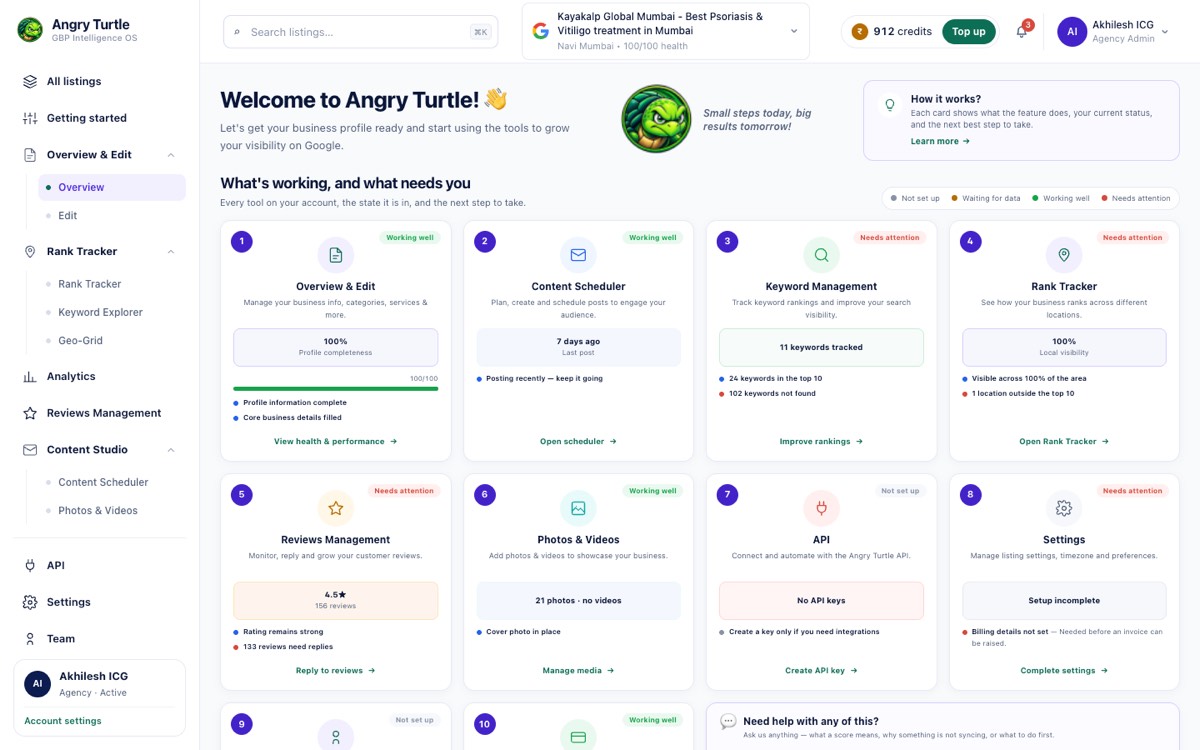

Ready to have this run for you?
Book a free audit — we'll show you where you stand in 48 hours.