 Angryturtle
What Is Review Velocity?
Review velocity is the rate at which a business receives new Google reviews, usually tracked monthly. A business bringing in 10 new reviews a month has higher velocity than one bringing in 1 a month, even if that second business happens to have a larger total review count built up from years past.
Total count and velocity measure genuinely different things, and confusing them leads to bad conclusions. A business sitting on 400 reviews accumulated over eight years, with almost nothing new arriving lately, has a high count and low velocity. A newer business with 90 reviews, adding 15 a month, has a lower count but far higher velocity — and over time, velocity tends to matter more for where a business actually ranks.
Why velocity outweighs a static count
Google's local ranking system treats review velocity as a recency and engagement signal, not just a volume signal. A business receiving reviews consistently is telling Google, implicitly, that customers are still showing up and still willing to leave feedback right now. A business whose review count stopped growing months ago is telling Google something close to the opposite, regardless of how large that frozen number is.
This shows up clearly in competitive Indian categories — dental clinics, dermatology practices, restaurants, coaching institutes — where the gap between a top-3 local pack position and a mid-pack position 4 through 10 is very often explained by velocity differences rather than by who has the bigger raw total.
What a velocity gap looks like
Picture three hypothetical clinics in the same neighbourhood. Clinic A has built up 380 reviews over the years but received none last month — its count is high, its velocity is flat. Clinic B has 140 reviews and picked up 12 last month — a moderate count, active velocity. Clinic C has only 80 reviews total but added 20 last month — a lower count, but the fastest-growing velocity of the three.
Held over several months, Clinic C's trajectory tends to close the gap on Clinic A and often overtakes it — not because 80 reviews inherently beats 380, but because the trend line matters more to the ranking system than the snapshot does. There's no fixed timeline for exactly when this crossover happens; it depends on the competitive set and the category, and businesses shouldn't plan around a specific number of months as if it were a guarantee.
What drives velocity up or down
Whether a business actively asks for reviews, rather than passively hoping satisfied customers leave one unprompted, is the single biggest lever. The channel used for that ask matters too — in India specifically, WhatsApp review requests significantly outperform email requests, partly because WhatsApp open rates run far higher and partly because the request arrives somewhere the customer is already checking daily.
Timing plays a role as well: a review request sent immediately after a service, while the experience is still fresh, converts at a meaningfully higher rate than one sent days later once the moment has passed. And friction in the review process itself — whether the customer gets a direct link straight to the review form versus having to search for the business on Google first — determines how many people who intend to leave a review actually follow through.
Velocity as a gradient, not a target
There's no published number of monthly reviews that counts as "enough" — no verified threshold where a business crosses from struggling to competitive. Velocity behaves as an ongoing gradient: higher and more consistent is better, flat or declining is worse, and the right benchmark for any individual business is its own local competitive set, not a generic number pulled from somewhere online. What Angryturtle tracks, through Rank OS, is each location's velocity relative to its actual top-3 local competitors, since that comparison is far more actionable than an arbitrary universal target would be.
How Angryturtle builds review velocity
Angryturtle runs WhatsApp, SMS, and QR-based review request flows, timed and calibrated to each client's actual customer journey rather than a generic template — a dental clinic's post-appointment moment looks different from a restaurant's post-meal moment, and the request flow reflects that.
Related terms: Review signals → · Review sentiment → · Reputation management → · Prominence → · Rank OS → · Google reviews →
GBP Management Services → | Review Generation Engine → | Managed Local SEO →
Related glossary terms
A score you can argue with, not a black box
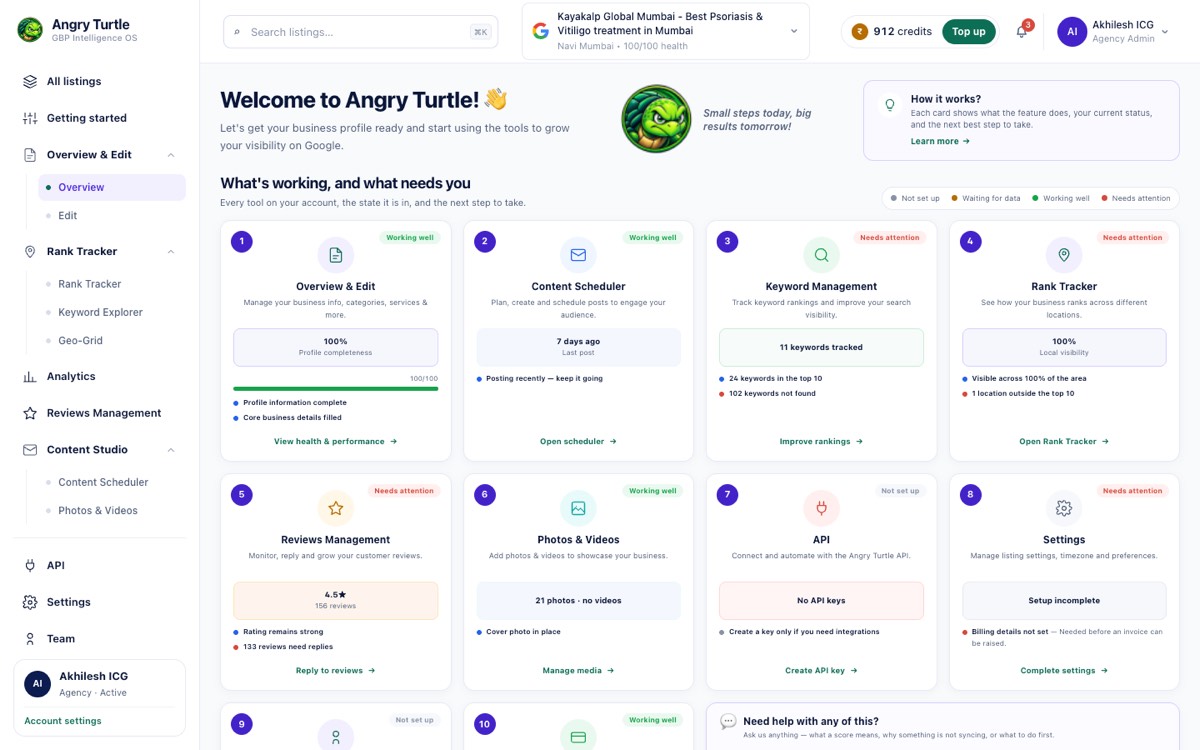
Rank OS gives every profile a 0–100 score built from five weighted dimensions — Relevance, Review Health, Freshness, Entity Authority and AIO Readiness — and the weights are tunable. Underneath it sits a ranked list of the fixes that move the number, each with the point lift it unlocks.
Ready to have this run for you?
Book a free audit — we'll show you where you stand in 48 hours.