 Angryturtle
9 Local SEO KPIs You Should Track
The 9 most important local SEO KPIs for Indian businesses — from geo-grid rank and review velocity to direction requests and citation score. With benchmarks.
·
The 9 Local SEO KPIs That Actually Matter
Most local SEO reporting is full of metrics that feel important but don't drive decisions. Rank tracking screenshots, "impressions," vague monthly summaries — none of it tells a business owner or a franchise regional manager what to do next Monday morning. This guide cuts to the 9 KPIs that tell you whether your local SEO is working, and what to do when it isn't.
A KPI is only useful if it's tied to an action. A dermatology clinic in Indiranagar tracking "average position" learns almost nothing — a competitor's rank could shift the average by two points without changing a single real customer outcome. The 9 metrics below were chosen because each one points at a specific lever you can pull: review requests, category selection, citation cleanup, profile completeness. None of them is vanity.
KPI 1: Share of Local Voice (SoLV)
What it measures: The percentage of geo-grid points where your business appears in the top 3 for your target keywords.
Why it matters: This is your overall local market share measurement. An improving SoLV means you're capturing more of the local pack; a declining SoLV means competitors are gaining ground you haven't noticed yet.
Target: Depends on competition level. In a moderately competitive market, 40 to 60 percent SoLV for your primary keyword is a strong position. In high-competition markets — dermatology in Koramangala, coaching institutes near a major exam centre — 25 to 35 percent may represent top-3 performance.
Tracking: Monthly geo-grid scan, compared to the previous month and to your top competitor. More on how geo-grid tracking works → and how to set up rank tracking end to end →
KPI 2: Review Velocity
What it measures: New Google reviews per month.
Why it matters: Review velocity is a ranking factor. Consistent new reviews signal an active, engaged business, not one coasting on reviews from three years ago.
Target: Benchmark against your top competitor. Match or exceed their monthly review rate. See how to build a review generation system →
Tracking: Count of new reviews in GBP Insights or your GBP dashboard, logged monthly.
KPI 3: Average Rating
What it measures: Your current Google star rating.
Why it matters: Average rating affects both rank and conversion. Below 4.0 stars meaningfully reduces click-through from local search results, even when your position is strong.
Target: Maintain above 4.3. Above 4.5 is excellent.
Tracking: Monthly snapshot, with a 6-month trend line so a single bad week doesn't get overweighted.
KPI 4: Review Response Rate
What it measures: The percentage of reviews that received a response from the business.
Why it matters: Response rate is a GBP engagement signal and a customer trust signal. Low response rates suggest inactive management, and prospective customers notice.
Target: 100 percent. Respond to every review. Templates and a full response framework →
Tracking: Count of reviews received vs. responses published, monthly.
KPI 5: Direction Requests
What it measures: Number of times customers clicked "Get Directions" from your GBP.
Why it matters: Direction requests are the strongest footfall-intent signal available from GBP data. A growing count usually precedes footfall growth by a few weeks.
Target: Month-on-month growth. The absolute number depends on location and category, so track the trend rather than a fixed benchmark.
Tracking: GBP Insights "Directions" metric, monthly, with a 6-month trend.
KPI 6: Calls from GBP
What it measures: Phone calls initiated directly from the GBP listing.
Why it matters: For most local service businesses, calls are the primary pre-visit or pre-purchase action. Growing call volume from GBP usually tracks with improving local search performance.
Target: Month-on-month growth.
Tracking: GBP Insights "Calls" metric, monthly. One caveat worth flagging: GBP Insights undercounts calls, since direct number dials don't get attributed. For accurate call attribution, use a call tracking number on the GBP listing.
KPI 7: NAP Consistency Score
What it measures: The percentage of directory citations with NAP exactly matching the canonical record.
Why it matters: Citation inconsistencies dilute local authority. A falling consistency score means new errors have crept into the citation ecosystem, often introduced by a directory pulling third-party data.
Target: 95 percent or higher across priority directories. Full framework for managing this at scale →
Tracking: Monthly citation audit across 50+ Indian directories. See the priority directory list →
KPI 8: GBP Profile Completeness
What it measures: How complete the GBP is — what percentage of available fields are filled.
Why it matters: Completeness is a ranking signal. Newly available attributes or fields left empty represent missed relevance opportunities that competitors with a fuller profile are already capturing.
Target: 100 percent of available, applicable fields completed. The full optimisation priority list →
Tracking: Monthly audit of profile completeness against all available fields.
KPI 9: Website Clicks from GBP
What it measures: Clicks from the GBP panel to the business website.
Why it matters: This is the volume of research-stage customers moving from local search to the website. For businesses with a strong website conversion rate, it's a leading revenue indicator.
Target: Month-on-month growth.
Tracking: GBP Insights "Website" metric, cross-checked with UTM parameter tracking in Google Analytics for GBP traffic. How to set up UTM tracking for local →
Building a KPI dashboard that people actually check
A spreadsheet nobody opens isn't a dashboard. The KPI reports that get used monthly share three traits. They fit on one screen — nine metrics with one-line context each, not eighteen tabs. They compare against something — last month, the same month last year, or a named competitor — rather than showing a number in isolation. And they end in a decision, not just a chart: "review velocity is down 30 percent, WhatsApp requests haven't gone out in two weeks, restart them this week."
A franchise with 40 locations across Pune and Ahmedabad doesn't need the same report as a single dermatology clinic in Gurgaon. The clinic owner wants nine numbers, once a month, in five minutes. The franchise regional manager wants those same nine numbers per location, rolled up by city, with underperforming branches flagged automatically. Same KPIs, different lens — see the multi-location strategies guide for how the reporting layer changes at scale, or the enterprise governance overview for how HQ-level rollups typically get structured.
What to do when KPIs decline
SoLV declining: Check for new competitor activity, review velocity gaps, or citation errors. Run a full audit rather than guessing at the cause. See the most common local SEO mistakes that cause this →
Review velocity declining: Reinspect the review request process. Has the WhatsApp flow stopped working? Has staff stopped asking verbally at the point of service? This is usually a process failure, not a demand problem.
Direction requests declining: May indicate a rank drop. Cross-reference with SoLV — if SoLV has also declined, rank recovery is the priority, not a directions-specific fix.
NAP consistency score declining: A new error has been introduced somewhere. Run a citation audit and identify which directory changed — JustDial and Practo are the most common culprits for silent data overwrites in India.
Profile completeness declining: Usually means Google added a new attribute or field that your team hasn't gone back to fill. Check the GBP dashboard for anything marked "add now."
Common mistakes in local SEO reporting
The most frequent mistake is tracking average rank instead of geo-grid distribution — a single number hides where you're actually winning and losing. The second is reporting metrics with no comparison point, so a decline of 15 percent looks the same as a decline of 2 percent on the page. The third, especially common in Tier 2 city businesses, is skipping NAP consistency entirely because it feels like background maintenance rather than a KPI, until a directory error quietly costs three months of rank progress.
Which KPI should a new business track first? Review velocity and GBP profile completeness. Both are fully within your control in month one, before SoLV and rank data have enough history to be meaningful.
How often should local SEO KPIs be reported? Monthly, at minimum. Weekly tracking for review velocity and suspension status is worthwhile for competitive categories like restaurants and dermatology, where a gap of even a few days is noticeable against active competitors.
Do these KPIs apply to service-area businesses without a storefront? Yes, with one adjustment — direction requests are less relevant since there's no address to navigate to. Weight SoLV, review velocity, and calls more heavily for service-area business profiles.
Angryturtle tracks all 9 KPIs for every managed client, monthly →
Stop guessing where you rank locally.
Rank OS scores your Google Business Profile the way Google's local algorithm does — relevance, review health, freshness, entity authority and AIO readiness — and shows you exactly what to fix.
Book a live demo →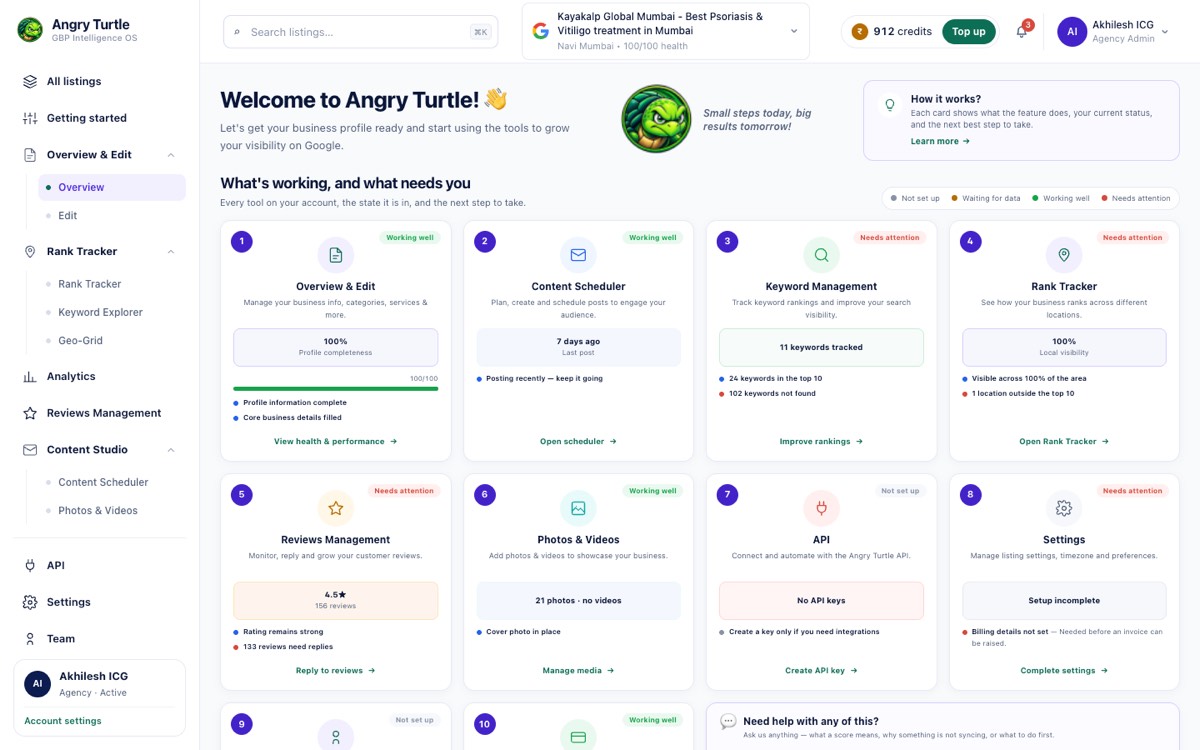

Ready to have this run for you?
Book a free audit — we'll show you where you stand in 48 hours.