 Angryturtle
Local SEO Measurement & Attribution
How to measure local SEO performance and attribute results to specific actions. KPIs, tracking setup, UTM parameters, and monthly reporting framework.
Lesson 5: Local SEO Measurement & Attribution
Learning objectives
By the end of this lesson you'll be able to pick the right KPIs for your business, set up tracking correctly with UTM parameters and call tracking, run a monthly performance review in under half an hour, and connect local SEO activity to actual business outcomes with reasonable confidence.
The attribution problem, stated honestly
Local SEO is genuinely harder to measure than paid advertising, and it's worth being upfront about why rather than pretending a dashboard solves it entirely. A customer who finds a clinic on Google Maps and dials the number directly from their phone generates no trace in Google Analytics at all — that call simply doesn't exist in a web analytics tool. GBP Insights captures a click on the profile's call button, but not a direct dial to a number the customer memorised or saved. Perfect attribution isn't achievable with the tools available today. Useful, directionally reliable measurement is.
Building the right KPI stack
Rank KPIs are the leading indicators — improvement here predicts business results will follow, even before those results show up. Share of local voice from monthly geo-grid measurement is the strongest of these, since it captures rank across an entire service area rather than one keyword's average position. GBP profile completeness, checked on a regular internal audit, is a supporting rank KPI worth tracking alongside it.
Engagement KPIs are lagging indicators that confirm rank improvement is actually translating into customer interactions: direction requests and calls from GBP Insights, website clicks (measured properly with UTM attribution, covered below), and photo views as a general engagement signal.
Revenue KPIs are the outcomes that ultimately matter but are hardest to attribute cleanly: appointment bookings traceable to local search through booking-system and UTM tracking, walk-in traffic (usually tracked manually or proxied through direction requests, since there's rarely a clean digital trace for someone who simply walked in), and revenue attributable through a CRM where that link genuinely exists.
Setting up UTM tracking on the GBP website link
Without UTM parameters on the GBP's website field, all traffic arriving from that link shows up in analytics as generic "Direct" or "Organic" traffic — indistinguishable from every other source, which makes it impossible to isolate how much of a site's traffic is actually coming from the GBP specifically. The fix is a tagged URL: https://yourwebsite.com/?utm_source=google&utm_medium=organic&utm_campaign=gbp. For multi-location businesses, tag each location's website field with its own campaign value — utm_campaign=gbp-koramangala for one branch, utm_campaign=gbp-andheri for another — so traffic and conversions can be isolated per location page rather than blended into one undifferentiated total. Build the tagged URL with Google's Campaign URL Builder, update the GBP's website field with it, then create a segment in GA4 filtered to that campaign value to view GBP-specific traffic and conversions cleanly.
Call tracking: closing the direct-dial gap
GBP Insights only counts calls made by clicking the call button inside the profile — a customer who dials the number directly from memory, a saved contact, or a screenshot never registers there at all. A call tracking number placed in the GBP's phone field closes this gap: it's a forwarding number that routes every call to the real business line while separately recording date, time, duration, and caller number, attributing the call specifically to the GBP as its source. Indian call tracking providers supporting local numbers include CallTrackingMetrics, Knowlarity, and Exotel. One constraint matters more than it might seem: the tracking number has to stay identical across the GBP and every directory listing, because using a different tracking number on GBP versus JustDial would recreate the exact NAP inconsistency this entire curriculum has spent several lessons warning against — see NAP and citations 101 for why that consistency matters everywhere, not just on the phone field.
A worked example: reconstructing what actually drove a spike
A physiotherapy clinic in Whitefield, Bengaluru, saw a 40% jump in GBP website clicks one month with no obvious campaign running. Without UTM segmentation, this would have been unexplainable noise. With it, the clinic's GA4 segment for utm_campaign=gbp showed the spike concentrated in a single week, and cross-referencing against the same week's geo-grid data showed share of local voice had risen from 38% to 51% following a deliberate review-generation push the month before. The specific mechanism: more top-3 grid coverage meant more searchers seeing the profile in the local pack, which meant more clicks through to the tagged website link — a chain that was only visible because UTM tracking and geo-grid data were both being checked in the same monthly cycle rather than looked at separately.
The monthly measurement cadence
Week one of the month: pull the previous month's GBP Insights — calls, direction requests, website clicks, photo views — and record them. Week two: run the geo-grid check for primary keywords and calculate SoLV against the previous month. Week three: count new reviews received and calculate review velocity, then confirm the response rate is still at or near 100% as covered in responding to reviews at scale. Week four: review UTM-tagged traffic in GA4, including goal completions like form submissions or booking clicks, compared against the previous month. The month-end report itself should take about ten minutes to assemble: one table comparing this month to last month across the five primary KPIs — SoLV, calls, directions, review velocity, website clicks from GBP — with a six-month trend line where the data's available to show it.
What practitioners get wrong
The most common mistake is never setting up UTM tracking at all and then trying to reconstruct GBP's contribution to traffic retroactively from generic "Direct" traffic data months later — by that point the signal is buried in noise that could have been avoided with five minutes of setup at the start. The second is measuring rank and reviews but never connecting either to an actual engagement or revenue metric, which leaves the business unable to answer whether the local SEO work is translating into anything beyond a better-looking dashboard. The third is running the monthly cadence sporadically — skipping a month here, doubling up there — which breaks the month-over-month comparison that makes the whole measurement exercise useful in the first place.
FAQ
Is it worth setting up call tracking for a single-location business, or is that overkill? Even a single location benefits, particularly if a meaningful share of enquiries come by phone rather than through a booking form — the direct-dial gap GBP Insights leaves unmeasured applies at any scale, not just to multi-location brands.
How long should I wait before judging whether local SEO activity is working? Rank and review metrics can show meaningful movement within 4-8 weeks of consistent execution. Revenue-level attribution takes longer to read confidently, generally 3-6 months, because a single month's engagement data is noisy enough that one strong or weak month doesn't reliably indicate a trend on its own.
What if GA4 and GBP Insights show contradictory numbers for the same period? That's expected rather than alarming — the two tools measure different things by design (GBP Insights counts specific in-profile actions; GA4 counts website sessions and events), and a gap between them is often exactly the direct-dial or non-UTM traffic this lesson describes, not a data error.
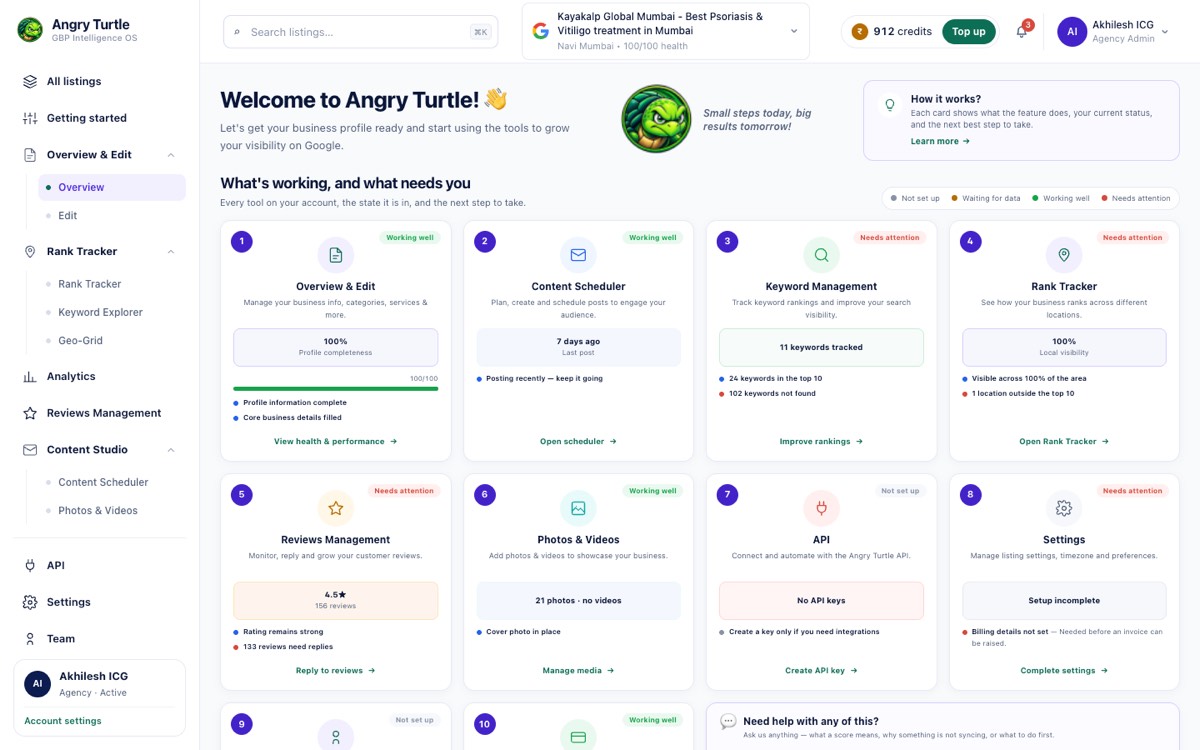
Does Angryturtle's insights product automate this monthly cadence? It surfaces GBP Insights, geo-grid SoLV, and review velocity in one place with month-on-month comparisons, which removes most of the manual pulling described above — the underlying KPI logic in this lesson is what the product's dashboards are built around, whether or not a business uses the platform to automate it.
Next lesson: Bulk operations and the GBP API →
A score you can argue with, not a black box
Rank OS gives every profile a 0–100 score built from five weighted dimensions — Relevance, Review Health, Freshness, Entity Authority and AIO Readiness — and the weights are tunable. Underneath it sits a ranked list of the fixes that move the number, each with the point lift it unlocks.
Ready to have this run for you?
Book a free audit — we'll show you where you stand in 48 hours.