 Angryturtle
Local SEO for Imaging and Radiology Centres
·
A patient walks out of an orthopaedic consult with a prescription for an MRI of the left knee. She doesn't know or care about the imaging centre's brand. She cares about three things: does this place have a 1.5T or 3T machine, what's the price, and can she get a slot today or tomorrow. That's the entire search intent behind "MRI near me" for most referral-driven imaging bookings, and it's a different intent than almost every other local SEO playbook is written for.
Radiology and diagnostic imaging centres — CT, MRI, X-ray, ultrasound, mammography — sit in a strange spot. They're healthcare businesses, so a lot of general healthcare local SEO advice applies. But the actual buying decision looks more like comparison shopping for a specific, named product than it does like picking a doctor.
The prescription is the starting point, not the profile
Almost nobody searches "best radiology centre" the way they'd search "best dermatologist." They search for the exact modality and body part a doctor already wrote down — "CT abdomen with contrast," "2D echo," "HRCT chest." A Google Business Profile that only lists a generic "Diagnostic Centre" category and a vague services blurb is invisible to that specific search, even while ranking fine for broader, lower-intent terms nobody with a prescription in hand is actually typing.
The fix is mechanical: name every modality the centre actually runs, as its own line in the services list, not folded into a paragraph. Choosing the right GBP category matters here more than most verticals, because "Diagnostic Imaging Centre" as primary with "Medical Diagnostic Imaging Centre," "MRI Center," or "CT Scan Center" as secondary categories (whichever genuinely apply) puts the listing in front of the specific-modality searches instead of the generic ones.
Price and turnaround time decide the booking, not brand loyalty
Two centres three kilometres apart running the same 1.5T MRI machine are, from a patient's perspective, close to interchangeable — unless one of them makes the price and the wait time for a slot visible before the phone call. Big-ticket imaging (MRI especially) carries real sticker shock, and a patient calling three centres to compare a knee MRI price will frequently book whichever one answered fastest with a clear number.
This is exactly the gap a GBP post can close that a static profile can't. A post naming a current package price, an evening-slot offer, or a same-day-report promise answers the actual question a referral-driven searcher has, rather than describing the centre in general terms. It also means response speed to GBP messaging and calls functions almost like a ranking factor here, even though Google doesn't score it directly — the centre that answers in ten minutes gets the booking regardless of which one is objectively better equipped.
Same-day and urgent bookings are their own search pattern
A chest CT ordered after an ER visit or a sudden fall doesn't wait for tomorrow. "MRI same day near me" and "24 hour CT scan" are real, if lower-volume, searches, and a centre that runs extended or 24-hour hours needs that stated explicitly in its GBP attributes and business description — not assumed to be obvious from the fact that it's a hospital-attached facility. A centre that quietly offers night slots but never says so anywhere Google reads is functionally competing only in the daytime-booking pool.
Equipment specificity is a trust signal that reviews alone don't cover
A patient choosing between two MRI centres increasingly wants to know the field strength (1.5T vs 3T) and whether the machine is open or closed-bore, because a claustrophobic patient or a large-bodied patient has a genuinely different set of options depending on the answer. This information rarely shows up in a generic services list, and it's exactly the kind of specific, checkable detail that entity SEO and knowledge graph work is meant to surface for AI-driven answers, not just traditional search — a searcher asking an AI assistant "which MRI centre near me has an open MRI" gets answered correctly only if that fact is written down somewhere the assistant can find it.
Multi-branch imaging chains face a sharper version of the usual problem
Chains running CT and MRI at one flagship branch and X-ray-only satellite centres elsewhere hit the standard multi-location duplicate-listing risk covered in multi-location local SEO strategies, but with a wrinkle: listing every satellite branch as though it offers the same modalities as the flagship misdirects patients who show up expecting an MRI a branch was never equipped to run. Categories and services lists need to be branch-specific, not copy-pasted from the flagship profile. Location data management exists for exactly this kind of per-branch accuracy at scale, and NAP consistency at scale covers the underlying data-hygiene problem generally.
Reviews for an imaging centre are about a narrow set of things
Patients rarely review an imaging centre on bedside manner. They review report turnaround time, whether the radiologist's findings matched what the ordering doctor expected, how the wait actually compared to the booked slot, and whether the technician explained the procedure (particularly relevant for anxious or claustrophobic patients). Prompting for that specific kind of feedback, rather than a generic "how was your visit" ask, produces reviews that are more useful to the next patient and more likely to get pulled into an AI-generated answer — the mechanism is covered in reviews and AI search visibility.
Referral partnerships change how discovery actually happens
A meaningful share of imaging bookings come through a doctor's or clinic's recommendation rather than an open Google search at all, which means a stale phone number or address on a partner clinic's referral page can silently redirect volume to a competitor with no visible cause on the imaging centre's own analytics. This is worth auditing directly rather than assuming Google Business Profile data alone tells the full discovery story — see reading GBP performance data for how to check what's actually driving bookings versus what's assumed to be driving them.
Where a platform helps
A single-location imaging centre can fix category accuracy, price visibility, and modality-specific service listings over a weekend. What's harder to sustain manually is per-branch consistency once a chain grows past two or three centres, ongoing review prompting that asks for the right kind of feedback, and staying visible as more of this search shifts toward AI-generated answers. Rank OS scores Relevance, Review Health, Freshness, Entity Authority and AIO Readiness per listing, and GBP management services can run the branch-level cleanup and review workflows directly for chains without a dedicated marketing team in-house.
Frequently asked questions
Do imaging centres need a different GBP category than a general diagnostic lab? Yes, where it applies. "Diagnostic Imaging Centre," "MRI Center," or "CT Scan Center" are more specific than the generic "Diagnostic Centre" category a lab might use, and specificity here tends to help with modality-specific searches. See choosing the right GBP category for the general logic.
Should an imaging centre publish its prices online? Where legally and practically feasible, yes — price comparison is a real, common behaviour for imaging bookings specifically, and a searcher who has to call three centres for a number will often book whichever answers fastest regardless of quality difference.
How is this different from local SEO for a diagnostic lab? A lab's searches are usually test-name and price driven with a lighter equipment-specificity component; imaging searches carry a heavier equipment and urgency dimension (machine type, same-day availability) because the tests are higher-cost and often follow an acute event. The diagnostic lab and pathology centre playbook covers the lab side of this same referral-driven pattern.
Does AI search change anything for a small, single-branch imaging centre? It changes what needs to be written down explicitly rather than left implied. A single accurate answer to "does this centre have an open MRI" or "is same-day CT available here," placed somewhere Google or an AI assistant can read it, is often enough — see AI overviews and local business in India for the broader mechanism.
Stop guessing where you rank locally.
Rank OS scores your Google Business Profile the way Google's local algorithm does — relevance, review health, freshness, entity authority and AIO readiness — and shows you exactly what to fix.
Book a live demo →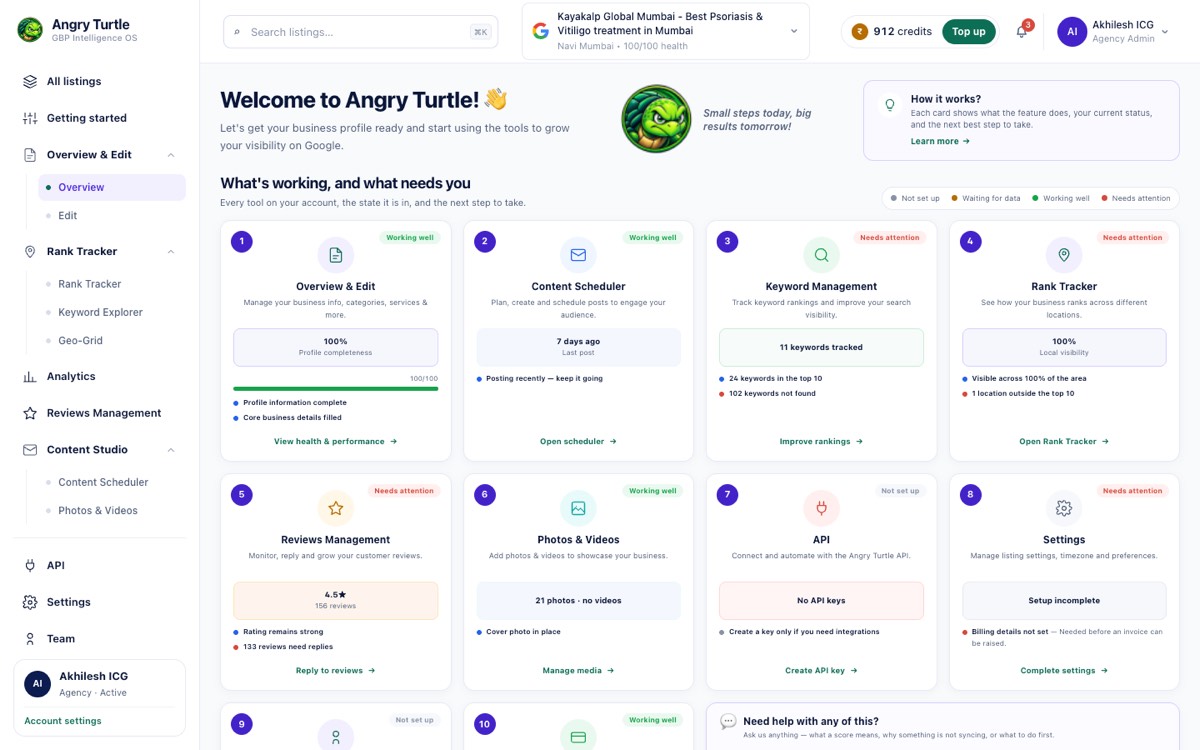

Related reading
Ready to have this run for you?
Book a free audit — we'll show you where you stand in 48 hours.