 Angryturtle
Location Data Management for Multi-Location Brands
One authoritative set of location facts, propagated everywhere it needs to go and monitored when it drifts. For chains, franchise groups and agencies running location data at a scale spreadsheets stop handling.
·
Location data management is the work of keeping one set of facts about a business — name, address, phone number, hours, categories, coordinates — true everywhere that fact appears, and pushing corrections out fast enough that "everywhere" doesn't quietly drift back out of sync six months later. Most businesses don't have a location data management problem until they have more than one location, at which point they have it whether they've named it or not. Angryturtle runs this discipline for multi-location brands in India, on a platform you can run yourself or hand to a managed team, built around the fact that Google's own API lets us write corrections back to the source instead of just reporting where the errors sit. Full detail on that write-back layer is at GBP write-back to Google, and the wider service is described at multi-location local SEO.
Location data management vs. listings management
These two terms get used as if they mean the same thing, and for a single shop they basically do. Past a handful of locations they split apart in a way that matters.
Listings management is the individual activity: claim the JustDial page, fix the Practo listing, update the GBP hours. It is work done one business listing site at a time. It's directory-by-directory work, and it's necessary, but it has no memory. Nothing about fixing today's JustDial listing tells you whether the same address is wrong on Sulekha, or whether it was ever right there in the first place.
Location data management is the layer underneath — the master record of what's actually true, the process that decides when a change happened and who's allowed to make it, and the audit that catches the platforms nobody remembered to touch. A franchise group can do listings management for years without ever building this layer, chasing whichever directory looks broken that week. It works, in the loose sense that nothing has caught fire yet, until the tenth branch opens or a name change goes out on the website but not on the twelve directories that still say the old brand. We cover this exact split at more length in what is a location data management platform and location data management vs. listings management, and the underlying accuracy outcome both are trying to produce is NAP consistency.
A 12-clinic chain and a 400-branch bank don't have the same problem
A single clinic with one location can keep its NAP straight with a shared spreadsheet and a person who checks it every so often. Nothing about that setup breaks.
Twelve clinics is a different animal already. Twelve addresses times a dozen directories is well over a hundred data points to keep synchronized, and clinics tend to relocate, add specialists, and adjust hours around festivals more often than a single-location retailer does. It's still manageable by a determined operations person with a checklist, but the margin for someone forgetting a platform is real.
At four hundred branches — the scale a regional bank or an NBFC operates at — manual tracking isn't slower, it's structurally impossible. Four hundred locations across even eight directories is 3,200 data points, each one capable of drifting independently, and a single missed relocation doesn't cost you a bad review, it costs you customers driving to a branch that closed. This is the point where location data management stops being a nice-to-have process and becomes infrastructure, the same way a company doesn't hand-manage payroll past a certain headcount. Enterprise local SEO exists for exactly this band of the market, and managing multiple locations walks through the operational side in more depth.
What actually goes wrong
The failures aren't exotic. They're the same handful of things happening on a schedule nobody controls.
A clinic changes its Diwali hours and updates the GBP. Justdial and Practo never get told, and for two weeks a patient calling the number listed there finds the clinic closed when the site says open, or open when it's actually shut for the holiday.
A regional brand rebrands — new name, new logo, sometimes a slightly different legal entity. The website changes overnight. The GBP gets updated within a week because someone remembers to do it. The other fifteen directories where the old name still sits keep it for months, sometimes years, because nobody owns the job of chasing every one of them down.
A new branch opens and the launch team is focused on staffing and signage, not on making sure the location shows up anywhere a customer might search for it. Three months in, someone notices the branch barely gets any Maps traffic and realizes it was never added to half the directories the older branches are on.
Two listings exist for the same address because a previous agency created a second GBP by mistake, or because a franchisee re-registered the location under a slightly different name. Google sees two entities at one address, which is exactly the kind of duplicate signal that erodes trust in both. Duplicate listings covers how this specifically happens and why it's worse than a single wrong listing.
And then there's the franchisee problem: someone at the local level has edit access to their own profile, changes the category to something that gets them more calls short-term, and breaks the brand's consistent categorization across the network without head office knowing it happened until a monthly report flags it.
What it actually costs
"Brand consistency" undersells what's at stake here. The real costs are specific.
A wrong phone number is a missed call, and a missed call for a clinic or a bank branch is a customer who called the competitor next because the number worked there. A wrong address is worse: it's footfall that never arrives, or worse, arrives angry after driving to a location that moved eighteen months ago. Google's own algorithm treats inconsistent location data as a trust signal problem, not a cosmetic one — a listing that can't agree with itself about where it is or what its number is tends to get quietly discounted in relevance and prominence, the same two levers that decide who shows up in the map pack in the first place.
There's a suspension angle too. Duplicate listings, conflicting addresses, and edits from unverified sources are exactly the pattern Google's spam systems are tuned to flag, and a suspended profile stops earning anything at all while it's under review. GBP suspension explains the mechanics, and if a listing has already gone down, GBP reinstatement is the recovery path.
The newer cost is the AI layer. When an AI Overview or a chatbot answers a "near me" question, it's pulling from the same directory ecosystem that location data management is supposed to keep clean. If JustDial says one address and the GBP says another, the model doesn't guess which is right — it often just declines to cite either, or worse, cites the wrong one with total confidence. Inconsistent location data used to cost rank. Now it also costs AI citations, and an AI system has no forgiveness mechanism the way a human searcher squinting at conflicting hours might.
What a working operating model looks like
A location data operation that actually holds together has a small number of pieces, and skipping any one of them tends to recreate the exact failure the others were meant to prevent.
There has to be a single source of truth — one file, one system, that every platform gets checked against, rather than "whatever the GBP happens to say today." Then there has to be a defined way changes propagate outward when something in that source file changes, with an owner and a timeframe, not a hope that someone remembers. Monitoring comes next: a recurring check, not a one-time audit, comparing what's actually live on every platform against the source file and flagging the gap before a customer finds it first. And there has to be governance — a clear answer to who is allowed to edit what, especially in a franchise or multi-branch structure where a local manager's convenience and the brand's consistency don't always point the same direction.
Skip the governance piece specifically and the other three collapse anyway, because someone with edit access will eventually make a change the source-of-truth file never authorized.
Who actually owns location data inside an organisation
Ask five people at a mid-sized multi-location brand who owns location data, and the honest answer, most of the time, is nobody specifically. Marketing thinks it owns the GBP because marketing set it up. Operations thinks it owns the address and hours because operations runs the branch day to day. IT thinks it owns anything with an API key attached to it. All three are half right, which in practice means the job falls through the gap between departments until something breaks visibly enough that someone has to step in and own it after the fact.
The two-department collision shows up in a predictable way. Marketing updates a branch's description to match a new campaign, and a week later an operations manager updates the same listing's hours for a genuine operational reason, working from an old cached version of the description that quietly overwrites marketing's change. Neither person did anything wrong. Nobody had a system that made "who changed what last" visible to the other side.
A clean handover, whether it's a move off a shared spreadsheet or off a previous vendor, needs three things settled before the first correction gets pushed. First, a single named owner per location or per network, a person rather than a department, even if that person delegates the day-to-day work to someone else. Second, a documented list of what the previous system actually got right, so nothing regresses during the switch and nobody rediscovers a problem that was already solved once before. Third, an edit hierarchy that survives the handover itself, so a franchisee's or branch manager's existing access doesn't quietly vanish, or worse, quietly persist somewhere nobody remembers to check months later. Agency OS's role-based access exists specifically for this handover moment, not only for ongoing day-to-day operation.
What a location data management platform actually needs to do
A location data management platform earns that name by doing four specific things, not by having a dashboard with a lot of numbers on it. It has to hold a single source-of-truth record per location. It has to detect drift against that record across every directory that matters for the business, not just Google. It has to be able to push a correction back out, not just flag one. And it has to enforce who's allowed to make which change, so a fix made in the morning doesn't get quietly reversed by someone else that afternoon.
Most tools in this category are strong on the second item, detection, and weak on the third, the actual write-back. A platform that finds a dozen mismatched listings and hands over a spreadsheet of what to fix manually has done the diagnostic half of the job. Angryturtle's write-back runs through the GBP API directly for the Google side, plus the citation engine's own directory integrations for the rest of the stack, so "detected" and "fixed" collapse into roughly the same step instead of two steps separated by however long it takes someone on the team to get around to the spreadsheet.
A 12-branch diagnostic chain in Chennai, worked through
A diagnostic chain running twelve collection centres across Chennai's OMR corridor and the western suburbs is a decent stand-in for where this stops being a spreadsheet job. Two years ago it had four centres, and one person kept the NAP straight in an evening a week. At twelve, that same person is now the compliance head for three cities and doesn't have that evening anymore. Three of the four newest centres opened in the last eighteen months without ever getting properly indexed on JustDial.
The constraint that actually decides the right answer here isn't the branch count. It's who has edit access. Two of the twelve centres are run by a partner lab under a franchise-style arrangement, with their own staff logging into their own GBP directly. That's the governance problem described above, and it's the reason a simple bulk-fix tool wouldn't be enough on its own, even if the chain wanted to run everything self-serve.
The defensible call for a chain like this is a hybrid. Self-serve Rank OS scoring across all twelve so the compliance head can see every centre's Entity Authority score in one place, paired with managed onboarding for the citation sweep across JustDial, Practo, and Sulekha specifically for the eight centres opened in the last two years, the ones most likely to have gaps nobody caught yet. The two partner-run centres get scoped Agency OS access rather than full network access, so the partner can update their own hours without touching the other ten. None of that requires guessing. It falls out of the constraint once someone actually names who can edit what.
How Angryturtle runs this
Angryturtle's advantage here starts with something most tools in this category don't have: the write path actually reaches Google. Corrections to name, address, phone, hours, categories, and service areas publish through the GBP API rather than sitting in a dashboard waiting for someone to copy them across manually. That's the difference between a remediation system and an advisory one — see GBP write-back to Google for the mechanics.
Discovery and monitoring run through the citation engine: automated scanning across 20-plus platforms, a duplicate finder for the two-listings-at-one-address problem, a directory-presence matrix showing exactly where a location is listed and where it's missing, and a manual citations logger for the handful of directories that need a human to submit a claim rather than an API call. Citations & NAP covers the full toolset.
Rank OS scores the outcome rather than just the activity. Entity Authority is one of its five weighted dimensions, built specifically from NAP consistency and citation coverage, so a location's data health shows up as a number that moves when the underlying data actually improves, not a vague sense that things are "better now." Rank OS explains how the five dimensions combine.
For anyone managing this across a portfolio rather than one location, Agency OS adds the governance layer directly — role-based access so a franchisee or a junior team member can be scoped to their own locations without touching the master record for the whole network, plus bulk operations for pushing the same correction across dozens of listings at once instead of opening each one individually. That's the piece most single-location tools never had to build, because they never needed it.
The India-specific directory layer
Business location data management built for the US or UK market assumes Google is most of the picture. Whether you write it multilocation SEO or multi-location SEO, the directory layer underneath it looks different here. In India it isn't. JustDial remains a primary discovery channel outside the top metros, Practo carries real weight for anything healthcare, Sulekha matters for home services, IndiaMART for B2B and industrial listings, and Zomato for anything food and hospitality. A location data strategy that only reconciles the GBP is missing directories that a meaningful share of local customers actually use to find a business in the first place.
Multi-state operations add a second layer: a bank or retail chain with branches across five or six states is dealing with regional-language name variants, different local directory strength by city, and sometimes state-specific business registration formats that show up differently across platforms. A vernacular name variant that's correct in Chennai can look like an inconsistency to an automated matcher if the same brand is romanized differently in Delhi. Angryturtle's citation work is built around the Indian directory set directly rather than routed through a syndication platform designed for Western markets, which is the same reason it handles multi-location SEO and citation coverage differently than tools like Yext or BrightLocal built for a different ecosystem. Citation aggregators (India) covers the directory landscape in more depth, and category-specific detail lives at healthcare local SEO, retail local SEO, banks and BFSI, and franchise local SEO.
Franchise and multi-department edge cases
Two situations come up often enough to name specifically, because both look like ordinary location data problems until someone actually digs in. The first is a franchise brand where individual locations are legally separate entities. The parent's marketing team can define the brand's standard categories, hours format, and description template, but it doesn't automatically have edit access to every franchisee's GBP, because in many agreements the franchisee, not the parent, is the verified owner of the listing. Fixing this requires either a franchise agreement clause granting the parent management rights, or a slower path of getting each franchisee to grant access individually, and no software shortcut skips that legal reality.
The second is a business that operates several distinct services from the same physical address — a hospital with an attached pharmacy and a separate diagnostic lab, for instance, all sharing one building and often one phone number. Google generally wants one listing per distinct business entity at a shared address, not one listing trying to represent three services at once, and not three near-identical listings competing against each other for the same searches either. Getting this split right, service by service, with distinct categories and a shared but clearly attributed address, matters more than it looks like it should, because getting it wrong reads to Google's spam systems as exactly the duplicate-listing pattern described earlier in this piece, even when every listing genuinely represents something real.
Who actually needs this
A single-location business doesn't need any of this — a shared spreadsheet and an occasional check covers it. The businesses this page is written for sit above roughly ten locations, where the number of location-times-platform combinations grows past what any team can track by hand.
Multi-location brands running twenty, fifty, or a few hundred branches are the core case: banks, hospital networks, retail chains, and hospitality groups where a single wrong address is a direct customer-facing failure, not just a ranking annoyance. Franchise groups face a version of the same problem with an extra wrinkle — governance matters more, because the people with edit access to individual locations aren't always employees of the parent brand, and their incentives don't automatically align with keeping the network consistent. Agencies managing a portfolio of client locations need this too, just aimed outward: they're the ones responsible for someone else's data hygiene across however many clients they hold, and white-label local SEO and Agency OS are built around exactly that responsibility. Enterprises with unlimited-profile needs and internal compliance requirements are the fourth group, usually the ones for whom governance and audit trail matter as much as the fixes themselves.
What to check before you build this
Before committing budget to a formal location data management process, a few questions are worth answering honestly. How many people currently have edit access to any listing across the network, and does anyone actually have a list of them? When was the last time someone checked whether the address is the same on JustDial as it is on the GBP, for every location, not just the ones that come to mind? If a location moved or changed its hours tomorrow, how many separate places would someone need to remember to update it, and who owns making sure that happens?
If the honest answer to the second question is "we've never checked" and the network has more than a handful of locations, there's very likely drift already sitting there, quietly costing calls and confusing whichever AI system gets asked about the business next.
What this isn't
Angryturtle's location data work is not a website or on-page SEO tool — if a business's core problem is thin content on its own site, that's a separate engagement, though the platform does check NAP consistency against what the website itself says. It isn't a backlink tool; citations here mean directory listings, not link acquisition, and the two shouldn't be confused. It isn't real-time: Google's own performance data lags by roughly a month, and even a pushed correction can take hours to actually reflect live on the profile, because that delay sits inside Google's system, not ours. And GBP Q&A specifically is being deprecated by Google, so any location data strategy leaning on it as a long-term channel is building on ground that's already shifting.
None of that is a reason to skip the work. It's a reason to be honest about what a location data platform can and can't promise, rather than selling a smoother story than the underlying APIs actually support.
Getting started
Two paths exist and neither is the "real" one with the other bolted on. Run it yourself on the self-serve platform if you have the internal team to own the audit and remediation cadence — pricing covers the Solo, Agency, and Enterprise tiers, and a 15-day trial runs on Solo, which covers two profiles if you want to see the citation engine and Rank OS scoring against your own listings before committing. Or hand the operational load to Angryturtle's managed team, which runs the audit, the propagation, and the recurring monitoring as an ongoing service rather than a one-time cleanup — GBP management services and local SEO agency India describe that side of the work, and enterprise-multi-location governance is worth reading if the concern is specifically about who's allowed to touch what across a large network.
Frequently asked questions
What is location data management? It's the discipline of maintaining one accurate set of core facts about a business location — name, address, phone, hours, categories, coordinates — and keeping every platform that displays those facts in sync with a single source of truth, rather than fixing each directory listing independently whenever it happens to look wrong.
How is it different from listings management? Listings management is the individual act of fixing a specific directory listing. Location data management is the system underneath it: the master record, the change process, the monitoring cadence, and the governance rules that decide what "correct" means before any listing gets touched.
At what point does a business actually need this as a formal process? Somewhere past ten locations, manual tracking starts breaking down because the number of location-by-platform combinations outgrows what a person can check by hand. Below that, a disciplined spreadsheet and a periodic manual review is usually enough.
Does bad location data actually affect Google Maps ranking? Yes. Inconsistent NAP data is one of the more direct trust signals Google's local algorithm weighs, and it factors into both the relevance and prominence components of local ranking, not just a cosmetic accuracy score.
Does this affect AI Overviews and chatbot answers too? It does, and the effect is less forgiving than a Maps ranking. When an AI system finds conflicting facts about the same business across directories, it commonly declines to cite the business at all rather than guessing which source is right.
Can Angryturtle actually fix a wrong listing, or does it just show me the problem? It fixes it. Corrections publish through Google's own API for the GBP itself, and the citation engine handles discovery, duplicate detection, and a directory-presence matrix across the broader directory set, including a manual logger for the platforms that need a human-submitted claim rather than an automated one.
Do you cover Indian directories specifically, or just Google? Both. The citation engine reconciles the GBP alongside JustDial, Practo, Sulekha, IndiaMART, and Zomato, built through direct integrations with the Indian directory set rather than a syndication layer designed for the US and European market.
Is this only for enterprise clients, or can a smaller multi-location business use it? Both. The same Rank OS and citation-engine backbone runs under the Solo, Agency, and Enterprise plans — a ten-branch chain and a four-hundred-branch bank use the same underlying system at a different scale and governance depth.
Rank at every point, not one number
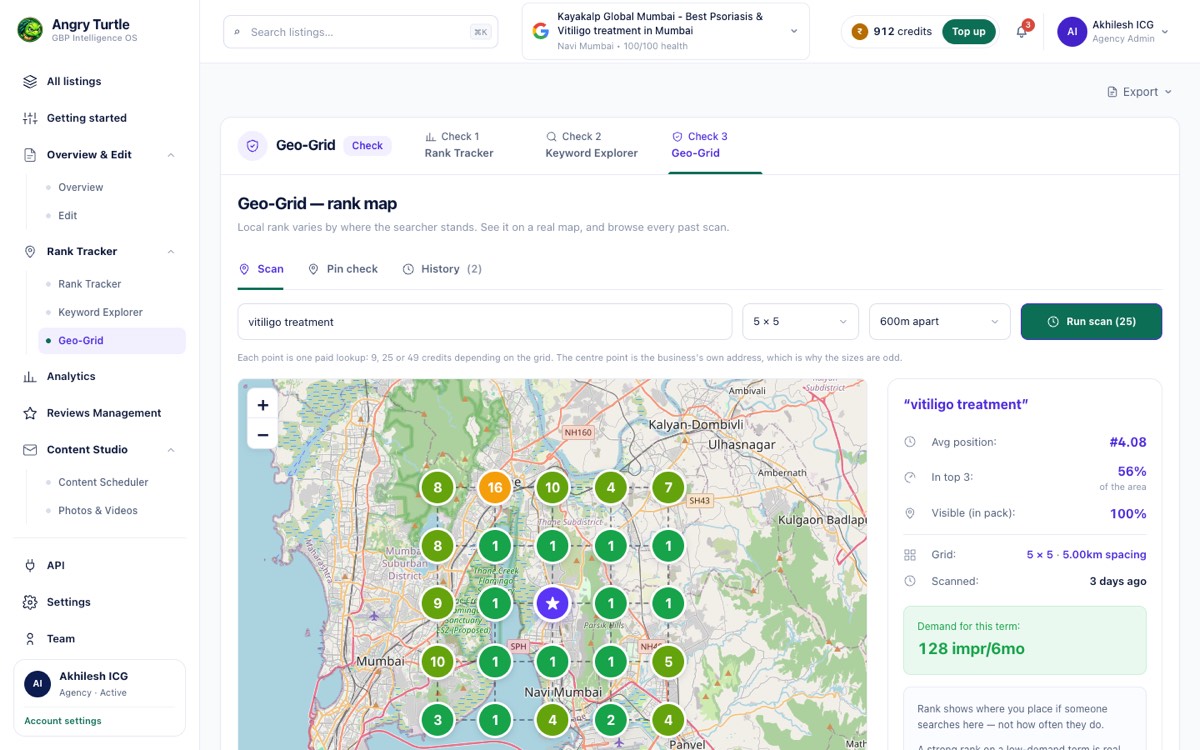
A single "you rank #4" figure hides the truth. The geo-grid runs the search from a grid of points across the service area and shows where you actually win, where you fade, and where you are not in the pack at all.
Ready to have this run for you?
Book a free audit — we'll show you where you stand in 48 hours.