 Angryturtle
Local SEO in Guwahati
Optimising for a catchment that reaches well beyond Assam.
·
Guwahati listings often pull search traffic from four states, not one. A diagnostic center on GS Road doesn't just compete for Kamrup district patients — a meaningful share of its searches originate from Meghalaya, Nagaland, Arunachal Pradesh, and further into the Northeast, because Guwahati functions as the region's medical, retail, and logistics hub. That out-of-city search volume changes what local SEO actually needs to account for here, well before the usual questions about categories and reviews.
Localities that carry the city's search volume
GS Road is the commercial spine, running long enough that search behavior differs noticeably between its stretches near Christian Basti and its stretches further toward Bhangagarh. Zoo Road and the area around Guwahati Zoo carry a dense retail and food-service cluster. Beltola has grown into a large residential and mid-market commercial pocket. Dispur, as the seat of the state secretariat, generates a specific kind of search tied to government offices and adjacent services. Paltan Bazar sits near the railway station and carries transient, travel-driven search — hotels, eateries, ticketing agents — quite different from a residential locality's pattern. Six Mile, out toward the airport, has become its own hub for logistics and newer retail development.
A business anchored to only "Guwahati" as its keyword loses the zone-level intent that actually drives a nearby click. "Pharmacy near Zoo Road" and "pharmacy in Guwahati" are not the same search, and Google's local pack responds to the more specific one when there's a genuinely nearby result to show. Landmark-based navigation matters here in a way that's easy to underweight — asking for directions "near Christian Basti flyover" or "opposite Dispur police point" is standard local phrasing, and a Google Business Profile address that doesn't reference any landmark misses how people actually confirm they've found the right place. That's worth checking directly in a local SEO audit, alongside NAP consistency across whatever directories the business is already listed on.
Assamese, Bengali, Hindi, and English, often in the same query
Assamese is the majority language, but Guwahati's population includes a large Bengali-speaking community, particularly in and around Paltan Bazar and parts of the old town, plus a substantial Hindi-speaking migrant and trading population and an English-speaking layer tied to government, education, and the corporate sector. A vernacular search query in this city can plausibly show up in any of the four, and it's common for a single search session to mix scripts — Assamese transliterated into Roman characters combined with an English service term.
This layered language mix means a Google Business Profile description written in English alone captures only one slice of the actual demand. A hospital serving patients from across the Northeast benefits from a profile and posts that use plain, correctly spelled place names as locals actually write them, rather than a single fixed language choice, and from service descriptions that match the specific terms a Bengali- or Hindi-speaking patient from outside Assam is likely to type rather than the terms a lifelong Guwahati resident would.
Healthcare draws from well beyond the city, and search behaves accordingly
Guwahati's hospitals and diagnostic labs function as the referral endpoint for a huge catchment across Assam and the neighboring states, since specialist and diagnostic capacity elsewhere in the Northeast is thinner. A patient searching from Shillong or Itanagar for a specific procedure is searching with travel already assumed, which means the profile and content need to answer questions a purely local patient wouldn't ask — how to reach the facility from the airport or the interstate bus stand, whether the hospital has any tie-up with patients traveling from outside the state, what documentation a non-resident patient needs. That's a different content job than the usual hospital SEO or diagnostic lab SEO approach built around a single-city catchment, even though the underlying schema and profile mechanics are the same.
Education and tourism follow their own patterns. Guwahati's colleges and coaching centers draw students from across the Northeast the same way its hospitals draw patients, and Kamakhya Temple and the riverfront drive a steady tourism search volume that spikes around specific festival dates. Logistics is the quieter fourth pillar — Guwahati's role as the region's transport gateway means a lot of warehousing, freight, and courier search volume that behaves closer to B2B entity search than consumer map-pack search, similar to how IT services search behaves in other hub cities.
A worked example
A multi-specialty diagnostic lab near Six Mile had strong local rankings for searches originating within Guwahati but almost no visibility for searches coming from Shillong, roughly a hundred kilometers away, despite handling a steady stream of patients who traveled from there for specific tests. Its Google Business Profile listed only Guwahati-facing content: local landmarks, local transport instructions, nothing addressing a patient planning a same-day trip from outside the state.
The fix wasn't a different profile category or a new set of keywords in the usual sense. The lab added a short section to its profile description and website content addressing exactly what an out-of-state patient needs — approximate distance and travel time from Shillong and Itanagar, whether an appointment could be booked ahead of arrival, and which reports were available same-day versus requiring a return visit. None of that content targets a "near me" search at all, but it directly answers what a searcher planning cross-state travel is trying to figure out before they commit to the trip, and general inquiry calls asking those exact questions dropped once the answers were already on the page.
Where this doesn't help
None of this fixes a hospital or lab whose actual capacity can't handle out-of-state demand — sending more distant searchers toward a facility that's already at capacity for local patients just produces a worse experience for everyone involved. It also won't help a business whose Google Business Profile has been suspended or is competing against an old, duplicate listing under a slightly different name, since that needs direct resolution first. And it's not a substitute for actual multi-language reception at the facility itself — a profile that promises service in four languages but a front desk that only operates in one creates the same mismatch the addressing work is meant to solve, just on the human side instead of the map side.
A managed local SEO plan or a pricing conversation is a reasonable next step once category, address, and language coverage are actually in order, not a way to skip past them.
Local SEO in nearby cities
Addressing conventions, language mix and competitive density change from one city to the next, and a playbook tuned for Guwahati will not transfer cleanly. We cover Kolkata, Bhubaneswar, Raipur, Delhi and Gurgaon separately for that reason. If you run locations in more than one of them, multi-location local SEO services covers how the work is coordinated across a network, and managed local SEO covers what running it for you actually involves.
FAQ
Why would a Guwahati business optimize for searches coming from outside Assam at all? Because the city functions as the referral hub for much of the Northeast, and hospitals, diagnostic labs, and some retail and logistics businesses genuinely draw a large share of demand from Meghalaya, Nagaland, Arunachal Pradesh, and beyond. Ignoring that search doesn't remove the demand, it just means the content doesn't answer what that searcher actually needs.
Which locality name should a business use if it sits on a long road like GS Road? The nearest well-known landmark or cross-junction, not just the road name. GS Road runs long enough that "near Christian Basti" and "near Bhangagarh" describe genuinely different search catchments even though both are technically on the same road.
Should Google Business Profile content be written in Assamese, Bengali, Hindi, or English? A mix reflecting the business's actual patient or customer base, since Guwahati's query stream runs across all four languages, often within a single search session. A hospital serving patients from across the region benefits more from plain, correctly spelled multilingual coverage than from picking one language and staying there.
Does a business need a different Google Business Profile category to target out-of-state searchers? No. The category stays the same. What changes is the supporting content, description, and posts, which should answer travel-planning questions a distant searcher has that a local one wouldn't.
Is local SEO useful for Guwahati's logistics and freight businesses? Less as map-pack competition and more as entity presence, since that search behaves closer to B2B lookup by company name than consumer "near me" search. The value there is being reliably findable when a client searches the business directly, not competing for generic freight-related local terms.
What should a business do first if its listing has been suspended? Resolve the suspension directly before any of the local-search improvements above, since none of them matter if the profile itself isn't live to show up in results.
Stop guessing where you rank locally.
Rank OS scores your Google Business Profile the way Google's local algorithm does — relevance, review health, freshness, entity authority and AIO readiness — and shows you exactly what to fix.
Book a live demo →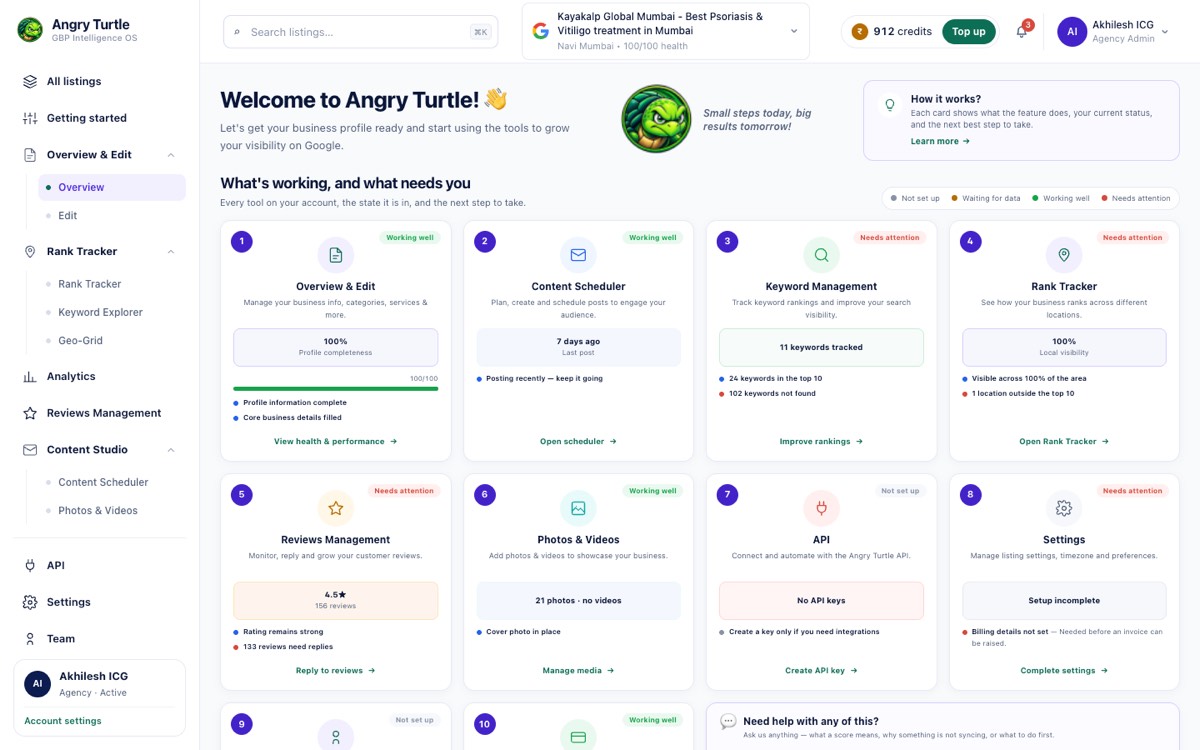

Ready to have this run for you?
Book a free audit — we'll show you where you stand in 48 hours.