 Angryturtle
Festival and Seasonal Demand in Indian Local Search
·
Diwali sends search volume for sweet shops and gift stores up weeks before the actual date. Wedding season does the same for banquet halls, caterers and bridal wear in Delhi and Jaipur. Monsoon shifts what people search for near hospitals and pest control services in Mumbai and Kolkata. None of this is a secret, but almost no local SEO guidance in India actually tells you what to do about it on your Google Business Profile, as opposed to your ad budget.
Contents
- Why seasonality hits Google Business Profile differently in India
- Which festivals actually move local search, by category
- What to change on your profile before a peak, not during it
- Posts, hours and photos during the peak itself
- What to do in the slow months
- [Where the GBP management fits](#where-management-fits)
- Frequently asked questions
Why seasonality hits Google Business Profile differently in India
Google's local ranking factors are relevance, proximity, and prominence. Seasonality mostly acts on relevance and prominence at once. Search intent itself changes: a jeweller who is invisible for "gold rate today" in March can become a serious contender for "Diwali gold offers near me" in October, purely because the query changed shape, not because the jeweller did anything different. And prominence signals move too, because review velocity, post frequency and click activity all spike for the businesses that are ready, which then feeds freshness, one of the inputs to a listing's standing.
A GBP that sits untouched between festivals is competing at a disadvantage against one that has been updated to match what people are actually typing that week. This is the practical version of the GBP ranking factors most guides describe only in the abstract.
There's a second, quieter effect. Google's own AI systems — AI Overviews and increasingly AI Mode — draw on recency signals when deciding which local business to surface for a time-sensitive question like "which sweet shops deliver for Diwali in Andheri." A profile that hasn't posted anything since June is a weaker citation candidate in October than one with a week-old post about festival hours. That's the same logic covered in measuring AI search visibility, just applied to a calendar instead of a keyword list.
Which festivals actually move local search, by category
Diwali is the biggest and broadest one. Sweet shops, electronics retailers, home decor, jewellers and clothing stores all see demand build for two to three weeks beforehand. Wedding season, which runs roughly November through February with a second smaller window around April-May, drives banquet halls, caterers, photographers, bridal wear and florists — and it's regional: Delhi-NCR and Punjab peak harder than the south.
Monsoon (June-September) changes demand for a different set of categories: hospitals and clinics see search patterns shift toward specific ailments, pest control and waterproofing services spike, and umbrella and raincoat retailers get a short but real window. Holi drives colour and sweet retailers, and to a lesser extent outdoor venue bookings. Eid affects meat shops, tailors and gift retailers, concentrated in specific neighbourhoods more than citywide. Back-to-school season (roughly April-June ahead of the academic year, though this varies by state board calendar) matters for coaching institutes, stationery stores and uniform tailors — a category local SEO for coaching institutes already covers from the demand side.
None of these dates are fixed on the Gregorian calendar the way "December 25" is. Diwali alone moves by weeks year to year. That's the actual argument for planning ahead rather than reacting: a listing update planned two weeks before Diwali needs a real lunar calendar check, not a rough guess based on last year.
What to change on your profile before a peak, not during it
Special hours are the most commonly missed field. Google Business Profile has a dedicated special-hours setting separate from regular hours, and it needs setting per date, per location — a business open till midnight the week before Diwali but closed entirely on the day itself needs both entered, not one guessed average.
The business description and services list are worth a light seasonal pass too, not a rewrite. A caterer's description that mentions wedding season menus in October reads as current; the same description sitting untouched from March reads as generic to anyone comparing three caterers in a search result.
Photos matter more here than most sellers assume. A sweet shop with last year's Diwali display photos looks dated by the time this year's festival rolls around — and Google's own guidance treats photo recency as one of many small freshness signals feeding prominence, on top of what it does for the human browsing the result.
If your business runs across multiple locations, the pre-peak checklist needs doing per listing, not once for the brand. A wedding-season update pushed to a Delhi outlet and forgotten for the Jaipur one leaves half the chain looking stale exactly when demand is highest there too.
Posts, hours and photos during the peak itself
GBP posts are the fastest lever during an actual peak window, and they're the one most businesses stop using right when they'd help most, because everyone is busy running the actual business. A short post about extended hours, a festival offer, or new stock lands in the profile's activity feed and contributes to the freshness signal covered in GBP post ideas and how often to update GBP for AI search.
Review response speed also tends to slip during a peak, which is exactly backwards — a bad review posted during your busiest week of the year gets seen by more people than the same complaint in a quiet month. Responding to negative reviews fast during a peak protects far more visibility than the same effort spent in February.
Photos published during the actual event, not staged beforehand, tend to read as more current to both users and Google's freshness checks. A bakery posting today's Diwali counter, rather than a stock photo from last year, is doing the small thing that compounds.
What to do in the slow months
The mistake in the other direction is going quiet the moment the festival passes. A wedding photographer who posts weekly through January and then nothing until September looks, from Google's perspective, like a business that stopped operating for eight months. Slow-season posting doesn't need to be frequent — even a monthly update keeps the freshness signal from decaying, which per Angryturtle's Rank OS model starts happening after roughly three weeks of inactivity on a listing.
Slow months are also the right time to do the unglamorous groundwork: cleaning up NAP consistency across directories, filling out secondary categories properly per choosing a GBP category, and building review volume before the next peak arrives and there's no time left to do it properly.
Where GBP management fits
Doing this manually across a calendar of festivals, each with different lead times and regional variation, is exactly the kind of recurring, date-driven task that gets skipped when a business owner is also running the counter during Diwali week. Angryturtle's managed GBP services schedule these updates ahead of the actual dates, and because the platform can push edits straight to Google rather than only flagging what needs changing, hours, posts and photos go live without someone remembering to do it from a phone at 11pm. The same Content Studio that handles day-to-day posting is timezone-aware to the listing's local time, which matters when a festival post needs to land the morning of, not the evening before somewhere else.
For agencies managing several clients across different verticals, this is also where a demand cluster view helps: seeing which of a client's keyword clusters are entering a seasonal upswing before the client even asks about it.
Frequently asked questions
Does Google actually reward festival-specific GBP updates, or is this just good practice for users? Both, and they're hard to separate. Special hours and current photos directly help the person searching. They also feed the freshness component of relevance signals Google uses for ranking, and increasingly the recency signals that AI systems weigh when deciding what to surface for a time-sensitive local query. There's no published multiplier for "posted during Diwali," but the mechanism runs through the same freshness and engagement signals that apply year-round.
How far ahead should special hours be set? As soon as the dates are confirmed, and definitely before the week of the event — GBP allows special hours to be scheduled well in advance, and setting them early avoids the scramble of doing it the night before a holiday when hours also tend to change with little notice.
Do these seasonal patterns apply the same way in every Indian city? No. Wedding season intensity, festival dates observed, and even monsoon timing vary by region. A Chennai business planning around Pongal has a different calendar than a Punjab business planning around a wedding season that runs heavier and longer. Treat the categories above as a starting point, not a fixed national calendar.
What happens to seasonal gains once the festival ends? They fade, generally within a few weeks, back toward the baseline set by the profile's ongoing completeness, review volume and category accuracy. Seasonal spikes are additive on top of that baseline, not a replacement for the work covered in GBP optimisation — a poorly optimised profile still underperforms during its best week of the year.
Stop guessing where you rank locally.
Rank OS scores your Google Business Profile the way Google's local algorithm does — relevance, review health, freshness, entity authority and AIO readiness — and shows you exactly what to fix.
Book a live demo →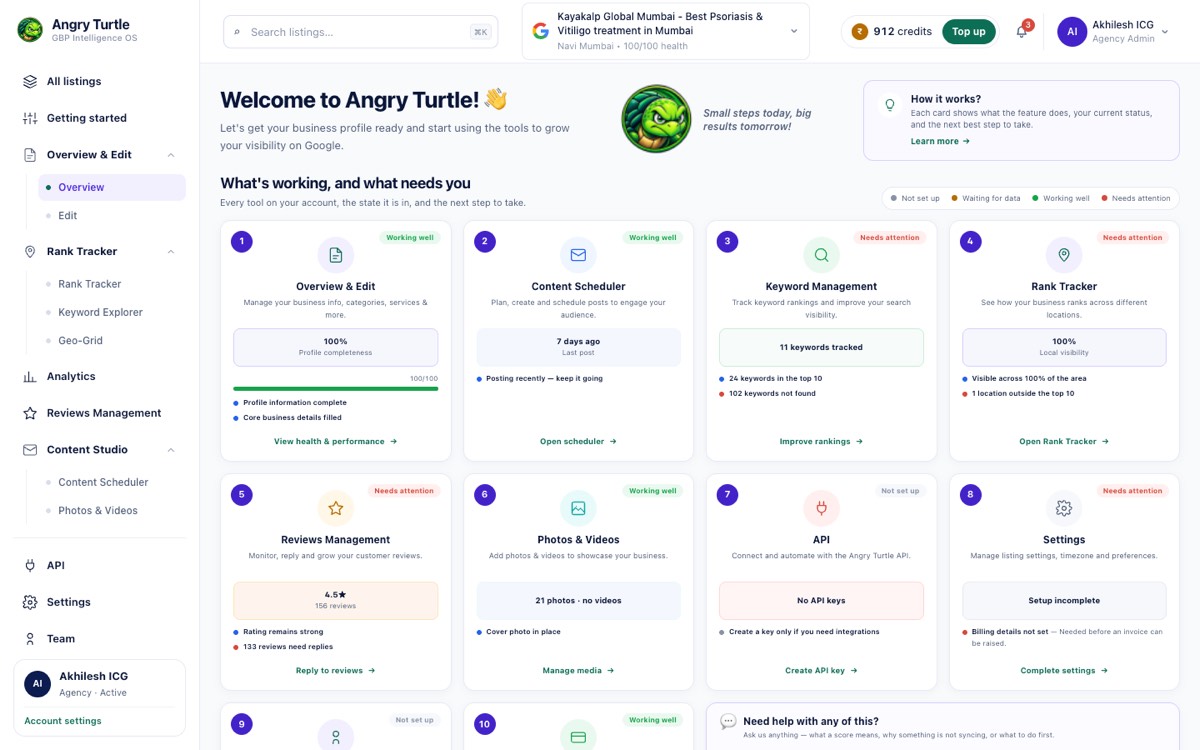

Ready to have this run for you?
Book a free audit — we'll show you where you stand in 48 hours.