 Angryturtle
How to Respond to Negative Google Reviews
What to say, what never to say, and how to turn a one-star review into proof you show up when things go wrong.
Respond within the first 24 to 48 hours, acknowledge the specific complaint, apologize where it's fair to apologize, and move the details offline. That's the whole playbook in one line. The rest of this piece is how to do it without making things worse.
A one-star review sitting unanswered for two weeks reads as neglect to anyone else who finds the listing later. A one-star review with a calm, specific reply under it reads as a business that shows up when things go wrong. Most people searching for a plumber, a clinic, or a restaurant aren't looking for a spotless five-star record. They're checking whether the owner responds like an adult when something breaks.
Why responding to negative reviews actually matters
Three things happen when you reply to a bad review, and they're separate from each other.
First, anyone reading the listing later sees the reply, not just the complaint. A prospective customer scrolling reviews reads the one-star review and your response as a pair. If your response is short, specific, and non-defensive, it often does more to build trust than a page of five-star reviews would.
Second, review activity feeds into how healthy a Google Business Profile looks over time, alongside how fresh the listing is and how complete the information is. A profile that never engages with its own reviews looks abandoned, and abandoned profiles tend to underperform ones that show ongoing activity.
Third, and this surprises people, a good-faith reply sometimes gets the review itself changed. A customer who left a review out of frustration will occasionally edit it upward, or delete it, once they see you took the complaint seriously and offered to fix it. It doesn't happen every time. It happens often enough that skipping the reply is leaving that option on the table for nothing.
The core principles before you write anything
Speed matters more than polish. A reply that shows up within a day or two, even a slightly imperfect one, beats a perfectly worded reply that shows up three weeks later. By then the reviewer has moved on and new readers just see silence followed by a late scramble.
Stay calm on the page even if you're not calm in the room. Reviews that feel unfair still get a level response. Arguing with a customer in public, however justified you feel, reads badly to everyone except you.
Never share private details in a public reply. This matters everywhere, but it's a hard line for healthcare and clinic listings especially — in India, confirming that someone is a patient, referencing their visit, treatment, or diagnosis in a public review reply can be a privacy violation on its own, separate from whether the original review was fair. If a healthcare reviewer names specifics, your reply should not repeat or confirm any of it.
Acknowledge what's true and apologize for the actual impact, not a blanket "sorry you feel that way." If the wait was long, say the wait was long. A real apology names the thing.
Move the specifics offline. A public reply is not the place to resolve a billing dispute line by line. It's the place to show you're willing to.
Keep it short. Two to four sentences does the job. A long public reply reads as defensive no matter how reasonable the content is.
Templates for the common cases
Service issue. "We're sorry the installation didn't go the way it should have. That's on us, not something we'd expect any customer to just accept. Please call us at [number] so we can look at what happened and make it right."
Billing dispute. "Thanks for flagging this. Billing errors are frustrating and we want to get yours sorted quickly. Can you email us at [address] with your invoice number so we can review the charge directly?"
Long wait time. "A wait that long isn't the experience we aim for, and we're sorry it happened on your visit. We're looking at scheduling to reduce this. If you're open to it, we'd like to hear more at [contact] so we can address it properly."
Review that seems unfair or possibly fake. Don't accuse the reviewer in public. Reply once, factually: "We don't have a record matching this visit under this name — if you can share more details at [contact], we'd like to look into it." Then flag the review to Google separately (see below) if it violates policy; the public reply and the flag are two different actions.
What not to do
Don't argue the facts in the reply itself. Don't say "that's not what happened" — invite them to a private conversation instead. Don't post a form response that's obviously copy-pasted across every review on the page; readers notice, and it undercuts the whole point of replying. Don't offer a refund or compensation amount publicly before you've actually talked to the person. Don't ignore reviews that mention safety, discrimination, or harassment and hope they age out of visibility.
When to also flag the review
Google will remove reviews that violate its policies: fake reviews, reviews from someone with no connection to the business, hate speech, spam, or a review posted by a competitor. Flagging is separate from replying, and you should generally do both — reply calmly in case the review stays up, and flag it through Google's report tool in case it shouldn't be there at all. Flagging isn't a substitute for engaging with real, if harsh, feedback. It's for reviews that break the rules, not reviews you simply dislike.
One thing to be clear about: none of this involves asking customers to change their reviews in exchange for anything, gating negative feedback before it posts, or paying for reviews. Google prohibits all of that, and it also just doesn't build the kind of review profile that holds up over time.
How Angryturtle helps with this, without taking over your voice
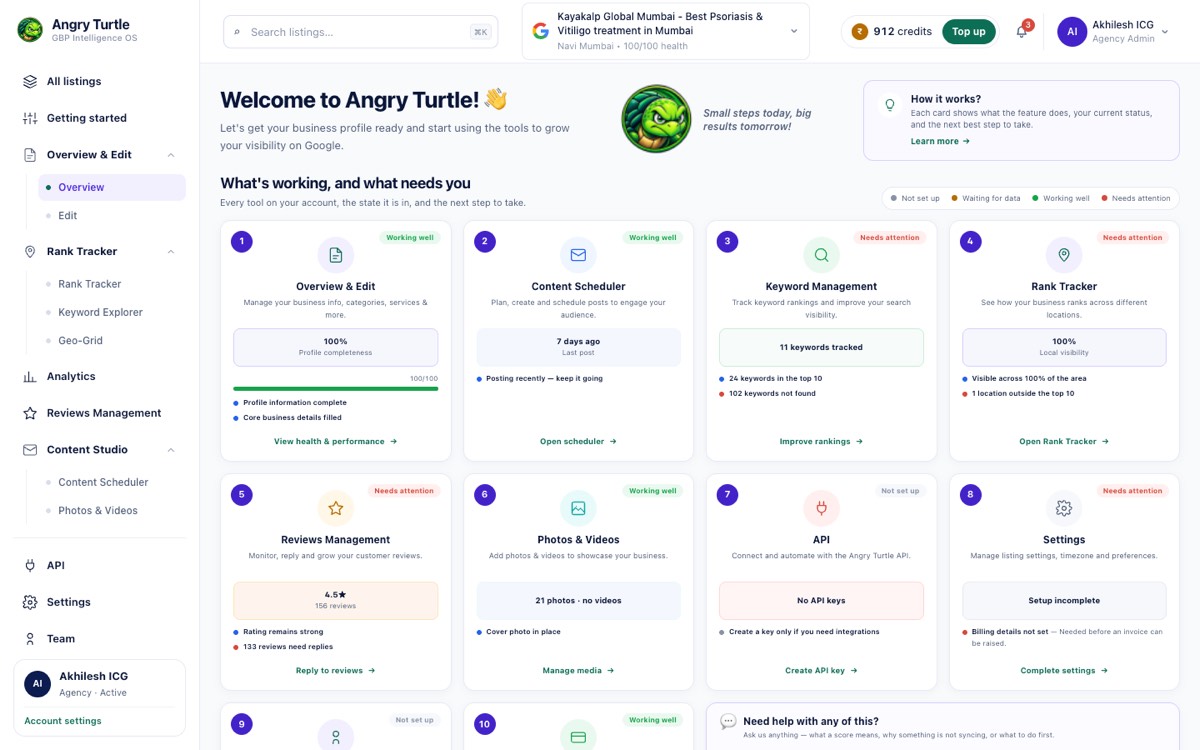
Writing a calibrated reply to every negative review, across every listing, every week, is the kind of task that's easy to fall behind on. Angryturtle's reviews AI drafts an on-brand reply for each incoming review, matched to the tone of the complaint, and you approve or edit it before anything goes live. Nothing publishes without a person looking at it first. Once you're happy with a draft, publishing is one click, pushed straight to the Google listing.
The same reviews engine reads sentiment across your entire review history, not just the newest one, and turns that into a prioritized list of what to fix. It also runs a Brand Identity vs Brand Image comparison: what you say about your business versus what your reviews actually say customers experience. When those two stories diverge, that gap is usually where the next negative review is going to come from before it happens.
This works two ways. Solo owners running one or two profiles can draft and approve replies themselves inside the same dashboard where they check everything else. Agencies and larger brands running the managed GBP service can hand review response over entirely, with drafts still routed for client approval before publishing, and the sentiment and gap analysis rolled into the monthly report. Either way, a human signs off before a reply goes public. And if the goal is broader visibility, not just review hygiene, that same review-health signal feeds into Rank OS, the scoring engine that tracks how a whole profile is performing and what to fix next.
FAQ
How fast should I respond to a negative Google review? Within 24 to 48 hours where possible. Faster responses read as attentive; a reply that shows up weeks later looks like it was prompted by embarrassment rather than genuine care.
Should I ever delete or hide a negative review? You can't delete a review yourself. You can flag it to Google if it violates policy — fake, off-topic, or abusive — but a real, if harsh, complaint about your service isn't something Google will remove just because you disagree with it.
Can responding to a bad review actually get it changed or removed? Sometimes. A reviewer who sees a genuine, specific reply will occasionally edit their rating or take the review down after the issue gets resolved privately. It's not guaranteed, and it shouldn't be the only reason you reply.
Is it okay to offer a refund or discount in the public reply? Better to invite the person to a private channel first. Publicly promising compensation before you've verified what happened can invite the same request from people who never had a real issue.
What if the reviewer never actually used my business? Reply once, briefly, noting you have no record of the visit, and flag the review to Google as fake or policy-violating. Don't get into a back-and-forth in the replies.
More how-to playbooks
A score you can argue with, not a black box
Rank OS gives every profile a 0–100 score built from five weighted dimensions — Relevance, Review Health, Freshness, Entity Authority and AIO Readiness — and the weights are tunable. Underneath it sits a ranked list of the fixes that move the number, each with the point lift it unlocks.
Ready to have this run for you?
Book a free audit — we'll show you where you stand in 48 hours.