 Angryturtle
Top Local SEO Agencies in India (Compared)
How to evaluate and compare local SEO agencies in India. Evaluation criteria, red flags, questions to ask, and what the best agencies actually deliver.
·
How to find and evaluate the top local SEO agencies in India
Searching "top local SEO agency India" turns up a mix of general digital marketing agencies, SEO generalists that list local SEO as one of many services, and a smaller number of genuine specialists. Some searches phrase it as an Indian SEO agency, others as local SEO services India, and a few go looking specifically for the best local search engine optimization company rather than a generalist — all of those searches land on roughly the same shortlist, and this guide applies to any of them. This guide is less about naming names and more about the criteria that actually separate agencies that deliver from agencies that don't — the questions worth asking before signing anything. Angryturtle's own local SEO agency India page sets out where it fits against these same criteria.
The four kinds of provider you'll actually run into
Search results for "local SEO agency India" blend together four genuinely different kinds of provider, and knowing which one you're looking at changes what questions matter.
Full-service digital marketing agencies sell local SEO as a line item alongside paid ads, social media management, and web design. They can be a reasonable fit if you already need several of those services from one vendor and don't mind local SEO getting a smaller, more generalist slice of attention. Boutique local-SEO specialists do only local and Google Business Profile work, usually with deeper India-specific citation knowledge and a narrower but more accountable scope. Independent freelancers and consultants — often a single person or a very small team — can be genuinely excellent for a single-location business with a modest budget, but they don't scale well past a handful of locations and rarely have backup coverage if that one person is unavailable. And platform-plus-managed-service hybrids combine self-serve software with an actual team executing on top of it, which matters mainly for agencies and multi-location brands that want both the tooling and the hands doing the work — Angryturtle sits in this fourth category, alongside a small number of other vendors in the space.
None of these four is automatically the right choice. A single-location café doesn't need an agency-grade portfolio tool; a 40-location retail chain almost certainly does. Matching the category to the actual scope of the job is the first filter, before any of the specific questions below.
Is local SEO their primary service, or one item on a long list?
Ask directly whether local SEO is the agency's primary service or one of twenty. The best local SEO specialists do local SEO as their core focus. Generalist agencies add it to a broad service menu without the operational depth — the dedicated team, the India-specific citation knowledge, the proprietary tooling — needed to execute it well.
A red flag worth watching for: an agency whose homepage leads with "Digital Marketing," "Social Media," and "SEO," with local SEO buried as a subsection under general SEO rather than its own discipline. That structure usually reflects how the agency actually staffs and prioritises the work, not just how the website happens to be organised.
How many GBP profiles do they actively manage right now?
Ask how many Google Business Profiles the agency is actively managing today, not how many clients they've had over their history. An agency managing a handful of profiles hasn't built the operational muscle or the institutional pattern-recognition that comes from managing profiles at real scale.
Worth asking as a follow-up: do they use the GBP API for bulk operations, or is everything done manually through the dashboard? Manual-only management at scale is itself a signal that the agency hasn't invested in the tooling that multi-location clients specifically need. Angryturtle's guide to managing 100 GBP listings covers what that operational maturity actually looks like in practice.
Do they run India-native citation management?
Ask which Indian directories fall inside the agency's citation management scope. The answer should include JustDial, Sulekha, and IndiaMART at minimum, Practo for healthcare clients specifically, and 99acres or MagicBricks for real estate clients — plus whatever vertical-specific platforms apply to the client's own industry. Our own directory guide lists the full set most Indian businesses should consider.
An answer built entirely around Western citation tools, without reference to any Indian directory by name, suggests the agency is running a Western playbook unadjusted for the Indian market rather than genuinely India-native citation work.
Do they use geo-grid rank tracking, or just average position?
Ask how the agency tracks local rank. The answer should reference geo-grid tracking — sometimes called local heatmap tracking — rather than just "average position in Search Console." Average position doesn't capture how rank actually varies across a city, and an agency reporting only that number is either not measuring the thing that matters or not measuring it precisely enough to act on. See Angryturtle's guide to share of local voice for why grid-based measurement beats a single average figure.
Do they have real depth in your specific vertical?
Ask whether the agency has specific experience in your industry. Healthcare, BFSI, real estate, and education each carry distinct GBP management requirements, compliance constraints, and citation ecosystems, and an agency with no depth in your vertical will manage your account with the same generic playbook it uses for everyone else. Angryturtle's industry pages cover the sector-specific requirements across healthcare, real estate, hospitality, education, franchise, retail, and banks in more depth, and if AI search visibility is also part of the brief, Angryturtle's AEO agency page covers that adjacent discipline.
Who actually writes and publishes review responses?
Ask who drafts and publishes review responses, and whether the agency runs review generation for clients or only monitors what comes in. The answer should be specific: responses drafted and published directly by their team, and review generation running through WhatsApp flows for Indian clients specifically, since that's the channel that actually moves the needle here — see Angryturtle's WhatsApp review request guide for why. "We monitor reviews and you respond" is a monitoring service, not a management one, and it's worth knowing which one you're actually buying.
Is the process documented, or vague by design?
Ask for the onboarding checklist, the specific monthly execution scope, and the SLAs for review response time and suspension escalation. Agencies running a real, repeatable process have these documents ready. Agencies that stay vague about scope tend to also stay vague about accountability once something goes wrong.
Will they give you a rate before a long sales process?
Ask for a per-location monthly rate or range with clear inclusions. Agencies that won't give any indication of price before a lengthy multi-call sales process are often optimising for deal size over client fit — a reasonable agency should be able to give a ballpark figure early, even before the exact scope is finalised. Angryturtle's own pricing page is a reasonable example of what up-front clarity looks like: Managed Essentials, Growth, and Agency Partner tiers with published starting rates rather than a number you only get after three calls.
A worked example: a three-location restaurant group in Chennai
Take a restaurant group running three locations across Chennai, with a marketing manager who also handles social media and has maybe six hours a month to spend overseeing an outside vendor rather than doing the work directly. Their budget rules out a large full-service agency's minimum retainer, and a single freelancer can't realistically cover three locations' worth of ongoing review response and post cadence without becoming a bottleneck.
That combination of constraints points toward either a boutique local-SEO specialist with genuine restaurant-vertical experience, or a platform-plus-managed-service hybrid where the marketing manager keeps some visibility through a client portal without having to chase status updates by email. The specific thing worth asking either type of provider: how do you handle review requests across three locations without the same generic WhatsApp message going out from every branch, and can the marketing manager see geo-grid rank by location without asking for a custom report each month. A provider that can answer both concretely is doing the job properly; one that answers only the first, or answers with "we send a monthly PDF," is giving Chennai's competitive restaurant search landscape less attention than three active locations need.
The honest recommendation for this exact business isn't "hire the biggest agency you can afford" — it's match the provider category to the six-hours-a-month oversight budget and the three-location reporting need, and let vertical fit and reporting depth decide between the two categories that actually clear that bar.
What checking references actually reveals
Case studies on an agency's own website are marketing material by definition, curated to show the best outcome the agency has ever produced. A reference call with a current client, ideally one who's been with the agency for at least six months rather than one still in an early honeymoon period, reveals something different: what actually happens when a suspension hits, how quickly a request for a scope change gets a real answer instead of a stall, and whether the monthly report changes month to month or reads like a template with new numbers dropped in.
The single most useful question to ask a reference isn't "were you happy" — almost everyone says yes to that, since dissatisfied clients tend to have already left. Ask instead what the agency did the last time something went wrong, whether that was a suspension, a missed deadline, or a mismanaged review response. The answer to that question, more than anything on a case-study page, shows whether the agency's process holds up under the kind of pressure every client relationship eventually runs into.
Agencies confident in their own work rarely resist a reference call, and one that offers only written testimonials or refuses to connect a prospect with a current client at all is worth treating with more scrutiny than one that answers the request without hesitation.
Ten questions worth asking any shortlisted agency
Is local SEO your primary service? How many GBP profiles do you actively manage? Do you cover Indian directories — JustDial, Practo, IndiaMART, Sulekha — in citation management? How do you track local rank, and with what tool? Who writes and publishes review responses, and what's your response-time SLA? What does month one actually look like, in specific scope terms? Can you share an anonymised case example in our industry? What's your SLA for suspension escalation? What's your per-location monthly rate in rupees? And what's the minimum commitment period?
Red flags worth walking away from
No legitimate local SEO agency guarantees a specific ranking position, because Google's algorithm isn't within any agency's control — an agency promising "top 3 in 30 days" is either misinformed about how ranking works or selling something it can't actually deliver. Bulk citation packages sold on volume alone — "we'll build a thousand citations for a fixed low price" — are usually citation spam dressed up as managed local SEO, not the real thing.
Ask any agency candidly whether they've had clients suspended under their management and what happened next. Honest agencies have had some suspensions over enough client history and have a clear reinstatement process ready — see Angryturtle's guide to GBP suspension reasons and the reinstatement service for what that process should look like. An agency claiming zero suspension history across a real client base is either unusually lucky or hasn't managed enough profiles to have run into it yet.
An agency running a Western local SEO playbook unchanged for an Indian client — no adjustment for Indian directories, no WhatsApp review generation, no accounting for Indian search behaviour patterns — isn't the right partner for this market, regardless of how polished its case studies look. And a monthly report built around impressions and generic traffic metrics, with nothing on geo-grid rank, calls, or direction requests by location, isn't accountability — it's a report designed to look busy.
What a good monthly report actually contains, next to what a weak one contains
A weak report is a PDF with a rank-tracking screenshot, a paragraph of general commentary, and a "keep up the good work" close. It rarely names a specific action taken that month, and it almost never breaks anything down by individual location.
A report worth paying for names the specific GBP changes made that month — which fields, which locations — states the review count and response rate change location by location, shows geo-grid movement rather than a single average position, and includes at least one specific action planned for next month tied to a stated reason. The difference isn't length. A one-page report that names three specific things done and three specific things planned is worth more than a fifteen-page report that never gets more specific than "improved visibility."
What best-in-class managed local SEO actually includes
A dedicated account structure rather than a rotating pool of juniors, monthly GBP optimisation across every location rather than a set-and-forget setup, India-native citation management across dozens of directories, review generation running through WhatsApp flows, review responses on a defined SLA, geo-grid rank reporting by location and keyword, a scoring system to prioritise monthly execution rather than guesswork, suspension monitoring with fast escalation, and a quarterly strategy review that includes real competitive analysis rather than a generic template. Angryturtle's own Rank OS is one way to see that scoring-and-prioritisation approach in a concrete tool rather than as an abstract description.
Where a managed agency isn't actually the right answer
Not every business needs an agency. A single-location business with an owner who has an hour or two a week to spend and a genuine interest in doing the work directly can get real results from a self-serve platform alone, without paying for a managed retainer on top. The trigger point for actually needing a managed service tends to be either scale — three or more locations where the coordination overhead alone eats the owner's available time — or a specific gap the owner can't close themselves, like citation cleanup across dozens of directories or review response volume that's outgrown what one person can keep up with. Angryturtle's own plans reflect this split deliberately: Solo and Agency self-serve tiers for businesses and agencies that want to do the work themselves with better tooling, and Managed Essentials, Growth, and Agency Partner tiers for the ones who want someone else doing it. Evaluating "should I hire an agency at all" honestly, before evaluating which agency, saves a chunk of this whole exercise for a meaningful share of small businesses.
FAQ
Should I choose an agency purely because it's the biggest one I can find? No. Scale matters for operational maturity, but vertical fit and process transparency matter more for whether the agency will actually manage your specific business well.
Is a rank guarantee ever legitimate? No agency controls Google's algorithm, so a guaranteed specific ranking position isn't something a legitimate agency can promise. Treat any firm offer of a guaranteed rank as a warning sign rather than a selling point.
How do I know if an agency's citation work is India-native or just relabelled Western tooling? Ask them to name the specific Indian directories in scope — JustDial, Sulekha, IndiaMART, and vertical-specific platforms like Practo or 99acres. A vague answer, or one built entirely around a single Western citation tool, is the tell.
Do I need an agency at all, or is self-serve software enough? For a single location with an owner willing to spend an hour or two a week, self-serve software alone can be genuinely enough. Multiple locations, limited time, or a specific gap like citation cleanup or review-response volume are the usual triggers for needing a managed layer on top.
How long should the evaluation process itself take? Two to three weeks is reasonable for a serious shortlist of three or four providers — enough time for reference calls and at least one detailed scoping conversation with each, without dragging into the kind of extended sales cycle that itself was flagged above as a red flag.
Is the top local SEO agency in India always the biggest name? No, and that's a common mistake in this search. The top local SEO agency in India for a given business is whichever one matches its vertical, branch count, and budget on the criteria above — a large, well-known name is sometimes the wrong fit for a three-location business, and a smaller specialist is sometimes the wrong fit for a two-hundred-branch chain. Size and rank in a search results page aren't the same thing as fit.
What actually makes a provider the best local search engine optimization company for a specific business, rather than just a well-known one? The criteria in this guide, not the search ranking of the agency's own website. India-native citation coverage, per-branch geo-grid tracking rather than an averaged number, documented process, and vertical depth matter more than brand recognition — an agency can rank well for "best local search engine optimization company" itself and still be a poor fit for a specific vertical or branch count.
See how Angryturtle delivers all of this → Or book a demo to see the platform side of this directly, or get in touch with specific questions about your situation.
Stop guessing where you rank locally.
Rank OS scores your Google Business Profile the way Google's local algorithm does — relevance, review health, freshness, entity authority and AIO readiness — and shows you exactly what to fix.
Book a live demo →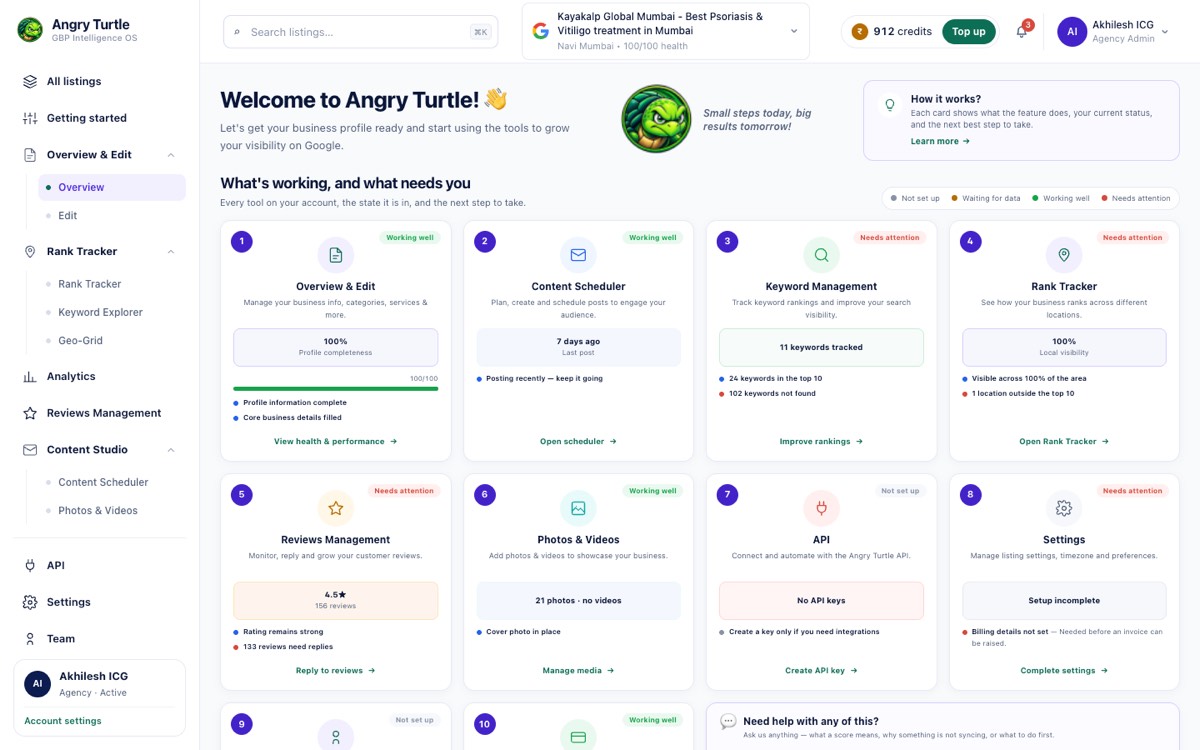

Related reading
Ready to have this run for you?
Book a free audit — we'll show you where you stand in 48 hours.