 Angryturtle
DIY AEO vs Managed AEO: Which Is Right for Your Indian Business?
DIY AEO is viable for single-location businesses with an owner or team member who can commit 5–8 hours per month to GBP management, review generation, and content updates. Managed AEO is recommended for multi-location businesses, competitive metro markets, healthcare/education where AI citations have direct revenue impact, and businesses without internal digital marketing capability.
The DIY-versus-managed framing usually gets pitched as a decision about capability — can this business handle AEO itself, or does it need to hire someone. That's the wrong axis. Angryturtle is both a self-serve platform a business can run itself and a managed service where Angryturtle's team runs it for the business — so the actual decision isn't about which product to buy, it's about who's going to operate it week to week.
What a business owner can genuinely do without help
GBP management is the most approachable part of AEO for a non-technical owner. Updating the description, adding photos, publishing posts, and replying to reviews are all designed to be done through a dashboard interface, no technical background required.
Review building is mostly a discipline problem, not a skill problem — asking for reviews via WhatsApp, a QR code, or a verbal request at checkout is something any staff member can execute once the habit is established.
Basic schema is more approachable than it sounds if the site runs on a common CMS with an SEO plugin — LocalBusiness and FAQPage schema can often be added through a form interface rather than hand-written JSON-LD.
Content reformatting — rewriting an existing page's opening to lead with a direct answer instead of building up to one — is a writing task, not a technical one, once someone understands what "answer-first" formatting means.
What starts to strain a DIY approach
The list above covers the individually approachable tasks. What's harder to sustain DIY is the combination of all of them, done consistently, across every location a business operates, month after month, on top of running the actual business. A single-location owner with some spare time can realistically keep this going. An owner running three locations, or a category with heavy competition, tends to find the discipline breaks down first — GBP posts slip, review follow-up gets skipped during a busy month, and schema never gets revisited after the initial setup.
Multi-location NAP consistency in particular is a task that scales badly by hand. Keeping the same name, address, and phone format correct across ten GBP listings and forty directory citations, done manually, is exactly the kind of repetitive, error-prone work that swallows hours without anyone noticing until an inconsistency has already cost a citation somewhere.
What managed AEO actually adds
A managed AEO engagement isn't a different set of tasks from the DIY list — it's the same tasks, executed with more structure and less risk of drift. Systematic review building replaces ad hoc requests with a repeatable WhatsApp and QR-code workflow, staff training, and monthly velocity reporting that shows whether the process is actually working. Technical schema implementation covers the sites where a plugin-based approach isn't available, and keeps schema current as the business's services or locations change. Multi-location management centralises NAP consistency and per-location posting rather than relying on someone remembering to update every listing individually. And ongoing platform tracking — staying current on GBP policy changes, new schema types, and how AI Overview eligibility shifts over time — is the kind of background work a business owner realistically has no time for.
A Lucknow salon owner tries DIY first, on purpose
The owner of a single-location salon in Lucknow's Hazratganj area decided to run AEO herself for the first quarter, mostly to understand what the work actually involved before paying anyone to do it. She kept a shared spreadsheet, posted to GBP twice a week, and asked every satisfied customer for a review through a QR code taped to the billing counter. It worked, for a while — reviews climbed from 40 to 95 over three months, and the salon moved from fifth to second in its local pack for "salon near me" in that neighbourhood.
Then she opened a second branch across town. The spreadsheet system that worked for one location fell apart almost immediately for two — GBP posts for the new branch got forgotten for three straight weeks during the opening rush, and a phone number typo on one directory listing for the new branch sat uncorrected for over a month because nobody was checking systematically. She moved to a managed engagement at that point, not because the DIY tasks had become harder individually, but because the second location doubled the volume of small, repeatable work with no corresponding increase in her own available hours.
What goes wrong with an all-or-nothing decision
The mistake that shows up most often isn't picking DIY or managed, it's treating the decision as permanent and binary when the actual need changes as the business does. An owner who commits to full managed service for a single, low-competition location sometimes pays for more oversight than the situation needs. An owner who insists on staying fully DIY after opening a third location is usually the one whose review velocity quietly stalls and whose GBP posting cadence goes from twice a week to once a month without anyone deciding that on purpose — it just happens because there's no longer enough time in the week.
Where Angryturtle fits either way
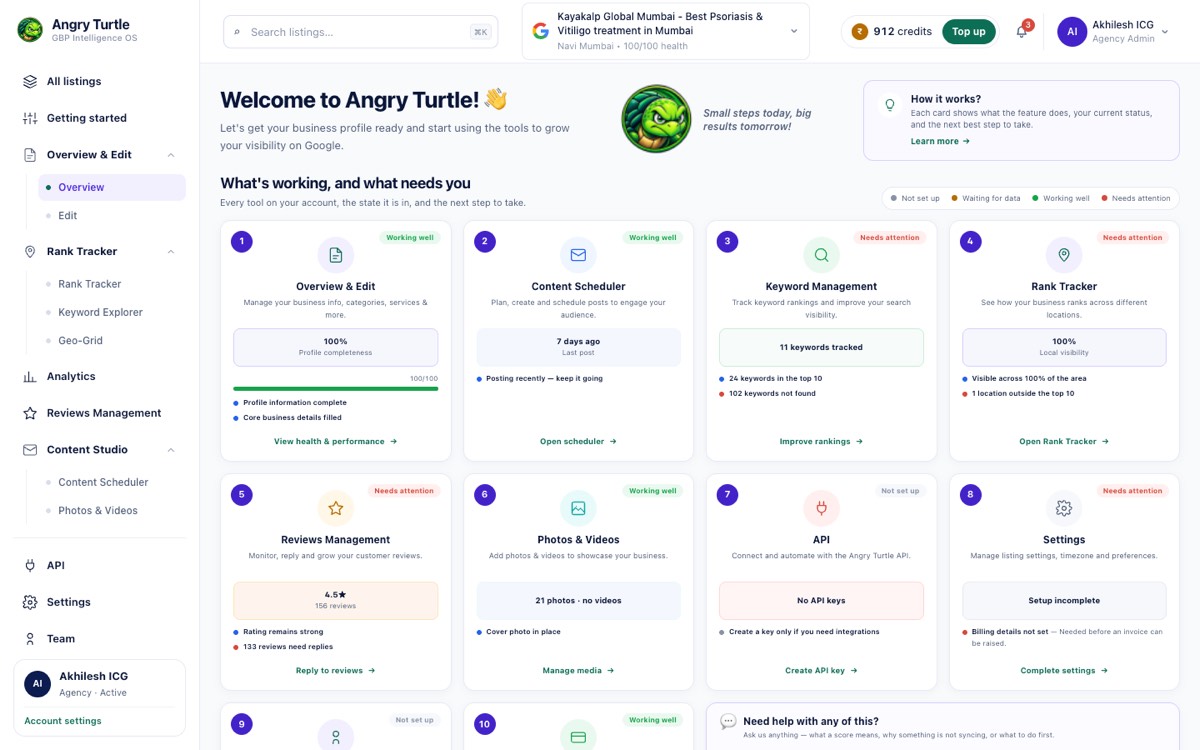
Angryturtle's platform underpins both paths. A business running AEO itself can use the platform directly — Rank OS for the scoring and prioritised action plan, Ask Maps / AIO for checking whether the profile is actually showing up as a citable answer, and the GBP editor that pushes changes straight to Google rather than leaving them stuck in a queue. A business that wants the managed version gets the same underlying platform operated by Angryturtle's team, with the reporting and reviewer discipline built in.
That's the honest version of the decision: it's not DIY-tool versus managed-agency as two separate products built by two separate companies. It's the same operating system, self-driven or driven for you.
What to check before picking a path
A short set of honest questions decides this faster than debating it in the abstract. How many locations does the business run today, and is that number likely to change within the next year. Does anyone on staff already have a few consistent hours a month free, or would AEO tasks be competing with something else that's already underfunded on time. Is the category competitive enough that inconsistent execution would actually cost visibility, or is the local competition thin enough that steady-but-imperfect effort is still enough to lead. And has the business tried DIY at all yet, since a quarter of real experience settles the question better than guessing upfront.
A reasonable way to decide
A single location with an owner or team member who has a few hours a month to spare, in a category that isn't fiercely competitive, is a realistic DIY candidate — especially with the platform doing the scoring and prioritisation rather than the owner guessing what to fix next. Multiple locations, a highly competitive metro category, or a high-stakes vertical like healthcare or education where the cost of getting something wrong is higher than the cost of paying for it to be managed properly, all tilt toward the managed path.
Nothing about this is permanent, either. Plenty of businesses start on the self-serve side to understand what AEO actually involves, then move to managed once the location count grows or the competitive intensity picks up. Others do the reverse — start managed to get the foundation built properly, then take over day-to-day maintenance themselves once the schema, GBP structure, and review workflow are already in place.
FAQ
Is Angryturtle only for businesses that want a managed service, or can it be used self-serve too? Both. Angryturtle is a self-serve platform a business can operate itself, and it's also the platform behind Angryturtle's managed service. The underlying scoring, GBP editing, and AI-readiness tools are the same either way — the difference is whether Angryturtle's team is operating it on the business's behalf.
What's the realistic monthly time commitment for a business trying to run AEO itself? It varies by location count and category, but the recurring tasks — GBP posts, review follow-up, a periodic AI-citation check, occasional content updates — add up to a noticeable but manageable slice of a month for a single location. Multiple locations multiply that time roughly in proportion, which is usually the point where a managed approach starts making more sense than adding more hours.
Can a business move from self-serve to managed later without starting over? Yes — since it's the same platform underneath, a business's existing GBP data, schema, and Rank OS history carry over rather than needing to be rebuilt from scratch when Angryturtle's team takes over day-to-day operation.
Does a managed engagement replace the need for a website, or just the GBP and AEO work? Managed AEO through Angryturtle covers GBP, reviews, citations, and AEO-specific content and schema work — it isn't a website-building or general on-page SEO service. A business still needs its own website work handled separately, whether in-house or through another provider.
Start with an AI Search Readiness Audit →
Internal links used: AI Search Readiness Audit · AEO Services · Managed Local SEO · Rank OS · Ask Maps / AIO · GBP write-back / edit to Google · done-for-you vs DIY local SEO · Review generation strategy blog · Review request WhatsApp blog · NAP consistency at scale blog · Manage 100 GBP listings blog · Multi-location local seo guide · NAP consistency glossary · Rank OS glossary
More comparisons
A score you can argue with, not a black box
Rank OS gives every profile a 0–100 score built from five weighted dimensions — Relevance, Review Health, Freshness, Entity Authority and AIO Readiness — and the weights are tunable. Underneath it sits a ranked list of the fixes that move the number, each with the point lift it unlocks.
Ready to have this run for you?
Book a free audit — we'll show you where you stand in 48 hours.