 Angryturtle
Angryturtle vs Semrush Local
Angryturtle vs Semrush Local: managed done-for-you local SEO vs an SEO platform's local add-on. Which delivers more for Indian businesses?
Semrush Local is an add-on inside a much larger SEO platform. Angryturtle is a standalone local SEO and AEO product built around a single Google Business Profile and nothing else. That difference in scope shapes almost everything else in this comparison, starting with what you're actually paying for.
What Semrush Local is
Semrush Local sits inside a Semrush subscription, which most Indian teams already pay for reasons that have nothing to do with local SEO — technical audits, content research, competitor keyword tracking, paid search intelligence. The base platform is priced by tier, with the Local add-on layered on top of that. Its local feature set includes GBP management and optimisation prompts, listing distribution to a directory network, review monitoring and response tools, a map rank tracker, and a local heatmap that works similarly to a geo-grid.
These are tool features. A team logs in, reads the prompts, and decides what to act on and when. Semrush doesn't execute the changes itself.
Where the two products actually differ
The clearest difference is execution versus tooling. Semrush Local surfaces data and suggests actions; a team decides what to do and does it manually. Angryturtle executes directly — GBP updates, posts, citation building, review responses — inside a monthly managed scope, or self-serve if a team wants to run it themselves through Agency OS.
India directory coverage is the second gap. Semrush's listing-distribution network is primarily Western, and coverage of JustDial, Practo, IndiaMART, and Sulekha through that network is limited. Angryturtle's citation engine was built around exactly those directories, alongside the broader set most local SEO tools already cover.
Cost structure matters too, in a specific way. Semrush Local is an add-on to Semrush, and most Indian businesses already subscribe to Semrush for broader SEO purposes unrelated to local. If local SEO is the primary use case, a team ends up paying for a large platform to access one component of it. Angryturtle's pricing is built around the local SEO job itself, with nothing bundled in that a local-only buyer doesn't need.
Specialisation is the last piece. Semrush is a broad SEO platform covering technical SEO, content, advertising intelligence, and local as one module among several. Its local features are capable but aren't the deepest available in the category. Angryturtle's entire product, from Rank OS down to the Ask Maps AIO layer, exists only for local, with geo-grid rank tracking as one piece of that focus rather than a bolt-on feature.
Side-by-side comparison
| Capability | Semrush Local | Angryturtle |
|---|---|---|
| Model | SaaS add-on (self-serve) | Platform that acts, self-serve or managed |
| GBP management | Tool prompts | Full execution via direct GBP editing |
| Listing distribution | Yes, Western focus | Yes, India-native |
| Review monitoring | Yes | Yes, via AI-drafted replies |
| Review response execution | No | Yes |
| Map rank / geo-grid | Yes | Yes, inside Rank OS |
| Demand-cluster sizing | No | Yes, via demand clusters |
| AI-answer readiness | No | Yes, Ask Maps |
| India directory coverage | Limited | Full (JustDial, Practo, Sulekha, IndiaMART) |
| Standalone (no platform needed) | No | Yes |
| Pricing | See Semrush's pricing page | Published rupee pricing, per-location |
Cost, spelled out
Semrush plus its Local add-on is billed as base platform plus add-on combined for most Indian teams — and that's for tooling, not execution. Angryturtle's self-serve tiers start at ₹999/month for Solo (up to two profiles) and ₹3,499+/month for Agency, and the managed service starts at ₹1,499 per location per month with a ₹5,000 setup fee, fully executed rather than left as a dashboard prompt. Larger books get Enterprise pricing scoped to volume; see enterprise local SEO for what that covers.
India-specific fit
Semrush is widely used in the Indian digital marketing community, and its local add-on genuinely helps teams already inside Semrush who want to centralise reporting in one place. Where it thins out is exactly where India-specific local SEO gets hard: the citation ecosystem around JustDial, Practo, and Sulekha, and the execution gap between "here's what's wrong" and "here's the fix, made and pushed live." That gap shows up hardest for multi-location retail and hospitality brands, covered separately under retail local SEO, where dozens of listings need the same fix applied consistently rather than read as a suggestion in a dashboard. The shift toward AI-generated local answers, covered in how AI Overviews treat local businesses, makes that specialisation matter more each quarter, not less.
A decision worked through: a Nashik diagnostics chain with nine branches
A nine-branch diagnostics chain in Nashik was already three years into a Semrush Enterprise contract when its marketing lead asked whether adding Semrush Local would cover the GBP work each branch manager was doing inconsistently by hand. The technical SEO team used Semrush daily for the group's blog and site audits, so cancelling wasn't on the table. The actual question was narrower: would the Local add-on fix the GBP problem specifically.
Two things made the answer no. First, four of the nine branches had duplicate or unclaimed listings on Practo, and Semrush's distribution network doesn't reach Practo at all — the add-on would have reported the gap without a path to close it. Second, the marketing lead had one part-time coordinator, not nine branch managers with spare hours, and Semrush Local's prompts still needed someone to open the dashboard, read the suggestion, and go make the change in each of nine separate GBP accounts. The chain kept Semrush for its original purpose and brought in managed execution for the GBP and Practo side specifically, which closed the branches' duplicate-listing problem within the first billing cycle rather than adding it to a backlog of read-but-not-done recommendations.
What goes wrong when a team picks the tool instead of the job
The recurring mistake isn't choosing the wrong vendor, it's mismatching the purchase to the actual bottleneck. A team that's already drowning in unactioned recommendations from one dashboard rarely fixes that by adding a second dashboard with more recommendations — Semrush Local included. The bottleneck in that case is execution capacity, not visibility into what needs doing, and buying another reporting layer on top of an execution gap just produces a longer backlog, not a shorter one.
What to check before deciding
A few honest questions settle most of this without needing a vendor call. Is the team's real gap "we don't know what's wrong" or "we know what's wrong and nobody has time to fix it" — the first favours a tool, the second favours execution. Do any of the business's locations depend on JustDial, Practo, or Sulekha for real customer volume, since that alone rules out relying on Semrush's network as the only citation layer. And is Semrush already earning its subscription for technical SEO and content work that has nothing to do with local — if yes, there's rarely a reason to cancel it just to add local coverage elsewhere.
Where it doesn't really matter which one you pick
A single-location business with no India-directory dependency and a marketing person who genuinely has time to read prompts and act on them weekly can get reasonable results from either Semrush Local's suggestions or a simpler local tool — the gap between the two only opens up once directory depth or execution volume becomes the constraint, which for a small single-location account, it often isn't yet.
Who should keep Semrush, and who should switch
A team that leans on Semrush daily for technical audits, content gap analysis, or competitor keyword research has no reason to give that up — Semrush Local can keep living alongside a dedicated local tool without conflict. The switch makes more sense when local SEO stops being a line item and starts being the main channel: a single clinic, a multi-location retail chain, or an agency managing a book of Indian listings where citation depth and GBP execution are the actual bottleneck, not technical SEO.
Frequently asked questions
We already pay for Semrush — should we add Local or switch to Angryturtle? If a team uses Semrush for technical SEO and content, keeping Semrush makes sense. Evaluate whether Semrush Local's coverage and execution model actually meet the local SEO need. If a team needs someone executing local SEO rather than a tool to run themselves, Angryturtle is the complement or the alternative.
Does Semrush Local cover JustDial and Practo? Not natively. Semrush's listing-distribution network doesn't include major Indian directories, which is the primary India-specific limitation of the add-on.
What's the actual cost comparison? Semrush base plus the Local add-on is priced as a subscription plus add-on for tools alone in India — check current tiers directly on Semrush's site. Angryturtle's managed service starts from ₹1,499 per location per month, fully executed, with self-serve tiers from ₹999/month for teams who'd rather run it themselves. See pricing →
Can Angryturtle replace Semrush entirely? No, and it isn't trying to. Semrush covers technical SEO, content research, and paid search intelligence that Angryturtle doesn't touch — it's a local, not a website, SEO tool. The two solve different problems and many teams run both.
Does Angryturtle's map tracking work the same way as Semrush's heatmap? Both check rank across multiple points rather than one, but Angryturtle's version lives inside Rank OS, so a rank movement also updates the overall score and the next recommended fix instead of sitting in a standalone report.
See what a managed alternative looks like — start with a free trial →
More comparisons
A score you can argue with, not a black box
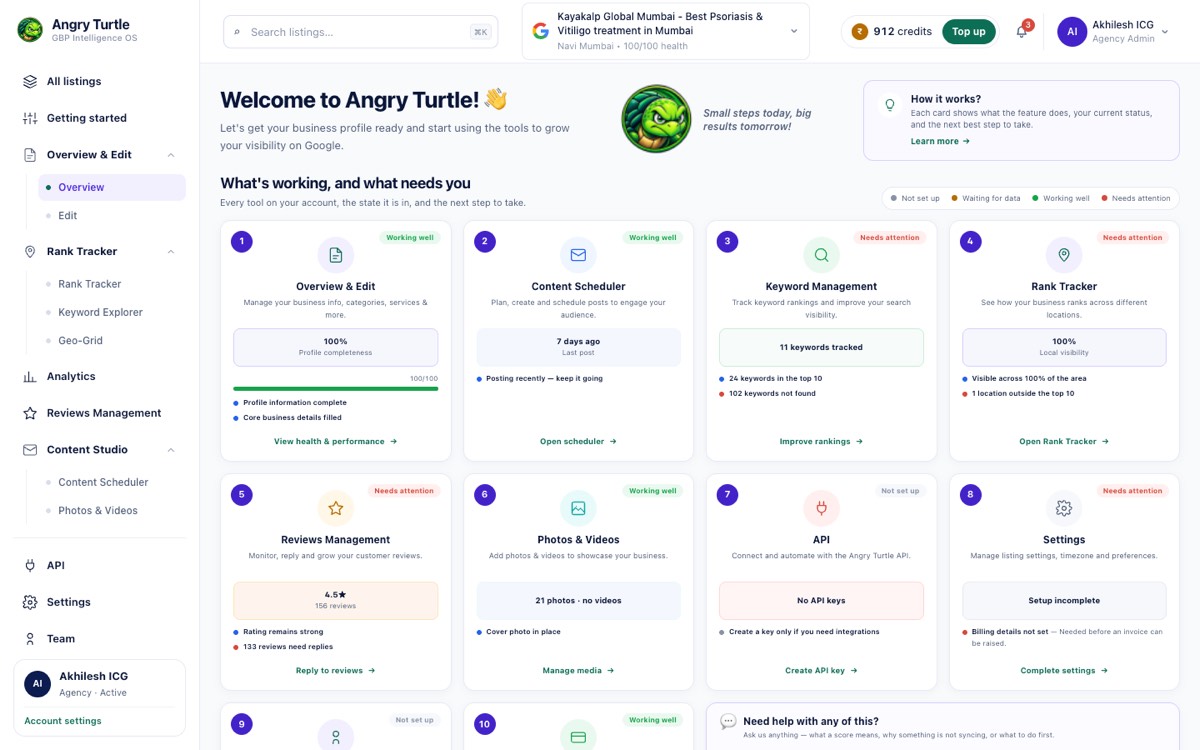
Rank OS gives every profile a 0–100 score built from five weighted dimensions — Relevance, Review Health, Freshness, Entity Authority and AIO Readiness — and the weights are tunable. Underneath it sits a ranked list of the fixes that move the number, each with the point lift it unlocks.
Ready to have this run for you?
Book a free audit — we'll show you where you stand in 48 hours.