 Angryturtle
Angryturtle vs Uberall
Uberall syndicates listing data across a global publisher network; Angryturtle scores every profile and acts on it, India-first, self-serve or managed.
Ten locations is Uberall's usual floor. It's a German enterprise location-marketing platform built for brands with hundreds of Western outlets who need one console for listing syndication, reviews, and local pages. Angryturtle has no location minimum, and it's built around a different problem: not syndicating data everywhere, but scoring a Google Business Profile, telling you the highest-value fixes, and pushing those fixes straight to Google.
What Uberall does well
Uberall has been in the location-marketing category for over a decade, and its core strength is data distribution: push your NAP once, and it syndicates across a wide publisher network, mostly European and North American directories, plus Google, Apple Maps, Bing, and several data aggregators. It bundles review monitoring, a landing-page builder for local pages, social post scheduling, and cross-network analytics into one enterprise console. For a global retail or restaurant chain with hundreds of Western locations, that's a real efficiency gain over managing each directory by hand.
The platform is priced and sold at enterprise scale, and its analytics roll up performance across the whole publisher footprint rather than one profile at a time. Teams that already run global multi-location marketing operations tend to know the tool already, which lowers onboarding friction for large brands moving into a new market.
Where it falls short for Indian businesses
Uberall's publisher network was built for European and US directories. JustDial, Sulekha, Practo, and IndiaMART, the platforms Indian customers actually search and trust, aren't meaningfully covered. A hospital chain or a real estate developer with forty locations across Mumbai, Bengaluru, and Hyderabad gets syndication to directories nobody in those markets checks, while the ones that matter locally go unmanaged. See entity authority and the knowledge graph for why that citation gap compounds over time rather than staying flat.
There's also a deeper gap than directory coverage. Uberall gives you dashboards and a response interface; it doesn't tell you which of the forty things wrong with a profile is worth fixing first, or what that fix is worth in ranking terms. AI-answer readiness, whether a listing shows up when Google's AI Overviews or a chatbot is asked a local question, isn't part of the product at all. That gap will widen as more local search moves through AI-generated answers instead of ten blue links, a shift covered in more depth at how AI Overviews treat local businesses.
Four things Uberall doesn't do
Angryturtle leads with four things no comparable tool, Uberall included, currently does.
The first is Rank OS, a single 0 to 100 score for each profile built from five weighted dimensions: relevance, review health, freshness, entity authority, and AIO readiness. Instead of forty metrics scattered across tabs, a profile gets a grade and a short list of the moves that would raise it, each with the expected point lift attached.
The second is that those weights are config-tunable. Anyone can see exactly what the score is built from and adjust how much each dimension counts for a given business, rather than trusting an opaque model. Uberall's analytics show what happened across the network; they don't score a listing or say what to do about the score.
Third is cluster and demand sizing. Angryturtle groups keywords into industry-aware demand clusters and tracks their momentum, whether a cluster is scaling, broadening, concentrating, or decaying, and sizes the untapped opportunity using Google Ads Keyword Planner data. That's closer to a growth-planning tool than a syndication dashboard.
Fourth is AI-drafted review replies with one-click publish, plus a Brand Identity versus Brand Image read that compares the story a business tells about itself to what its reviews actually say, and flags the gap. Uberall monitors reviews and gives a team an interface to respond in; Angryturtle drafts the reply and can publish it directly.
The rest of the platform underneath
Underneath those four, Angryturtle also does the work Uberall is known for: NAP citation management across a wide directory set including JustDial, Practo, Sulekha, and IndiaMART, GBP write-back for hours, categories, service areas, and media through direct GBP editing, geo-grid rank tracking, and a suspension-risk audit most syndication tools don't touch at all. This isn't managed-only. It's available as a self-serve platform across Solo, Agency, and Enterprise tiers, with an optional managed team layered on top for businesses that want execution handled rather than run in-house. Enterprise buyers get unlimited profiles, volume pricing, and SSO, the same tier Uberall competes in, just with India-native data underneath it — see enterprise local SEO for the specifics.
Side-by-side comparison
| Capability | Uberall | Angryturtle |
|---|---|---|
| Model | Enterprise SaaS (self-serve) | Self-serve platform that acts, self-serve or managed |
| Rank OS-style scoring | No | Yes, 0-100 with tunable weights |
| Demand cluster / opportunity sizing | No | Yes |
| AI review auto-reply | No, monitoring plus manual response only | Yes, one-click publish |
| Location data syndication | Yes, global, limited India coverage | Yes, India-native via citation engine |
| GBP active management (write-back) | Partial | Full, including categories, hours, media |
| AIO / AI-answer readiness | No | Yes, Ask Maps |
| Geo-grid rank tracking | No | Yes |
| India directory coverage (JustDial, Practo, Sulekha, IndiaMART) | Limited | Full |
| Smallest practical deployment | Built for multi-location estates | A single profile |
| Pricing | See Uberall's pricing page | Published rupee pricing, per-location |
A regional hospital chain runs the numbers
A 22-location diagnostic and hospital chain across three states was evaluating Uberall on the strength of a global healthcare conference demo, where the syndication console looked impressively comprehensive. The chain's ops lead ran a smaller test first: check whether Uberall's network actually reached Practo, since roughly a third of the chain's appointment bookings traced back to Practo referrals in the chain's own analytics. It didn't. Uberall's demo had covered Google, Bing, and a set of aggregators none of which mattered much for how patients in those three states actually found the chain's branches.
That single check reframed the decision. The chain didn't need a bigger syndication console; it needed the specific directories driving actual bookings covered properly, plus a way to know which of its 22 profiles needed attention first rather than treating all of them as equally urgent. A syndication-first tool answers the first need adequately for Western directories and not at all for Practo; a scoring-and-execution platform answers the second need directly, which is what ended up mattering more once the actual referral data was checked instead of the demo.
What goes wrong when a demo drives the decision
The mistake that keeps recurring in this category is buying based on how comprehensive a console looks in a sales demo rather than checking it against the specific directories a business's own customers actually use. A dashboard that lists fifty publisher integrations reads as thorough right up until someone checks whether the three or four directories that actually drive bookings in India are among them.
What to check before signing an enterprise contract
Before committing to a multi-year enterprise syndication contract, confirm directly, by name, whether JustDial, Practo, Sulekha, and IndiaMART are covered for the categories that matter — not "global directory network," the specific ones. Pull the chain's own referral data and check which sources actually drive bookings today, then verify the platform under consideration reaches those sources specifically rather than a generic international list.
Who each is for
Uberall fits a global or Western-market multi-location brand whose main need is syndicating consistent data across a European/US publisher network, with reviews and local pages as a secondary layer. If your locations are mostly outside India and you're not looking for a scoring model or AI-answer coaching, it's a capable, established tool for that job.
Angryturtle fits Indian businesses at any size — a single-location clinic on Solo, an agency running client portfolios, or an enterprise chain with hundreds of outlets — that want a platform telling them what to fix and then doing it, not just a dashboard reporting what happened. It also fits enterprise buyers anywhere who want India-grade citation depth alongside the same volume-pricing and SSO tier Uberall sells at.
Frequently asked questions
Is Uberall available in India? It's technically accessible, but the product and its publisher network are built around European and US markets. Coverage of India-specific directories like JustDial, Practo, and Sulekha is limited.
We run a large Indian retail chain. Should we use Uberall or Angryturtle? Angryturtle's Enterprise tier covers the India citation stack natively, gives full GBP write-back across locations, and includes the Rank OS scoring layer Uberall doesn't have. Talk to enterprise local SEO →
Does Angryturtle score profiles the way Uberall's analytics do? Differently. Uberall's analytics report performance across its publisher network. Angryturtle's Rank OS gives each profile a single tunable score across five dimensions and ranks the specific fixes that would move it, with expected point lift. Read more about Rank OS →
How does Angryturtle compare to other alternatives like Yext? Yext sits in a similar category to Uberall — global listing syndication with limited India depth. See the full Yext comparison → for how that one breaks down.
What does Angryturtle cost compared to Uberall? Uberall is enterprise-priced in EUR/USD with a 10+ location minimum. Angryturtle starts from a single location and scales through Solo, Agency, and Enterprise tiers with rupee pricing. See pricing →
If your listings are scattered across directories Uberall's network doesn't reach, and you want a score telling you what to fix next rather than a report telling you what already happened, start with a free trial and see the Rank OS read on your own profiles.
If you are weighing the two platforms directly rather than looking for an alternative to either, the Uberall vs Yext comparison covers that matchup on its own terms.
More comparisons
A score you can argue with, not a black box
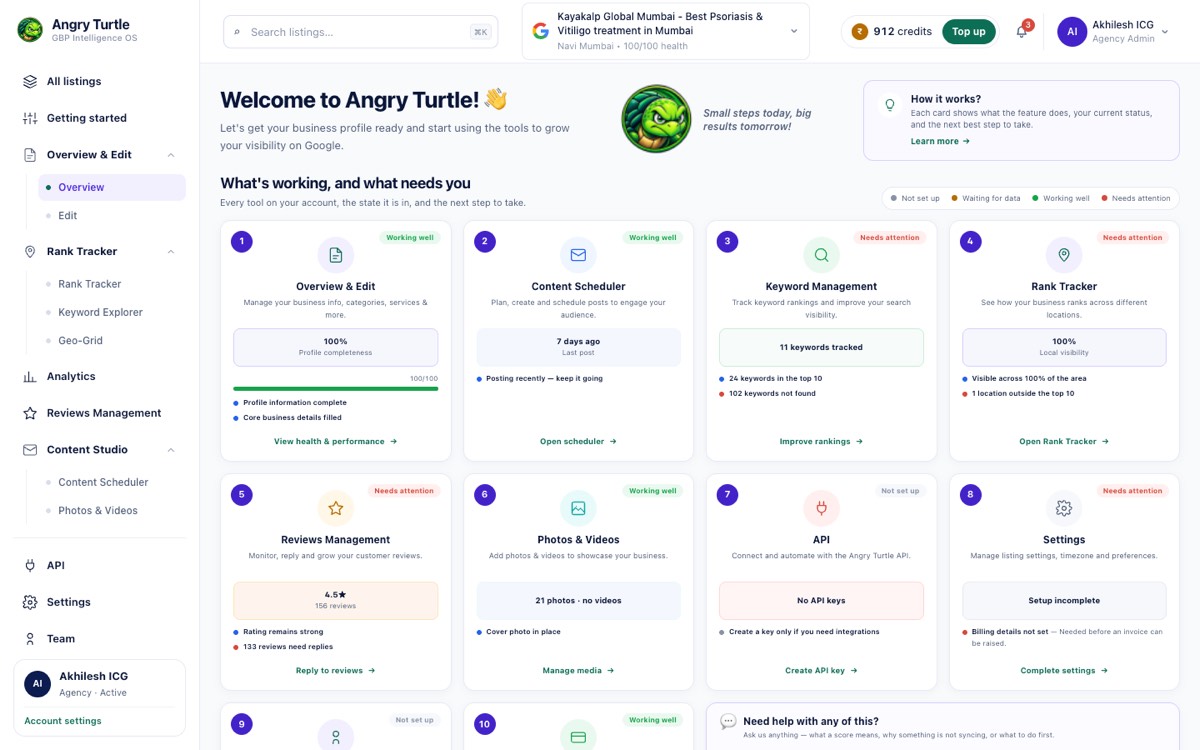
Rank OS gives every profile a 0–100 score built from five weighted dimensions — Relevance, Review Health, Freshness, Entity Authority and AIO Readiness — and the weights are tunable. Underneath it sits a ranked list of the fixes that move the number, each with the point lift it unlocks.
Ready to have this run for you?
Book a free audit — we'll show you where you stand in 48 hours.