 Angryturtle
DCG Stage 1 — Diagnosis: Foundations of Local SEO Audit
The Diagnosis stage of Angryturtle's DCG Framework. What a local SEO audit covers, what the Rank OS baseline reveals, and how it becomes the foundation for all execution.
·
DCG Stage 1: Diagnosis
Five data points determine whether a local SEO plan will work: the GBP completeness score, the geo-grid baseline, the NAP consistency score, the review velocity gap versus competitors, and the composite Rank OS score that combines all four. Skip collecting any one of them and the "plan" that follows is a guess wearing a strategy document's clothes.
In the DCG Framework, Diagnosis is the non-negotiable first stage. It answers where exactly a business stands, and why. Without a rigorous Diagnosis, every subsequent action is a guess dressed up as strategy. With it, every action is targeted at a known constraint.
What the Diagnosis stage covers
GBP audit. Every element of the Google Business Profile gets reviewed: is the primary category the most specific option available? Are services listed individually? Are attributes complete? Is the description compliant and keyword-aligned? When were photos last uploaded? Is the booking link set up? Is the profile verified and published?
The audit produces a completeness score and a prioritised remediation list — not a narrative report, but a ranked to-do list tied to actual point values.
Geo-grid baseline. A geo-grid rank scan runs for the 3 to 5 highest-value keywords across the target service area. This produces the baseline Share of Local Voice, the percentage of geographic grid points where the business ranks in positions 1 through 3.
The baseline answers three things at once: where the business is winning, where it's losing, and specifically who is outranking it in which zones. A pharmacy chain in Bangalore, for example, might discover it holds top-3 rank in Indiranagar but disappears entirely past HSR Layout, three kilometres away — invisible in one zone and dominant in another, a pattern a single "average rank" number would completely hide.
NAP consistency audit. The business's name, address, and phone number gets checked against 50-plus Indian directories. Every discrepancy is identified: an old phone number still live on JustDial, a name-format variation on IndiaMART, a truncated address on Sulekha.
Review velocity analysis. Current review count, monthly velocity, and average rating get compared against the top 3 competitors. The velocity gap — how many more reviews per month the leading competitor generates — becomes a specific, measurable target rather than a vague "get more reviews" instruction. See review velocity for how this metric is defined and tracked.
Rank OS scoring. The five Rank OS dimensions get scored, and the lowest-scoring dimension becomes the primary constraint — and the primary Month 2 priority.
What Diagnosis produces
Diagnosis produces three concrete outputs, not a summary document:
The Rank OS score. A composite 0-100 score with a dimension-level breakdown, telling a business not just how it's performing overall but exactly which dimension is the bottleneck.
The gap map. A prioritised list of specific gaps, ordered by impact. Not "your GBP could be better," but "your primary category is wrong, your services section has 2 entries when it should have 14, your JustDial phone number is outdated, and your review velocity is 4 a month against your top competitor's 18."
The Month 2 priority. Based on the Rank OS score, the single most impactful action for Month 2 gets identified, and execution in the Cost Optimization stage starts from there. See Cost Optimization for what happens next.
Why Diagnosis takes a full month
Most agencies begin execution in Week 1. Angryturtle uses Month 1 for Diagnosis for two reasons.
First, the data required takes real time to collect and analyse properly — geo-grid baselines across multiple keywords and zones, citation audits across 50-plus directories, and competitor velocity tracking aren't instant lookups. A 30-day window also allows for seasonal normalisation of GBP Insights data, since a single week's call and click volume can be skewed by a local holiday or a one-off event.
Second, the cost of a wrong diagnosis is high. A month of effort directed at the wrong constraint is a month lost. A thorough diagnosis costs one month up front, but the ROI of the execution that follows is dramatically higher when the diagnosis is right — a category fix identified in Week 1 of Diagnosis can unlock rank movement in Month 2 that eight months of review generation on the wrong category never would have.
Diagnosis findings differ sharply by industry
The five-part audit structure is identical across verticals, but what it surfaces varies a lot. Healthcare audits routinely turn up category errors and Practo NAP mismatches. Real estate audits find duplicate project-site profiles and RERA numbers placed in the wrong field. Franchise audits typically reveal name-format inconsistency across units before anything else. Knowing the pattern for a vertical speeds up diagnosis, but it never replaces running the actual audit for a specific business.
Common mistakes businesses make before a proper Diagnosis
Assuming "more reviews" is always the answer. It's the most common instinct and often the wrong first move if a category error or suspension is quietly capping visibility underneath it.
Auditing only the GBP and skipping directories. A clean Google profile sitting on top of ten years of inconsistent JustDial and Sulekha listings still drags on entity confidence.
Comparing rank against only one competitor. A single comparison point misses whether the business is losing ground broadly or only to one specific rival in one specific zone.
Running the geo-grid scan for branded terms only. Branded searches ("Sharma Clinic Gurgaon") tell you almost nothing about competitive visibility; the scan needs to cover the generic, high-intent terms customers actually use when they don't already know the business.
FAQ
How long does a full Diagnosis take? Typically the full first month of engagement, covering the GBP audit, geo-grid baseline, NAP audit, and review velocity analysis in parallel.
What's the difference between the Rank OS score and the geo-grid SoLV? The Rank OS score is a composite across five dimensions of profile and citation health. SoLV is specifically about geographic rank coverage. Both feed into the same gap map, but they measure different things — see Rank OS and geo-grid rank tracking.
Does Diagnosis apply the same way to a single-location and a multi-location business? The five audit components stay the same, but multi-location Diagnosis adds a network-level rollup on top of individual location scores. See multi-location applications.
What happens if Diagnosis finds an active suspension? Reinstatement becomes the immediate priority ahead of anything else in the gap map, since a suspended profile has zero local pack visibility regardless of how well everything else scores. See GBP reinstatement.
Stop guessing where you rank locally.
Rank OS scores your Google Business Profile the way Google's local algorithm does — relevance, review health, freshness, entity authority and AIO readiness — and shows you exactly what to fix.
Book a live demo →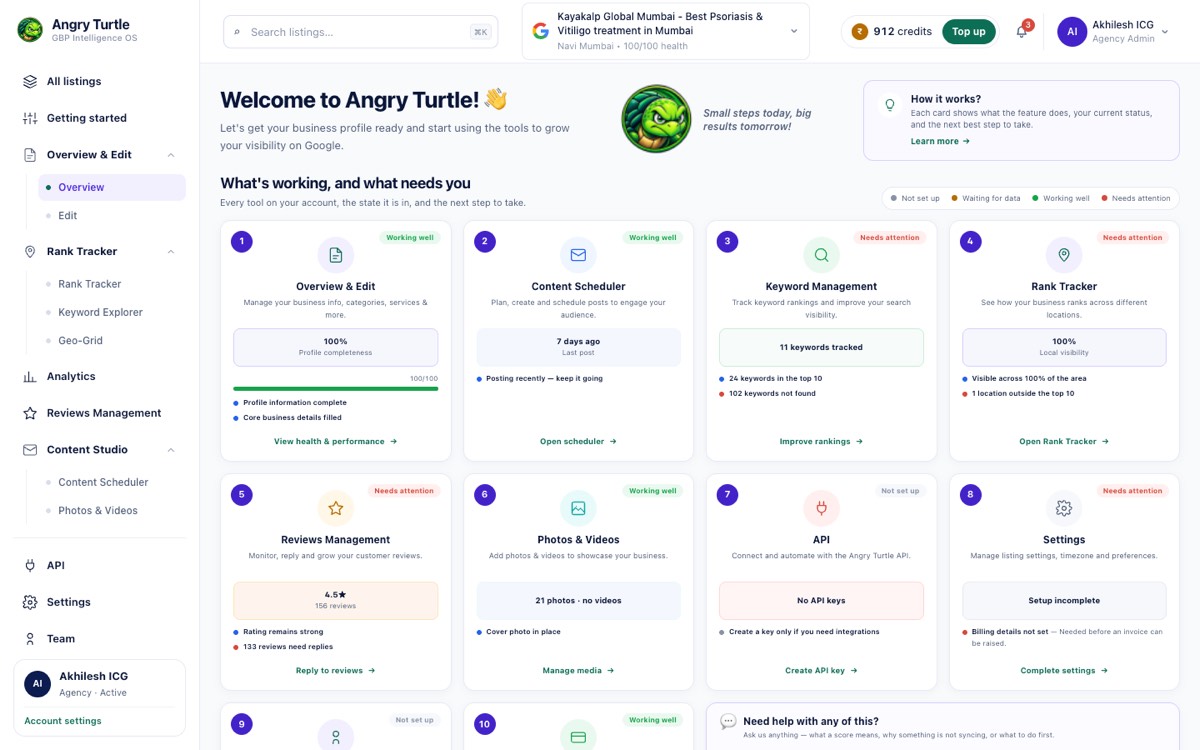

Related reading
Ready to have this run for you?
Book a free audit — we'll show you where you stand in 48 hours.